

Table Of Content
- Crypto Exchange Marketing Strategy: From User Acquisition to Trading Volume (2026 Playbook)
- Why crypto exchange marketing is different
- The exchange growth funnel: six stages and the metric for each
- Step 1: Choose your markets before your channels
- Step 2: Build trust before you buy traffic
- Step 3: Crypto exchange user acquisition, judged by user quality
- KOL and affiliate programs
- SEO and AI search
- Paid media within platform rules
- PR and events
- Step 4: Activation, from sign-up to first trade
- Step 5: Develop trading volume the right way
- Step 6: Retention and VIP programs
- Compliance-aware exchange marketing
- The metrics that show whether your strategy works
- A 90-day crypto exchange marketing plan
- Common crypto exchange marketing mistakes
- How Sigma supports crypto exchange growth
- Planning your exchange’s next market?
- Frequently asked questions
- Sources
Crypto Exchange Marketing Strategy: From User Acquisition to Trading Volume (2026 Playbook)
In short
- Registrations are not growth. An exchange grows when visitors become verified, funded, actively trading users who stay.
- A crypto exchange marketing strategy covers six stages: market selection, trust, acquisition, activation, volume and retention.
- Regulation now shapes the plan. The UK bans referral bonuses for crypto, Dubai requires approval for incentives, and the EU requires clearly labeled, fair marketing.
A crypto exchange marketing strategy is a plan for turning attention into verified, funded and actively trading users, in markets where the exchange is allowed to operate. It covers six connected stages: choosing markets, building trust, acquiring users, activating them through KYC and a first trade, developing trading volume, and retaining them over time.
Most guides on how to market a crypto exchange stop at the first click. They list channels, recommend “engaging content” and move on. That approach fills a dashboard with registrations and leaves the trading floor empty.
This playbook follows the whole path instead. It is written for growth leads, CMOs and founders at centralized exchanges, and for the partners who work with them. Each section ends with the metric that tells you whether it is working.
Why crypto exchange marketing is different
Marketing an exchange looks like marketing any fintech app until you run the numbers. Five things set it apart.
- The real conversion happens late. A sign-up costs little. A verified account that deposits and trades is where the value starts, and most users drop off before reaching it.
- Trust is the product. Users hand over identity documents and money. Past exchange failures mean every new user arrives skeptical.
- Channels are restricted. Major ad platforms limit crypto advertising, and many require licensing and certification before an ad can run.
- The rules differ by country. A referral bonus that is normal in one market can be banned in the next.
- Demand moves with the market. Interest rises and falls with prices. A strategy that only works in a bull market is not a strategy.
Because of these factors, general crypto marketing advice only gets an exchange part of the way. The rest of this guide focuses on what is specific to exchanges.
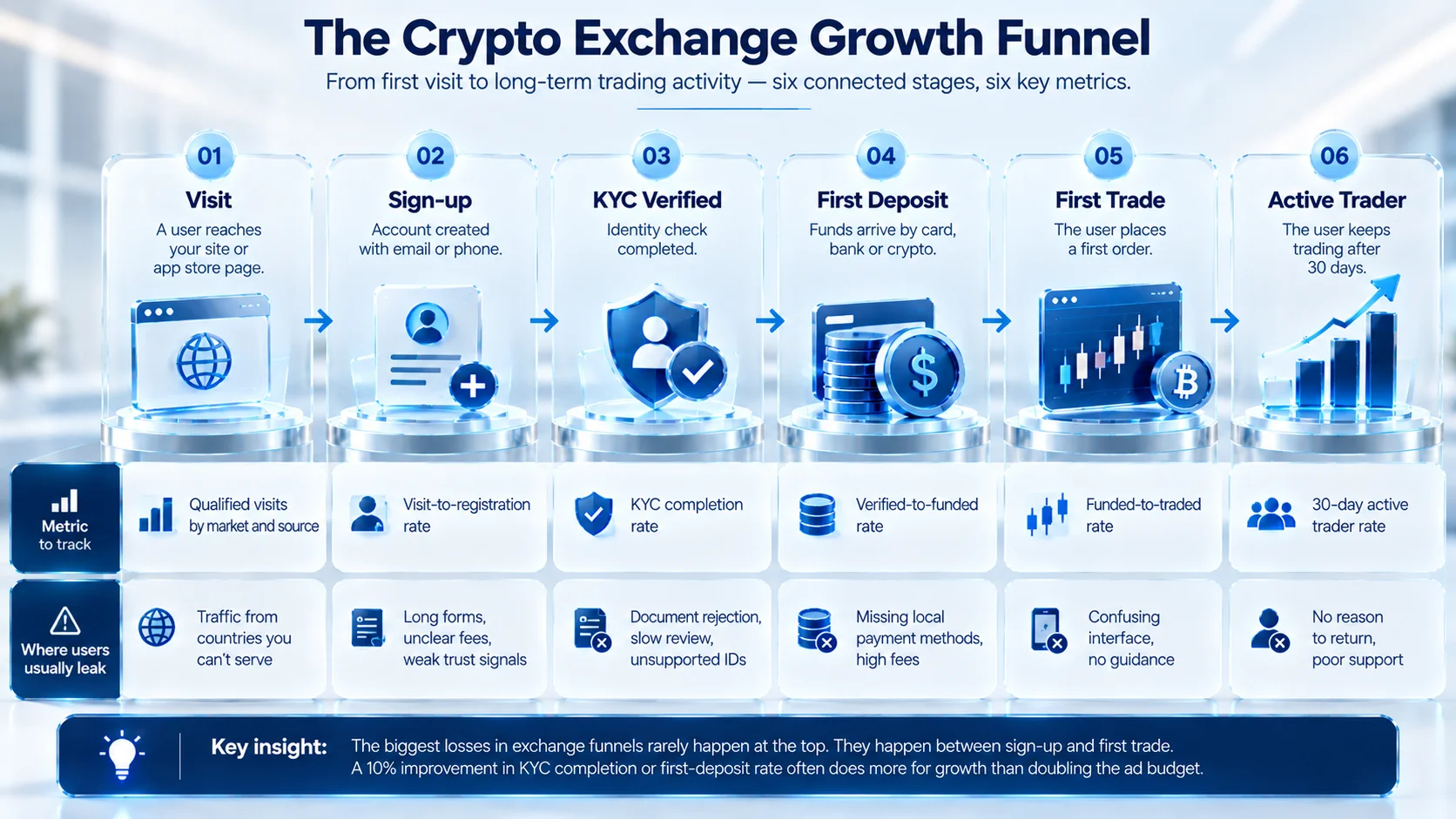
The exchange growth funnel: six stages and the metric for each
Every exchange marketing decision should map to one stage of this funnel. If you can’t say which stage a campaign serves and which metric it should move, it’s not ready to launch.
| Stage | What happens | Metric to track | Where users usually leak |
|---|---|---|---|
| 1. Visit | A user reaches the site or app store page | Qualified visits by market and source | Traffic from countries you can’t serve |
| 2. Sign-up | Account created with email or phone | Visit-to-registration rate | Long forms, unclear fees, weak trust signals |
| 3. KYC verified | Identity check completed | KYC completion rate | Document rejection, slow review, unsupported IDs |
| 4. First deposit | Funds arrive by card, bank or crypto | Verified-to-funded rate | Missing local payment methods, high fees |
| 5. First trade | The user places a first order | Funded-to-traded rate | Confusing interface, no guidance |
| 6. Active trader | The user keeps trading after 30 days | 30-day active trader rate | No reason to return, poor support |
Sigma perspectiveFrom an operational perspective, the biggest losses in exchange funnels rarely happen at the top. They happen between sign-up and first trade. A ten percent improvement in KYC completion or first-deposit rate often does more for growth than doubling the ad budget.
Step 1: Choose your markets before your channels
Marketing starts with a question most teams skip: where are we actually able to win? An exchange that markets to countries where it lacks licensing, local payments or language support pays for users it can’t keep.
Score each candidate market on five factors before you spend anything there.
| Factor | Question to answer |
|---|---|
| Regulatory access | Are we licensed or permitted to serve and market to users here? |
| Payment rails | Can users deposit in local currency through methods they already use? |
| Language and support | Can we offer the app, help center and live support in the local language? |
| Product fit | Do our assets, trading products and fees match what local users want? |
| Distribution access | Do we have local KOLs, partners and communities to reach users? |
Regions such as the GCC, the wider MENA region, Persian-speaking communities, LATAM and the CIS each score differently on these factors. In the Gulf, for example, licensing and Arabic-language support matter most. In other regions, local payment rails often decide the outcome.
Step 2: Build trust before you buy traffic
Sending paid traffic to an exchange that doesn’t look trustworthy wastes money twice: once on the click, and again on the user who leaves and tells others. Fix trust first.
- A clear page showing where the exchange is licensed or registered, with links to the regulators.
- A security page explaining custody, cold storage and account protection in plain language.
- Proof of reserves or independent attestations, where available.
- A transparent fee schedule that users can find without signing up.
- Visible support channels with realistic response times, in each target language.
- Official social accounts that are verified and listed on the site, so users can spot impersonators.
Trust also comes from consistency. The brand, the claims and the tone should match across the website, the app, KOL content and support. Our guide on building a crypto brand people trust covers this in depth.
Step 3: Crypto exchange user acquisition, judged by user quality
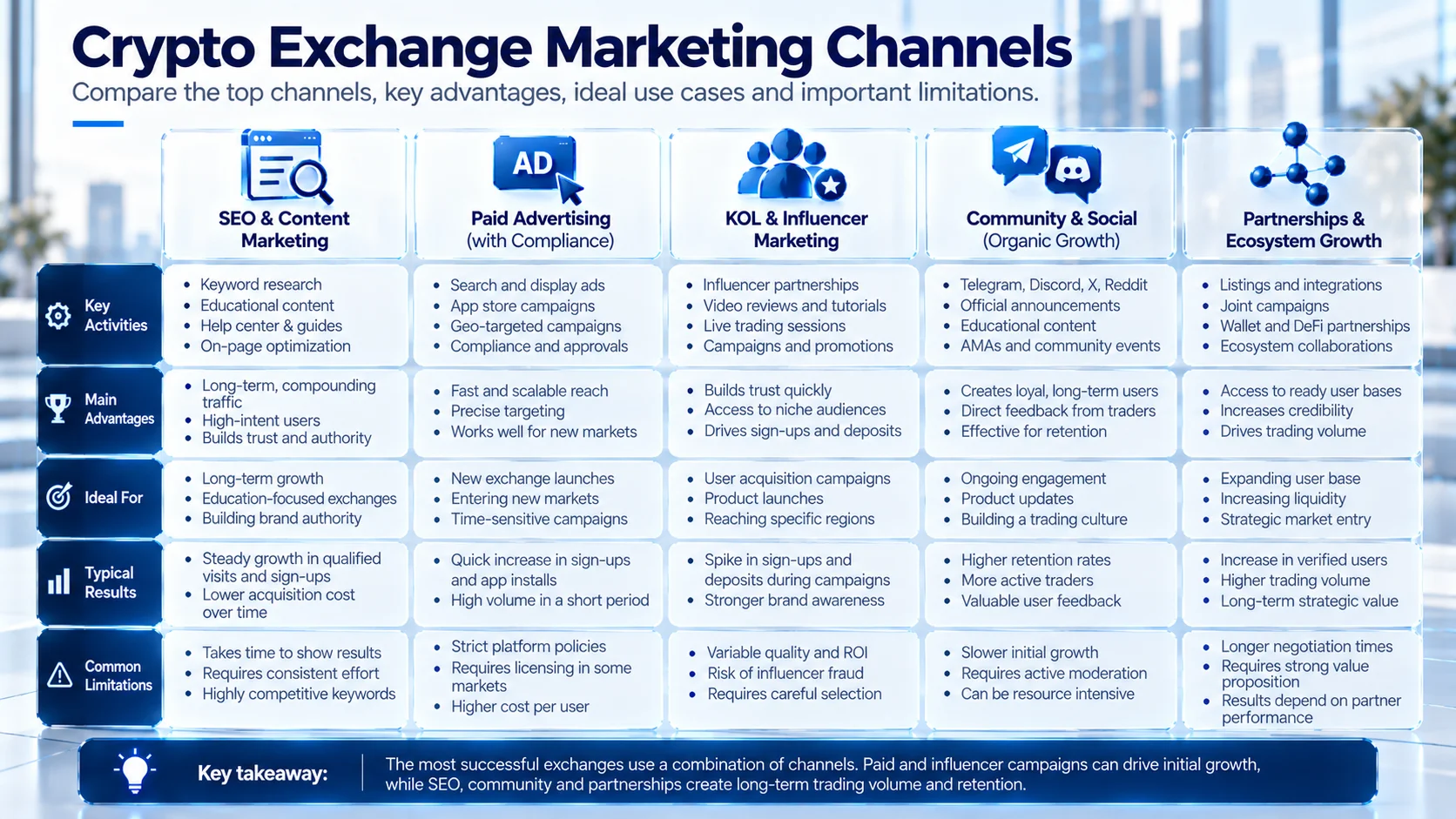
Every channel can bring registrations. Far fewer bring traders. Compare channels on the quality of users they deliver and the risks they carry, not only on cost per sign-up.
| Channel | User quality | Speed | Main cost driver | Main risk |
|---|---|---|---|---|
| KOLs | High when audience fits | Fast | Creator fees and revenue share | Fake engagement, undisclosed promotion |
| Affiliates and IBs | High, paid on results | Medium | Commission on fees or volume | Bonus abuse, low-quality partners |
| SEO and AI search | High intent | Slow | Content and technical work | Takes months to build |
| Paid media | Variable | Fast | Media spend and certification | Platform restrictions, rising costs |
| PR | Indirect, builds trust | Medium | Agency fees and placements | Coverage without conversions |
| Community | High, drives retention | Slow | Team and moderation | Scams and impersonation |
| Events | High for partners and VIPs | Episodic | Travel, booths, side events | Spend without follow-up |
KOL and affiliate programs
For most exchanges, creators and partners are the strongest acquisition engine. A trusted KOL can bring users who already understand trading. An affiliate or IB program keeps paying only for users who become active. If you’re new to the term, read our explainer on what a KOL is.
The key is structure. Give every partner a unique referral link and sub-ID, and report on first trades rather than sign-ups. Then move the partners who perform from one-off fees to long-term revenue share. Our guide to crypto influencer marketing covers campaign mechanics.
SEO and AI search
Organic search brings users with intent: people searching how to buy a specific coin, how to deposit in their currency, or which exchange supports a product. Localized guides, coin pages and comparison content compound over time. Before you sign with a crypto SEO company, check how it handles geo-blocked pages and paid links.
AI answer engines now matter as well. When users ask ChatGPT or Perplexity which exchange to use, the answer draws on content that clearly explains fees, security and availability. Our guide to AEO for crypto explains how to become a cited source.
Paid media within platform rules
Paid channels can scale quickly, but crypto advertising is restricted. Google, for example, allows crypto exchanges to advertise in the UAE under clear conditions. They must hold a licence from VARA, the FSRA or the DFSA, and be certified by Google. Other markets have their own conditions.
Crypto ad networks offer reach on crypto and finance sites, and retargeting brings back visitors who didn’t finish sign-up. See our guides to Google Ads for crypto, crypto ad networks and crypto retargeting.
PR and events
PR rarely drives sign-ups directly, but it shapes what users, partners and regulators find when they search your name. Events work best for partnerships, VIP relationships and market entry, as long as every meeting has a follow-up plan. See our guide to Web3 conference marketing.
Step 4: Activation, from sign-up to first trade
Activation is where most exchange marketing budgets are lost. A user who signs up but never trades has cost money and produced nothing. Treat the path to first trade as part of marketing, not as a product team’s problem.
- Shorten KYC without cutting corners. Support the identity documents common in each market, explain what’s needed before the user starts, and show progress during review.
- Offer local deposit methods. The most common reason verified users don’t fund is that their preferred payment method isn’t available.
- Guide the first trade. A simple first-trade flow, short tutorials and clear fee display help new users act with confidence.
- Follow up quickly. Email, push and in-app messages should help users who stop mid-way, in their language. See our guide to crypto email marketing.
- Use incentives only where they’re allowed. Rules differ sharply by market, as the compliance section below explains.
Watch out for bonus farming
- Large sign-up bonuses attract users who claim the reward and leave.
- Duplicate accounts and coordinated referral abuse inflate partner payouts.
- Rewards tied to trading volume can encourage wash trading, which is market manipulation.
- Tie rewards to verified, sustained activity, and check partner traffic for abuse patterns.
Step 5: Develop trading volume the right way
Volume is the result of active users, product depth and liquidity working together. There are no shortcuts that are both effective and legitimate.
- Product depth. Spot pairs users want, and, where licensed, derivatives, copy trading or earn products give active users more reasons to trade.
- Liquidity. Tight spreads and deep order books make trading cheaper and more attractive. Crypto exchange market making is usually provided by professional market makers under disclosed contracts.
- Fee structure. Clear maker and taker fees, with tiers that reward real activity, help retain active traders.
- Campaigns. Trading competitions and campaigns can lift activity when the rules are fair, disclosed and legal in the target market.
Where the line isWash trading, fake volume and undisclosed volume incentives are market manipulation. They also destroy the trust that the rest of this strategy depends on. Sigma does not support artificial volume and does not guarantee trading volume for any platform.
Step 6: Retention and VIP programs
Retention is where an exchange’s marketing pays back. A user who trades for a year is worth many times a user who trades for a week.
- Fee tiers that reward loyalty. Make the next tier visible and reachable.
- VIP and high-volume onboarding. Dedicated account managers, direct support channels and tailored products for larger traders.
- Local communities. Telegram or Discord groups in each language, with real support and scam protection.
- Ongoing education. Market explainers, product guides and risk education keep users engaged and informed. See our guide to crypto content marketing.
- A product feedback loop. Questions from support and community should shape the next product update and the next piece of content.
Compliance-aware exchange marketing
An exchange can build a strong funnel and still lose everything to a marketing breach. The rules below are general information, not legal advice. Always confirm them with counsel in each market.
| Market | Key rule | What it means for marketing |
|---|---|---|
| United Kingdom | Crypto financial promotion rules since 8 October 2023 | Referral and sign-on bonuses are banned, first-time investors get a 24-hour cooling-off period, and a prescribed risk warning is required |
| European Union | MiCA marketing communication rules | Marketing must be clearly identifiable, fair, clear, not misleading and consistent with the white paper |
| Dubai (UAE) | VARA Marketing Regulations, in effect since 1 October 2024 | Marketing must be done by or for licensed firms, paid promotions must be disclosed, and incentives such as referral rewards need VARA approval |
| United States | FTC endorsement guidance, plus federal and state financial rules | Any paid relationship with a creator must be clearly disclosed in the content itself |
| Ad platforms | Platform crypto policies | Certification and proof of licensing are often required before ads run |
The UK details come from Kroll’s summary of the FCA rules. The Dubai details come from the VARA Marketing Regulations rulebook. The EU rules are set out in MiCA, and the US disclosure rules in the FTC’s influencer guidance.
Two practical rules follow. First, geo-target every campaign and KOL partnership to markets where you are permitted to operate. Second, brief every partner on disclosure and risk-warning requirements in their own market and language.
The metrics that show whether your strategy works
Build one dashboard that tracks the whole funnel by market and by source. These are the metrics that matter most.
| Metric | Definition | Why it matters |
|---|---|---|
| Cost per verified user | Spend divided by users who complete KYC | Removes cheap sign-ups that never verify |
| Cost per first trade | Spend divided by users who place a first order | The best single measure of channel quality |
| KYC completion rate | Verified users divided by sign-ups | Shows onboarding friction by market |
| Funded rate | Users who deposit divided by verified users | Reveals payment gaps |
| 30-day active trader rate | Users still trading after 30 days divided by first traders | Separates real users from bonus seekers |
| Volume per active user | Trading volume divided by active users | Shows engagement depth, not just headcount |
| LTV to CAC | Lifetime fee revenue per user compared with acquisition cost | Tells you which channels are worth scaling |
Attribution makes this possible. Use referral codes, UTM tags, sub-IDs and, where relevant, on-chain data. Our guide to chain attribution explains how to connect them.
A 90-day crypto exchange marketing plan
This plan suits an exchange entering a new market or resetting its crypto exchange growth strategy. Adjust the timing to your team and licensing status.
- Days 1 to 15: foundation. Confirm market access and rules, set up tracking for every funnel stage, audit trust pages, and fix the largest onboarding leak.
- Days 16 to 30: local readiness. Localize the app, help center and key pages. Open local support and community channels. Brief compliance on every planned campaign.
- Days 31 to 60: controlled acquisition. Test five to ten KOLs, launch the affiliate or IB program, start SEO content and run small paid tests where permitted. Measure cost per first trade for each source.
- Days 61 to 90: scale and retain. Move budget to the sources with the best verified results. Launch VIP onboarding and retention messaging. Review the dashboard and set the next quarter’s targets.
Common crypto exchange marketing mistakes
- Reporting registrations as success.
- Buying traffic from countries the exchange can’t legally serve.
- Paying KOLs for posts instead of tracked results.
- Launching big sign-up bonuses without abuse controls.
- Translating campaigns instead of localizing them.
- Treating KYC and deposits as someone else’s problem.
- Going quiet in a bear market, then paying more to rebuild later.
How Sigma supports crypto exchange growth
Sigma is a Finance and Web3 growth infrastructure network, not an agency that sells campaigns in isolation. For exchanges, that means connecting each stage of this funnel to the systems that keep it working.
- Market entry: network presence and regional access across the GCC, MENA and Persian-speaking markets.
- KOL infrastructure: vetted regional creators, tracked links and long-term partner deals.
- Affiliate and IB systems: program design and partner networks paid on verified activity.
- Community and localization: native-language communities, onboarding support and product feedback.
- Partnerships: introductions to ecosystem partners, liquidity providers and market makers.
If you’re comparing partners, our guides to choosing a Web3 marketing agency and the best crypto marketing agencies explain the options. For the wider framework, see our Web3 go-to-market guide.

Key takeaways
- Measure success at the first trade and the 30-day mark, not at registration.
- Choose markets by licensing, payments, language and distribution before choosing channels.
- KOLs, affiliates and IBs work best when paid on tracked, verified activity.
- Activation and retention usually offer bigger gains than more traffic.
- Build volume through product, liquidity and real users. Never through artificial volume.
- Check incentive and disclosure rules in every market before launch.
Planning your exchange’s next market?
Tell us which region you’re targeting and where your funnel leaks. We’ll show you how we would measure progress from first visit to active trader.
Frequently asked questions
What is a crypto exchange marketing strategy?
A crypto exchange marketing strategy is a plan for turning attention into verified, funded and actively trading users in markets where the exchange is allowed to operate. It covers market selection, trust building, acquisition, activation through KYC and a first trade, trading volume development and retention.
How do you market a crypto exchange?
Start by choosing markets where you have licensing, local payments and language support. Build trust pages before buying traffic. Then combine KOLs, affiliate and IB programs, SEO and permitted paid media, and measure each channel by cost per first trade rather than cost per sign-up.
How do crypto exchanges get new users?
Most exchanges combine creator partnerships, referral and affiliate programs, organic search, paid media where allowed, PR and community. The most valuable users usually come from channels paid on verified activity, such as affiliate and IB programs. Trusted KOLs whose audiences match the target market are a close second.
How can a crypto exchange increase trading volume?
Sustainable volume comes from more active users, deeper products and better liquidity. That means improving activation, adding products users want where licensed, working with professional market makers under disclosed contracts, and rewarding real activity through fair fee tiers. Wash trading and fake volume are market manipulation.
How much does it cost to market a crypto exchange?
Costs depend on the number of markets, licensing, channels and partner models. Affiliate and IB programs are paid as commission on activity, KOLs through fees or revenue share, and paid media through ad spend. The useful measure is cost per first trade and lifetime value per user, not the total budget.
Are referral bonuses allowed for crypto exchanges?
It depends on the market. The UK has banned incentives such as referral and sign-on bonuses for crypto promotions since October 2023. Dubai’s VARA requires prior approval for incentives. Other markets have their own rules, so check each one with legal counsel before launching a referral program.
Sources
- Kroll, “New Rules for Financial Promotions of Cryptoassets”.
- Virtual Assets Regulatory Authority (VARA), Marketing Regulations rulebook.
- European Union, Regulation (EU) 2023/1114 (MiCA).
- US Federal Trade Commission, “Disclosures 101 for Social Media Influencers”.
- Google Ads Help, “Updates to Cryptocurrencies and related products policy (February 2025)”.
Financial markets, including crypto, futures and leveraged products, involve risk. This content is for informational and strategic purposes only and does not constitute financial, investment or legal advice. Sigma is not a broker, exchange or financial advisor, does not manage user funds, and does not guarantee listings, trading volume, profits or outcomes. Some links on this site may be partner or referral links.

[…] volume quality and the confidence of larger traders all depend on a functioning order book. Our crypto exchange marketing strategy explains how liquidity fits into the wider growth […]