

How to Choose a Web3 Marketing Agency (Without Burning Your Launch Budget)
In short
Table Of Content
- How to Choose a Web3 Marketing Agency (Without Burning Your Launch Budget)
- What a Web3 marketing agency actually does, and the four types
- Start with your stage, not the agency’s pitch
- 12 questions to ask a Web3 marketing agency before you sign
- Red flags when hiring a crypto marketing agency
- The metrics that matter, by goal
- Web3 marketing agency pricing: models and what drives cost
- Contract and scope-of-work terms that protect you
- Compliance: what your agency must know in 2026
- Run a paid pilot before a long retainer
- A simple scorecard for comparing agencies
- When you need growth infrastructure, not just an agency
- Planning your next growth phase?
- Frequently asked questions
- Sources and further reading
- Start with the outcome, not the agency. A pre-launch token, an exchange entering a new region and a forex broker need very different partners.
- Judge agencies on evidence: attributed results, a named team, compliance knowledge and a real client report.
- Protect yourself in the contract: own your data and accounts, define the metrics, and keep a 90-day exit.
To choose a Web3 marketing agency, define the outcome you need first, match it to the right type of agency, then test each candidate on evidence: attributed results from similar projects, the named people who will do the work, knowledge of crypto advertising rules, and contract terms that let you own your data and leave if results don’t come. Follower counts, logo walls and promises are not evidence.
This guide is for founders, CMOs and growth leads at token projects, crypto exchanges, forex brokers and Web3 platforms who are about to spend real budget. It covers the four types of agency, the questions to ask, the red flags, the metrics that matter, pricing models, contract terms and compliance in 2026.
What a Web3 marketing agency actually does, and the four types
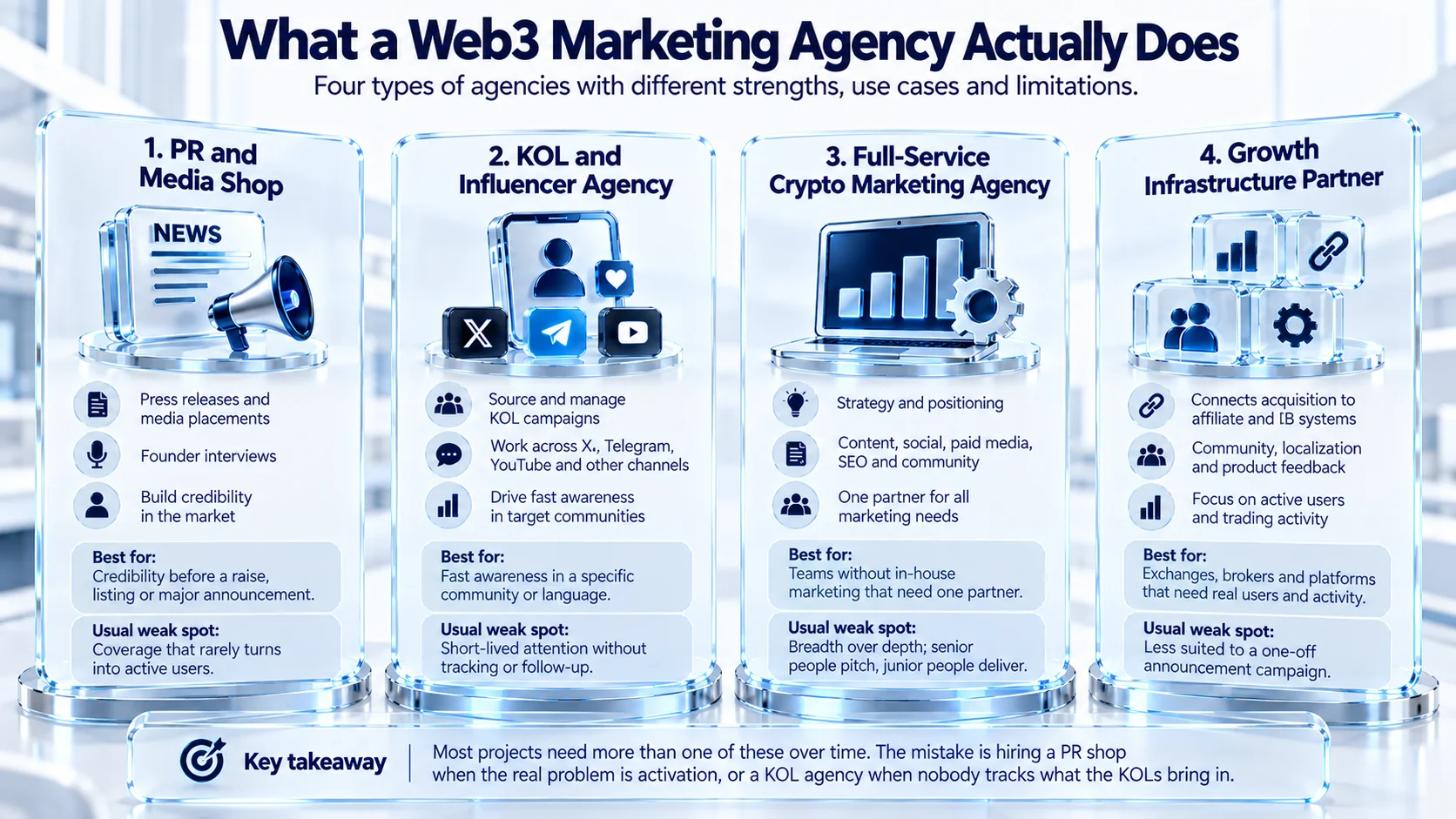
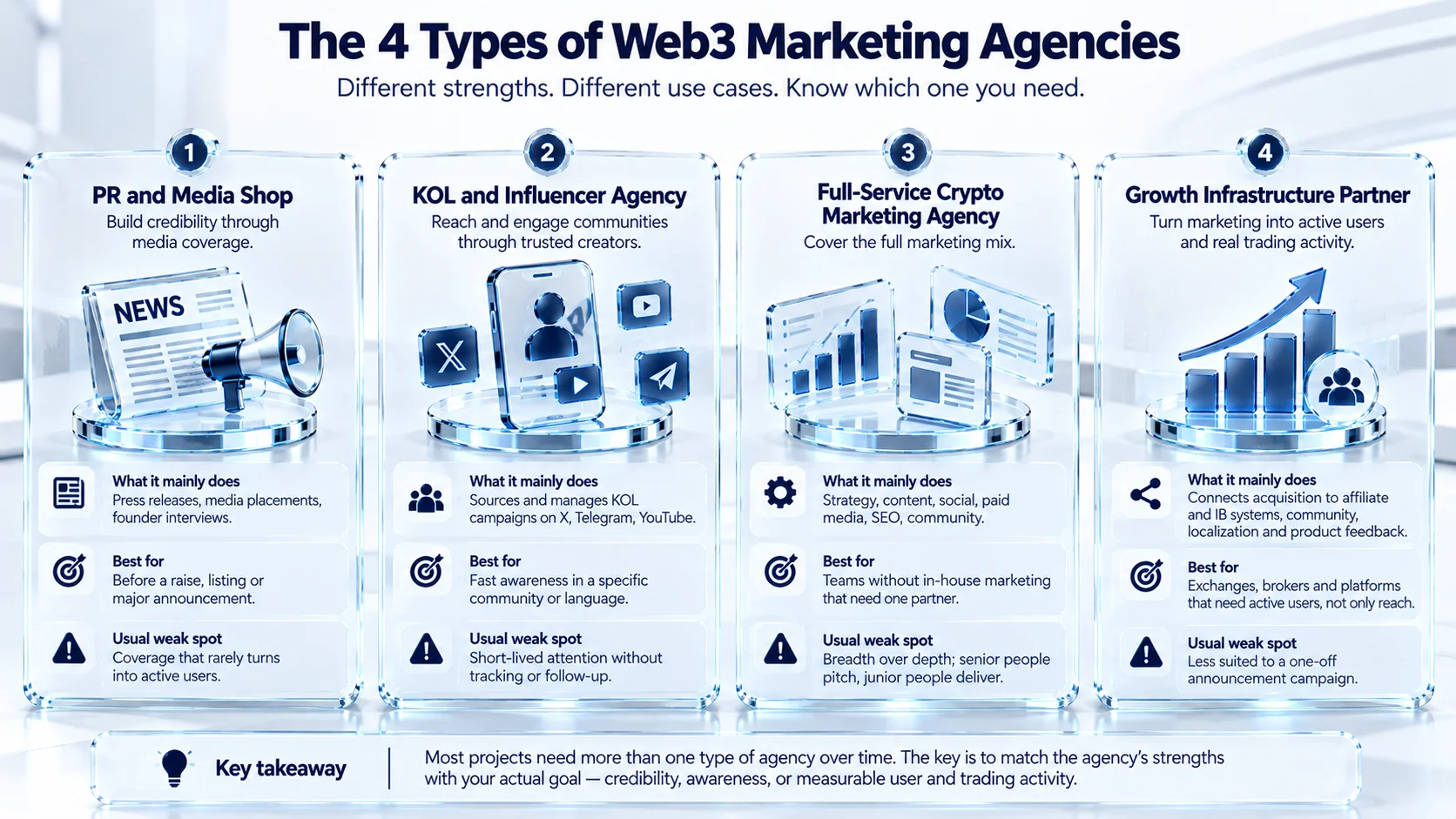
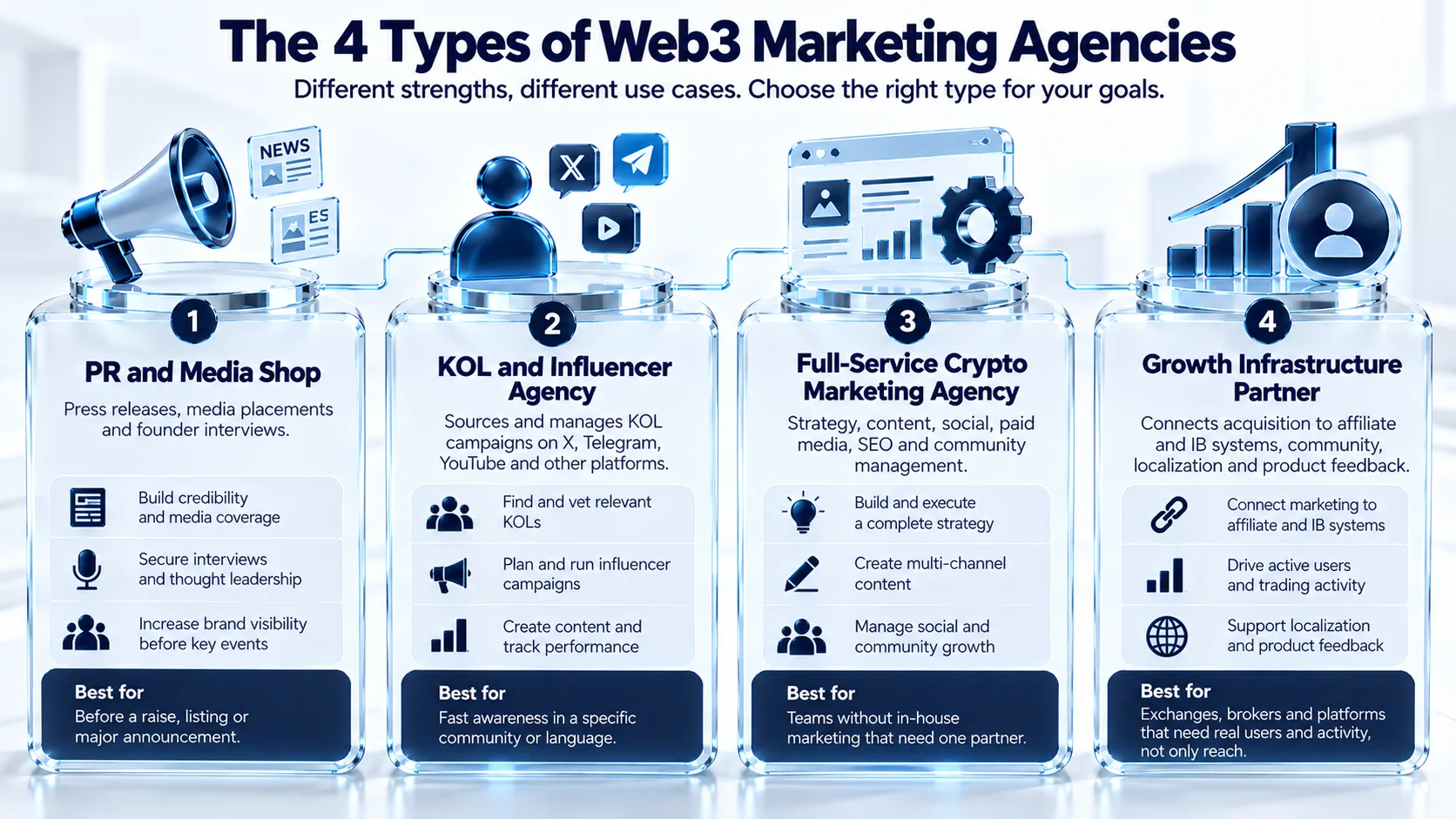
“Web3 marketing agency” is a broad label. Behind it are businesses with very different strengths. Knowing which type you’re talking to tells you what to expect and where it will fall short.
| Agency type | What it mainly does | Best for | Usual weak spot |
|---|---|---|---|
| PR and media shop | Press releases, media placements, founder interviews | Credibility before a raise, listing or major announcement | Coverage that rarely turns into active users |
| KOL and influencer agency | Sources and manages KOL campaigns on X, Telegram, YouTube | Fast awareness in a specific community or language | Short-lived attention without tracking or follow-up |
| Full-service crypto marketing agency | Strategy, content, social, paid media, SEO, community | Teams without in-house marketing that need one partner | Breadth over depth; senior people pitch, junior people deliver |
| Growth infrastructure partner | Connects acquisition to affiliate and IB systems, community, localization and product feedback | Exchanges, brokers and platforms that need active users and trading activity, not only reach | Less suited to a one-off announcement campaign |
Most projects need more than one of these over time. The mistake is hiring a PR shop when the real problem is activation, or a KOL agency when the real problem is that nobody tracks what the KOLs bring in.
Start with your stage, not the agency’s pitch
The right agency depends on where you are. Use this table to define what you’re buying before the first sales call.
| Your situation | Main need | Agency type to look for | Metric to judge it by |
|---|---|---|---|
| Token project, pre-launch | Narrative, early community, credibility | PR plus KOL, with strong community skills | Engaged community members, quality of early holders’ interest |
| Token launch / TGE | Coordinated distribution across channels | Full-service or launch specialist | Unique wallets interacting, retained community after launch |
| Post-listing project | Sustained attention and real usage | Content, SEO and community | Active users, organic and branded search growth |
| Crypto exchange entering a region | Localized acquisition and trading activity | Growth infrastructure partner with regional KOL and IB access | Verified users, first trades, 30-day active traders |
| Forex or CFD broker | Funded accounts within strict promotion rules | Partner with IB networks and financial-promotion experience | Funded accounts, active traders, IB retention |
| KOL or financial creator | Monetization and owned channels | Creator infrastructure partner | Revenue per follower, share of income from owned channels |
One more check before you shop. If the product, token design or launch plan has a structural problem, marketing will only expose it faster. Our guides on crypto tokenomics and on why token launches fail to get traction are worth reading first. A good agency will raise these issues itself instead of quietly taking the retainer.
12 questions to ask a Web3 marketing agency before you sign
Use the discovery call to test thinking, not to listen to a presentation. Each question below comes with what a good answer looks like.
- Which projects like ours have you worked on, and can we speak to one of them?
A good answer names the sub-sector (exchange, DeFi, broker, gaming) and offers a reference call, even under NDA. - Who exactly will work on our account, and how much of their time do we get?
Named people with visible profiles, and the person running your account joins the call. - How do you attribute results to your work?
Referral codes, UTM tags, sub-IDs and, where relevant, on-chain attribution. See our guide to chain attribution. - Can we see a real client report, with names removed?
The report shows outcomes such as active users or first trades, not just impressions. - Which channels would you not use for us, and why?
A specific answer tied to your audience. “We do everything” is a weak sign. - How do you select and vet KOLs?
Audience geography, engagement checks, disclosure history and tracked links. Our explainer on what a KOL is covers the vetting basics. - How do you handle ad platform rules for crypto?
They know that Google, Meta and X restrict crypto ads, and they know what certification or licensing your target markets require. - Which promotion rules apply in our target markets, and who reviews content against them?
A named review step, and familiarity with rules such as the FTC’s endorsement guidance, the UK FCA regime and MiCA. - How do you localize for our target regions?
Native-language teams and local KOL relationships, not machine translation of English campaigns. - Who owns the accounts, data, content and partner relationships when the contract ends?
You do. In writing. - What happens in the first 30 days?
An audit, a measurement setup and a small test plan, not a full-budget launch on day one. - What result would make you tell us to stop spending on a channel?
A clear threshold. Agencies that never recommend cutting spend are optimizing for their own retainer.
Red flags when hiring a crypto marketing agency
Walk away if you see these
- Promises of guaranteed results, token price impact, exchange listings or fixed returns.
- Reports built on impressions, follower counts and Telegram member totals.
- Growth plans with no data from comparable past work.
- Refusal to show a client report or provide a reference.
- No answer on who owns your ad accounts, community channels and data.
- Long lock-in contracts with no performance checkpoint or exit clause.
- KOL lists sold by follower count, with no audience geography or engagement data.
- Vague answers about disclosure, ad policies or regional promotion rules.
- Undisclosed markups or fees taken from KOLs and media partners on your budget.
The metrics that matter, by goal
Most disappointing agency relationships fail on measurement before they fail on execution. Agree on the metric that defines success for each goal before work starts.
| Goal | Vanity metric | Metric that matters |
|---|---|---|
| Awareness | Impressions, reach | Branded search growth, referral traffic, share of conversation in your category |
| Community | Member count | Share of members active each week, retained members after 30 and 90 days |
| Exchange user acquisition | Registrations | Verified accounts, first deposits, first trades, users active after 30 days |
| Broker client acquisition | Leads | Funded accounts, active traders, cost per funded account |
| Token launch | Follower growth | Unique wallets interacting, community retention after launch |
| PR | Number of placements | Coverage in outlets your audience reads, referral visits, citations in AI answers |
Sigma perspectiveFrom an operational perspective, the gap between “registered” and “traded” is where most exchange marketing budgets disappear. An agency that only reports registrations cannot tell you which channels bring traders and which bring bonus hunters. Ask for the full path from click to verified account to first trade, broken down by channel and by KOL.
Web3 marketing agency pricing: models and what drives cost
Prices vary widely, and published ranges should be treated as a starting point. One established agency’s own buyer guide, for example, lists monthly retainers from about $3,000 at entry level to $20,000 and above for full-service work, with costs rising with scope, KOL budgets and paid media. Those figures are self-reported and come without a stated methodology. Use them to calibrate conversations, not as a benchmark.
The structure of the deal usually matters more than the headline number:
| Model | How it works | Works well when | Watch for |
|---|---|---|---|
| Monthly retainer | Fixed fee for a defined scope | Ongoing content, community and SEO work | Scope that shrinks while the fee stays the same |
| Project fee | One price for a defined campaign or deliverable | Launches, audits, website builds | Unclear acceptance criteria |
| Performance or hybrid | Lower base fee plus payment per verified outcome | Exchange and broker acquisition with clean tracking | Outcome definitions that reward low-quality sign-ups |
| Token or equity | Payment partly in project tokens or shares | Rarely; only with long vesting and clear deliverables | Misaligned incentives and disclosure obligations |
The main cost drivers are the number of channels, the seniority of the team, the number of languages and regions, KOL and media budgets, and how much reporting and attribution work is included. Media and KOL fees are often billed on top of the agency fee. Ask for them to be shown separately, with any markup disclosed.
Contract and scope-of-work terms that protect you
A good contract makes expectations measurable and makes leaving possible. Before you sign, check that it covers each of these:
- Named team members and their time commitment.
- Specific monthly deliverables, not “ongoing support.”
- Written definitions for every KPI, including what counts as a verified user or active trader.
- Reporting cadence and access to raw data and dashboards.
- Your ownership of ad accounts, social accounts, community channels, content and data.
- KOL disclosure duties and a compliance review step for all published content.
- Separate line items for media and KOL spend, with markups disclosed.
- A performance checkpoint at 90 days with a no-penalty exit.
- Payment milestones tied to delivery for project work.
- Confidentiality that covers your data, tokenomics and partner terms.
Compliance: what your agency must know in 2026
Crypto marketing now runs inside real rules. An agency that can’t explain them will put your brand, and possibly your licence, at risk. This is general information, not legal advice.
- Ad platforms. Google, Meta and X all restrict crypto advertising and require certification or proof of licensing in many markets. Google, for example, updated its cryptocurrency policy in February 2025 to allow exchanges and software wallets to advertise in the UAE if they hold a licence from VARA, the FSRA or the DFSA and are certified by Google. Our guide to Google Ads for crypto covers this in more depth.
- Endorsements. The US FTC requires clear disclosure of any material connection between a brand and the people promoting it, placed in the post itself.
- UK financial promotions. The FCA’s guidance on social media promotions warns that influencers and affiliate marketers promoting regulated products without approval may be committing a criminal offence.
- EU. Under MiCA, crypto marketing communications must be identifiable as marketing, fair, clear and not misleading, and consistent with the white paper.
The practical test: ask the agency to walk you through how a single KOL post for your project would be briefed, reviewed, disclosed and geo-restricted. If they can’t answer in detail, keep looking.
Run a paid pilot before a long retainer
A short, paid pilot shows how an agency actually works before you commit to a year. Ninety days is enough to learn a lot.
- Weeks 1 to 2: audit and measurement. The agency reviews your funnel, sets up tracking and agrees KPI definitions with you.
- Weeks 3 to 6: controlled tests. Two or three channels at limited budget, each with a clear hypothesis.
- Weeks 7 to 12: scale what works. Budget moves to the channels with the best verified results. The rest are cut.
- Day 90: decision. Compare results against the success criteria you set on day one, then renew, change scope or exit.
An agency that refuses a pilot and insists on a twelve-month commitment from the start is telling you something about how confident it is in its own results.
A simple scorecard for comparing agencies
Score each finalist from 1 to 5 on every criterion, multiply by the weight, and compare totals. Adjust the weights to your stage.
| Criterion | Weight | What to check |
|---|---|---|
| Relevant track record | 20% | Similar projects, reference calls, verifiable public work |
| Measurement and attribution | 20% | Real report, KPI definitions, tracking setup |
| Team quality and access | 15% | Named people, seniority, time commitment |
| Compliance and ad-policy knowledge | 15% | Detailed answers on disclosure, licensing and review |
| Regional and language capability | 10% | Native teams, local KOL and partner access |
| Channel judgment | 10% | Clear reasons for what they would and wouldn’t do |
| Contract fairness | 10% | Ownership, transparency on spend, exit terms |
Comparing specific names? Our overview of the crypto PR agency model explains what to expect from PR-led partners.
When you need growth infrastructure, not just an agency
Some businesses outgrow the agency model. Exchanges, brokers and creator networks don’t only need campaigns. They need systems that keep producing users and activity after a campaign ends: affiliate and IB programs, localized communities, regional KOL relationships, onboarding support and a feedback loop into the product.
If your growth depends on trading activity in specific regions, ask any partner how they will connect acquisition to retention. Our Web3 go-to-market framework describes how those pieces fit together.
This is where Sigma works. As a Finance and Web3 growth infrastructure network, Sigma connects exchanges, brokers, KOLs and IBs through user acquisition, affiliate systems, community growth, localization and strategic partnerships, with a particular focus on the GCC, MENA and Persian-speaking markets. Sigma is not a broker, exchange or financial advisor, and does not guarantee listings, volume or results.
Key takeaways
- Define the outcome and your stage before talking to agencies.
- Choose the agency type that fits the problem: PR, KOL, full-service or growth infrastructure.
- Judge candidates on attributed results, named teams, compliance knowledge and contract fairness.
- Measure verified outcomes such as first trades and funded accounts, not reach.
- Start with a 90-day paid pilot with success criteria agreed in advance.
Planning your next growth phase?
Tell us your market, stage and goal. We’ll show you how we would measure success before we talk about scope.
Frequently asked questions
How much does a Web3 marketing agency cost?
Costs depend on scope, team seniority, the number of regions and languages, and whether KOL and media budgets are included. Agencies’ own published retainer ranges run from a few thousand dollars a month to more than $20,000 for full-service work, usually before media and KOL fees. Ask for agency fees and media spend to be priced separately.
What should a Web3 marketing agency deliver in the first 90 days?
An audit of your funnel, a working measurement setup with agreed KPI definitions, a small set of channel tests, and a clear recommendation on what to scale and what to stop. By day 90 you should be able to compare verified results against the success criteria set at the start.
Is a retainer or a performance-based deal better?
Retainers suit ongoing work such as content, community and SEO. Performance or hybrid deals suit acquisition for exchanges and brokers, but only when tracking is clean and the outcome is defined carefully, for example a verified first trade rather than a registration.
Can a marketing agency guarantee an exchange listing or token performance?
No. Listing decisions belong to exchanges, and token prices depend on markets. Credible partners offer listing readiness support and introductions, never guarantees. Treat any promise of a guaranteed listing, price impact or return as a reason to walk away.
What KPIs should I ask a crypto marketing agency to report?
Report on outcomes tied to your goal: verified users, first deposits, first trades and 30-day active users for exchanges; funded accounts for brokers; active and retained community members for projects. Impressions and follower counts can be included, but should not define success.
Should I build an in-house team or hire an agency?
Many projects combine both. Keep strategy, data and partner relationships in-house, and use agencies for specialist execution such as regional KOL campaigns, PR or paid media. Whatever the mix, make sure your company owns the accounts, data and community.
Sources and further reading
- Google Ads Help, “Updates to Cryptocurrencies and related products policy (February 2025)”.
- US Federal Trade Commission, “Disclosures 101 for Social Media Influencers”.
- UK Financial Conduct Authority, FG24/1: Finalised guidance on financial promotions on social media.
- European Union, Regulation (EU) 2023/1114 (MiCA).
- Coinbound, “How to Choose the Right Web3 Marketing Agency” (self-reported pricing ranges).
Financial markets, including crypto, forex, futures and leveraged products, involve risk. This content is for informational and strategic purposes only and does not constitute financial, investment or legal advice. Sigma is not a broker, exchange or financial advisor, does not manage user funds, and does not guarantee profits, listings, trading volume or outcomes. Some links on this site may be partner or referral links.