

Table Of Content
- KOL meaning: the short definition
- Where the term came from: sociology, medicine, then social media
- KOL vs influencer vs KOC vs ambassador vs affiliate vs IB
- What KOL means in crypto
- Where crypto KOLs operate
- Types of crypto KOLs, and what each one is good for
- How crypto KOLs earn money
- KOL rounds: what they are and why they draw scrutiny
- How projects and exchanges work with KOLs
- How to tell a credible KOL from a paid amplifier
- KOL disclosure rules in 2026: what changed
- United States: FTC endorsement rules
- United Kingdom: FCA financial promotions
- European Union: MiCA marketing communications
- Elsewhere
- Why KOLs work best as infrastructure, not one-off posts
- Building with KOLs?
- Frequently asked questions
- Sources and further reading
- KOL stands for Key Opinion Leader: someone whose judgment a specific audience trusts in a specific field.
- In crypto, KOLs are analysts, educators, traders and community leaders whose audiences act on what they say. That makes them powerful distribution and a common source of risk.
- The rules have tightened. In the US, UK and EU, paid crypto promotion now comes with clear disclosure and accuracy duties.
KOL stands for Key Opinion Leader: a person whose opinion carries weight with a specific audience because of their expertise, track record or position, not simply their follower count. A physician whose prescribing habits other doctors follow is a KOL. So is a crypto analyst whose threads thousands of traders read before they open a position.
In crypto, the term usually describes a creator on X, Telegram, YouTube or a similar platform whose audience acts on what they say. That makes KOLs one of the strongest distribution channels in the industry. It also makes them one of its most common sources of risk.
This guide is for founders, exchange growth teams and creators who want the complete picture: where the term comes from, how a KOL differs from an influencer or an affiliate, the main types of crypto KOLs, how they earn, how to spot a credible one, and what disclosure rules now require.
KOL meaning: the short definition
A KOL (Key Opinion Leader) is a person whose views shape how a defined audience thinks and acts, because that audience trusts their expertise, experience or judgment in a particular field. The defining trait is earned credibility within a niche. Reach alone does not make someone a KOL.
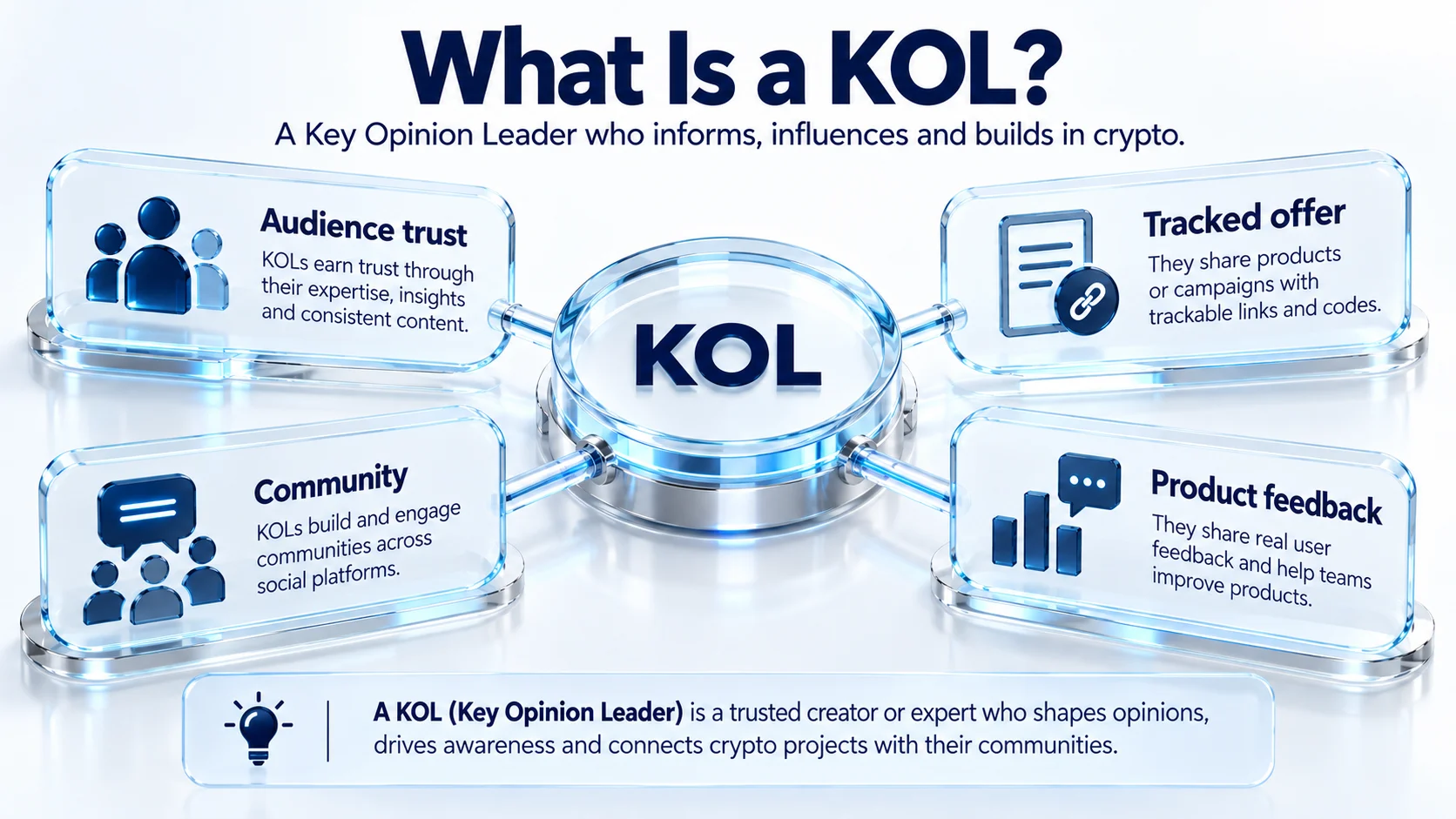
In marketing, a KOL is someone a brand partners with to borrow that credibility. In crypto, the word covers the people whose posts, videos and channels shape which projects, exchanges and tools a community pays attention to.
One clarification, because the search results for this word are crowded. As a regular word, “Kol” also appears in dictionaries as the name of a people of eastern India and as a given name. This guide is about KOL as the acronym.
Where the term came from: sociology, medicine, then social media
The idea is older than social media. In the 1940s and 1950s, communication researchers Paul Lazarsfeld and Elihu Katz described a “two-step flow”: ideas travel from the media to a small group of trusted opinion leaders, and from them to everyone else. People, they found, were persuaded less by broadcasts than by the people they personally trusted.
The pharmaceutical industry turned that observation into a commercial practice.
According to PMLiVE, the KOL concept came out of mid-20th-century sociology and gained traction in pharma during the 1970s. Companies worked with respected physicians to shape how new therapies were adopted.
A commentary in the Canadian Medical Association Journal notes that drug companies had been expanding their use of the KOL model since the late 1950s. It also cites an industry poll in which more than 60% of doctors said the term should be replaced because of its commercial associations.
From there, the term moved into consumer marketing, especially in China and other Asian markets, where “KOL” became the everyday word for a credible social media creator. Crypto, with its early and heavy Asian participation, inherited it.
The history matters for one reason. From the start, the KOL concept has carried a tension between independent expertise and paid influence. That same tension is the central problem with crypto KOLs today.
KOL vs influencer vs KOC vs ambassador vs affiliate vs IB
These terms are often used as if they mean the same thing. They don’t. Some describe why people listen to someone. Others describe how that person is paid.
| Role | What the term describes | Source of trust | Typical payment | Crypto example |
|---|---|---|---|---|
| KOL | A person with authority in a niche | Expertise and track record | Sponsorships, retainers, revenue share | An on-chain analyst whose research other creators quote |
| Influencer | A person with a large, engaged audience | Reach and personality | Sponsored posts | A lifestyle creator who covers crypto occasionally |
| KOC (Key Opinion Consumer) | An ordinary user sharing first-hand experience | Relatability | Perks, small fees, referral bonuses | A trader posting honest app reviews in a Telegram group |
| Brand ambassador | The length of a relationship with one brand | Visible long-term alignment | Retainer, often with exclusivity | A creator who represents one exchange for a year |
| Affiliate | A payment model based on referrals | Not a trust category | Share of fees or a fixed amount per referred user | A guide website earning a share of referred users’ trading fees |
| IB (Introducing Broker) | A business that refers and supports clients for a broker or exchange | Service and an ongoing relationship | Rebates or commissions on client activity | A regional team that onboards traders and supports them in their own language |
The useful way to read this table: KOL describes why people listen. Affiliate and IB describe how someone gets paid. One person can be all three at once. A respected educator can run an affiliate link for an exchange, hold an ambassador contract with it, and operate as an IB for a forex broker.
For a broader view of paid creator campaigns, see our guide to crypto influencer marketing.
What KOL means in crypto
In crypto, a KOL is a creator or community figure whose audience uses their judgment as a shortcut for its own research. That role is bigger here than in most industries because trust is harder to come by.
Teams can be pseudonymous. Transactions can’t be reversed. Tokenomics are complicated, and scams are common. Many users don’t have the time or technical background to evaluate a project alone, so they rely on people they already trust.
Academic research is starting to catch up with this.
A 2026 study from Vienna’s Complexity Science Hub, based on interviews with 13 crypto KOLs and accepted at the CHI 2026 conference, describes crypto KOLs as hybrid figures: part educator, part informal financial advisor, part entrepreneur and part community steward.
The authors also point to studies linking crypto influencer posts to short-term swings in trading activity. That is exactly why regulators now watch this space closely.
Where crypto KOLs operate
- X (formerly Twitter): real-time narratives, research threads and project discovery. Still the main venue for global crypto conversation.
- Telegram: channels and groups with direct reach and high conversion potential. Dominant in many Persian-, Arabic- and Russian-speaking communities, and also a favorite venue for impersonation scams.
- YouTube: long-form education. Smaller audiences per video, but deeper trust. KOLs interviewed in the Vienna study described YouTube as more opinion-shaping than the fast, fleeting posts on X or Telegram.
- Discord: project and protocol communities, where KOLs often act as moderators or ambassadors.
- TikTok and Instagram: reach to new and younger users. Several KOLs in the same study said they avoid TikTok because of the volume of meme-coin promotion there.
- LinkedIn: the B2B side of crypto, including exchanges, funds, founders and compliance professionals.
- Farcaster and other decentralized networks: smaller, crypto-native audiences. See our overview of decentralized social media.
Types of crypto KOLs, and what each one is good for
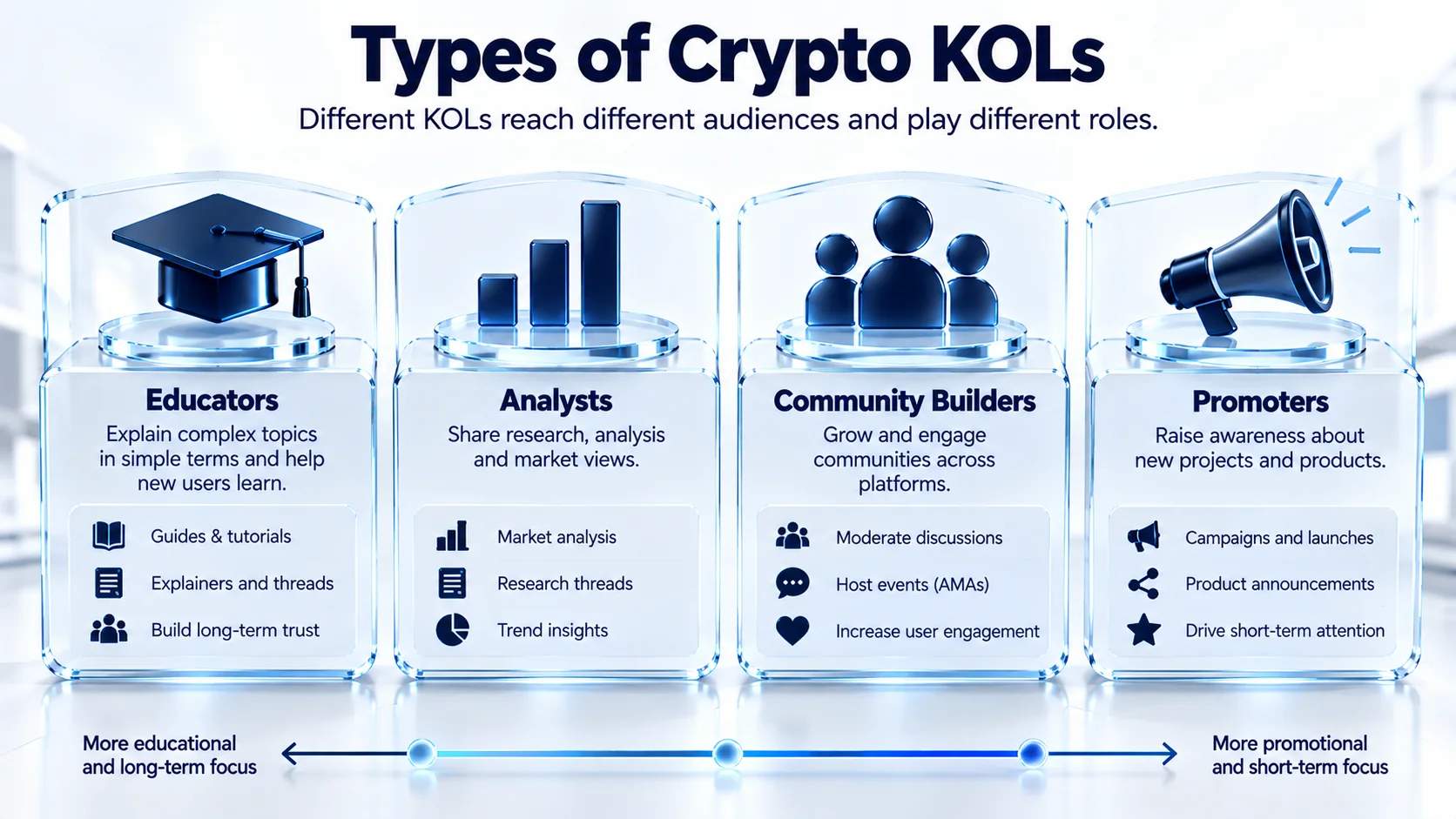
“Crypto KOL” covers very different people. Choosing the right type for the job matters more than choosing the biggest name.
| Type | What they publish | Best used for | Watch for |
|---|---|---|---|
| Analyst / researcher | On-chain data, market structure, project deep dives | Credibility with experienced users and industry insiders | Drifting from analysis into price calls |
| Educator | Tutorials, explainers, platform walkthroughs | Onboarding: registration, verification, first deposit | Guides that go out of date as products change |
| Trader | Positions, strategies, market commentary | Awareness of trading tools, futures and copy-trading products | Performance claims and leverage risk for followers |
| Community leader | Runs Telegram or Discord groups | Activation and retention in a region or language | Inflated member counts and inactive groups |
| News / aggregator | Fast updates and headlines | Announcements and listing awareness | Reach that rarely converts into active users |
| Builder / founder | Technical commentary and product updates | Credibility with developers and ecosystem partners | Conflicts of interest with their own projects |
Strong programs usually combine several types: an educator to get new users through setup, an analyst to build credibility, and a community leader to keep users engaged after the campaign ends.
How crypto KOLs earn money
Most established crypto KOLs have several income streams. Understanding them helps projects read incentives correctly, and helps creators build something more stable than one-off sponsorships.
- Sponsored content: a flat fee for a post, video, thread or Space. Simple, but it rewards reach rather than results.
- Affiliate and referral revenue: a share of the trading fees generated by users who sign up through the KOL’s link. This is common with exchanges.
- IB rebates: commissions tied to client trading activity, common with forex brokers and increasingly with crypto exchanges.
- Ambassador retainers: monthly payments for a longer relationship, often with exclusivity.
- Own products: courses, paid communities, newsletters, research subscriptions and tools.
- Token allocations: tokens granted or sold to KOLs before a launch, usually through a “KOL round.”
KOL rounds: what they are and why they draw scrutiny
Some token projects run a KOL round: an allocation sold or granted to selected creators before the token is publicly available, typically after earlier investors and often with a lock-up and vesting schedule. The project gets distribution from people with an audience. The KOL gets early exposure to the token.
The problem is alignment. A KOL who holds tokens has a financial reason to be positive about the project. If those tokens unlock while the audience is still buying, the KOL’s interest and the followers’ interest can point in opposite directions. If the holding isn’t disclosed, followers can’t take it into account.
Under the US Federal Trade Commission’s guidance, anything of value received from a brand counts as a material connection that should be disclosed. Token allocations are hard to argue out of that definition.
Projects considering a KOL round should take legal advice for every market they target, structure vesting with care (see our guide to crypto tokenomics), and require disclosure from every participant. For the wider launch picture, read crypto token launch marketing.
How projects and exchanges work with KOLs
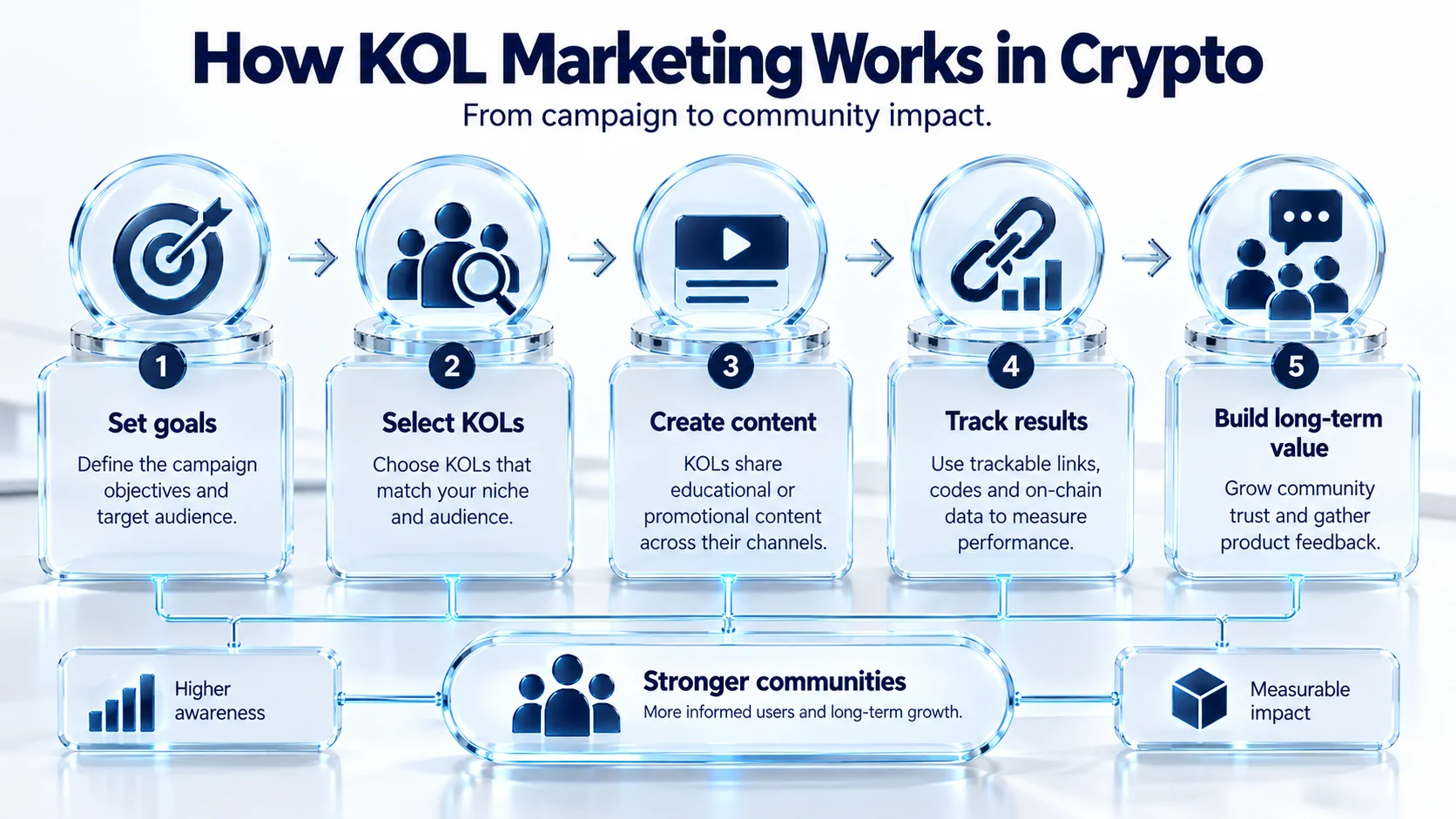
The difference between a KOL campaign that builds a user base and one that only buys a few days of attention usually comes down to process. A workable operating model looks like this:
- Define the outcome before choosing anyone. Awareness, registrations, first trades and 30-day active users are different goals. They need different KOLs and different metrics.
- Select for audience fit, not follower count. Check language, region, platform, how familiar the audience is with your product category, and whether the audience is even allowed to use your product.
- Write a clear brief. Include the key facts, what must not be said (no profit promises, no “guaranteed” anything), the disclosure format and any regional restrictions.
- Track every link and code. Use unique referral links, sub-IDs and, where possible, on-chain attribution. Our guide to chain attribution explains how.
- Pay for what you can measure. Hybrid deals (a modest fixed fee plus a performance component) often align incentives better than flat fees alone.
- Keep the KOLs who perform. Turn one-off campaigns into ambassador, affiliate or IB relationships with the creators whose audiences stay active.
From an operational perspective, the most common mistake in exchange KOL programs is reporting registrations as success. Registrations are cheap. Verified accounts, first deposits, first trades and users still active a month later are what show whether a KOL’s audience actually fits the platform. Measure the whole path, and the right KOLs become obvious.
How to tell a credible KOL from a paid amplifier
Follower counts are easy to inflate and say little about trust. The Vienna study offers a more useful lens. It identifies four behaviors that crypto communities treat as signs of credibility:
- Self-regulation: turning down sponsorships that don’t fit and keeping personal rules about what they promote.
- Bounded competence: admitting the limits of their knowledge and avoiding confident predictions.
- Accountability: disclosing paid relationships and holdings consistently.
- Self-correction: publicly learning from past mistakes and changing their practices.
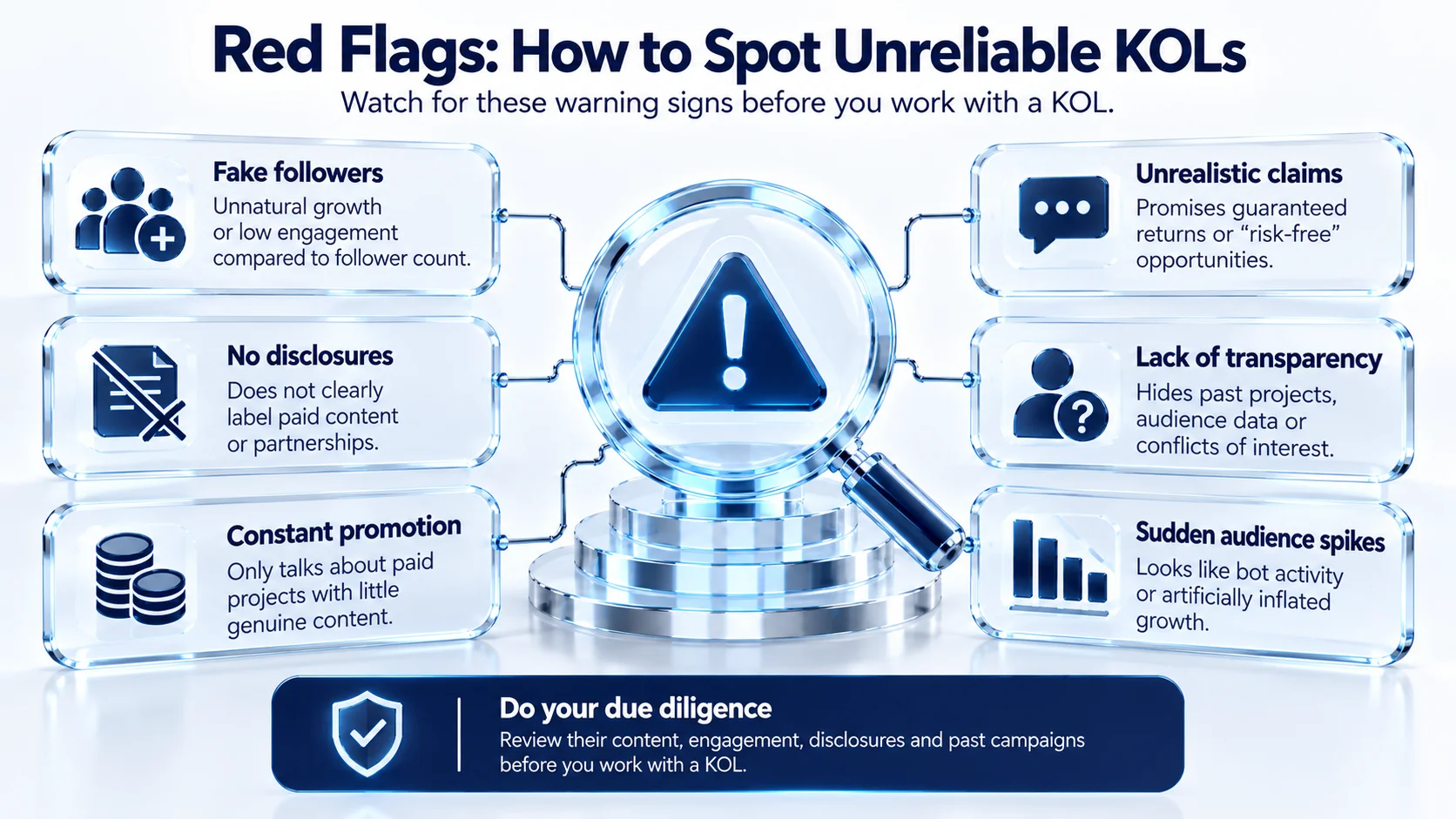
- Promotes a different token or platform almost every day.
- Engagement doesn’t match the audience: likes from empty accounts, generic comments that ignore the content.
- Paid posts carry no disclosure, or the disclosure is hidden in the bio.
- Old calls that went badly have been deleted, so there is no visible track record.
- Uses language like “guaranteed,” “risk-free” or “can’t lose.”
- Pushes urgency: countdowns, “last chance,” fear of missing out.
- Wants full payment upfront and offers no reporting.
- Won’t share audience geography or platform analytics.
Before working with a KOL, a project or exchange should be able to answer yes to each of these:
- Is their audience in markets where our product is legally available?
- Do their analytics show real, recent engagement from those markets?
- Do they disclose paid relationships clearly and consistently?
- Can they explain our product accurately, in their own words?
- Will they accept tracked links and report on results?
- Would we be comfortable if their past content appeared next to our brand?
The same questions help KOLs choose partners. Trust takes years to build and one bad promotion to lose. Our guide on building a crypto brand people trust covers this from the brand side.
KOL disclosure rules in 2026: what changed
Crypto promotion is no longer a regulatory gray area in the largest markets. The summary below is general information, not legal advice. Rules depend on where the audience is, not only where the KOL lives.
United States: FTC endorsement rules
The FTC’s guidance for social media influencers says that any “material connection” with a brand must be disclosed. That includes payment, free or discounted products, and personal or employment ties. The disclosure has to sit with the endorsement itself, not only in a bio.
Vague tags such as “sp,” “spon” or “collab” are not enough. US law can also apply to posts made abroad if they are reasonably likely to reach US consumers.
United Kingdom: FCA financial promotions
Since October 2023, cryptoasset promotions in the UK fall under the financial promotions regime. The FCA’s finalised guidance on social media promotions (FG24/1), published in March 2024, states that promotions must be fair, clear and not misleading. It also warns that influencers and affiliate marketers who promote regulated products without approval from an FCA-authorised firm may be committing a criminal offence.
European Union: MiCA marketing communications
Under the Markets in Crypto-Assets Regulation (MiCA), marketing communications about crypto-assets must be clearly identifiable as marketing, fair, clear and not misleading, and consistent with the asset’s white paper.
The rules for most crypto-assets and service providers have applied since 30 December 2024. Responsibility sits mainly with issuers, offerors and service providers, including for content published on their behalf. In practice, that means a project is accountable for what the KOLs it pays say about it.
Elsewhere
Regulators in the UAE, Singapore and other markets have published their own rules for virtual-asset marketing, and platforms such as YouTube, Instagram and X have their own paid-partnership labels.
The safest default for any KOL: disclose every paid relationship and token holding in the post itself, in the language of the post. The safest default for any project: treat commissioned content as your own advertising and review it the same way.
Why KOLs work best as infrastructure, not one-off posts
A single sponsored post rents an audience’s attention for a day. The attention fades, and nothing is left behind. The KOL programs that keep producing results connect that attention to systems that last.
The KOL growth loop: each stage keeps the value created by the previous one.
For platforms, this means linking the KOL program to affiliate and IB systems, localized community support and product feedback, so the people a KOL brings in become active users rather than one-time sign-ups.
For KOLs, it means owning more of the business: a website and search presence that doesn’t depend on one platform’s algorithm (see AEO for crypto), a content system (see crypto content marketing), tracked partner deals and a community that stays when a platform changes its rules.
This is the part of the work Sigma focuses on. As a Finance and Web3 growth infrastructure network, Sigma connects KOLs, IBs, exchanges and brokers through affiliate systems, community growth, localization and partnerships, with a particular focus on regional markets such as the GCC, MENA and Persian-speaking communities.
- A KOL is defined by earned credibility in a niche, not by follower count.
- KOL describes why people listen. Affiliate and IB describe how someone is paid. One person can be all three.
- Pick crypto KOLs by audience fit and measure first trades and retained users, not registrations.
- Disclosure is required in the US, UK and EU, and projects share responsibility for what paid KOLs say.
- KOLs create lasting value when they’re connected to tracking, community and product feedback.
Building with KOLs?
Sigma helps financial creators build the infrastructure behind their audience, and helps exchanges and brokers run KOL programs that turn attention into active users.
Frequently asked questions
What does KOL stand for?
KOL stands for Key Opinion Leader. It describes a person whose views influence how a specific audience thinks and acts because that audience trusts their expertise or judgment in a particular field. The term began in sociology and medicine and is now widely used in marketing, especially in Asian markets and in crypto.
Is a KOL the same as an influencer?
Not exactly. An influencer’s value comes mainly from reach and personality. A KOL’s value comes from recognized expertise in a niche. A KOL can have a smaller audience than an influencer but carry more weight on a specific topic, such as on-chain analysis or exchange security. In everyday crypto use, the terms often overlap.
How do crypto KOLs make money?
Crypto KOLs usually combine several income streams: sponsored posts, affiliate or referral revenue from exchanges, IB rebates, ambassador retainers, their own courses or paid communities, and sometimes token allocations through KOL rounds. Any paid relationship or token holding should be disclosed to their audience.
How many followers do you need to be a KOL?
There is no follower threshold. A KOL is defined by credibility and influence within a specific audience, not by audience size. A researcher with 15,000 engaged followers who trust their analysis can carry more influence in a niche than an account with ten times more passive followers.
Do crypto KOLs have to disclose paid promotions?
In most major markets, yes. The US FTC requires clear disclosure of any material connection with a brand. The UK FCA treats unapproved promotion of regulated products, including cryptoassets, as a potential criminal offence. The EU’s MiCA requires crypto marketing to be clearly identifiable. Rules vary by country, so local legal advice matters.
What is KOL marketing?
KOL marketing is a form of marketing in which brands work with trusted experts or creators to reach and persuade a specific audience. In crypto, it usually means partnering with analysts, educators, traders or community leaders to drive awareness, sign-ups and long-term user activity, ideally with tracked links and clear disclosure.
Sources and further reading
- Kropiunig, Kremer and Haslhofer, “Credibility Matters: Motivations, Characteristics, and Influence Mechanisms of Crypto Key Opinion Leaders”, Complexity Science Hub, 2026 (accepted at CHI 2026).
- PMLiVE, “Where did KOLs come from, and why do they matter?”
- Canadian Medical Association Journal, “How to make opinion leaders and influence people”.
- US Federal Trade Commission, “Disclosures 101 for Social Media Influencers”.
- UK Financial Conduct Authority, FG24/1: Finalised guidance on financial promotions on social media (March 2024).
- European Union, Regulation (EU) 2023/1114 on markets in crypto-assets (MiCA).
Financial markets, including crypto, forex, futures and leveraged products, involve risk. This content is for informational and strategic purposes only and does not constitute financial, investment or legal advice. Sigma is not a broker, exchange or financial advisor, does not manage user funds, and does not guarantee profits, withdrawals, listings or outcomes. Some links on this site may be partner or referral links.