Best Crypto Affiliate Programs (2026): Commissions and Terms Compared

Table Of Content
- The best crypto affiliate programs at a glance
- How crypto affiliate programs pay
- Headline rate vs effective commission
- Crypto referral program vs affiliate program
- The best crypto affiliate programs, one by one
- Binance Affiliate Program
- OKX Affiliate Program
- Bybit Affiliate Program
- Bitget Affiliate Program
- KuCoin Affiliate Program
- MEXC Affiliate Program
- Gate Affiliate Program
- Coinbase Affiliate Program
- Kraken Affiliate Program
- Ledger Affiliate Program
- How to choose a crypto affiliate program: a 7-point checklist
- Rules affiliates and creators must follow
- Common mistakes affiliates make
- How Sigma helps creators and platforms with affiliate growth
- Building an affiliate business or a partner program?
- Frequently asked questions
- Sources
- The best crypto affiliate programs in 2026 pay a share of the trading fees your referrals generate. On the official pages we checked on 25 November 2026, headline rates run from 50% (Binance, OKX, Bybit, Bitget, Kraken) to 60% (KuCoin) and up to 70% at MEXC, where that figure combines direct and sub-affiliate commission.
- The headline rate is a ceiling, not what you earn. Base tiers start lower, part of the rate is often passed to your referrals as a fee rebate, and some programs pay for a limited time. Coinbase, for example, pays 50% of fees for the first three months.
- Duration, qualification rules and where you are allowed to promote matter more than the top number. A lifetime 40% on an exchange your audience can legally use beats 70% on one they can’t.
- Promoting an exchange is a regulated activity in many countries. UK, EU and US rules all apply to affiliates and creators, not only to the platforms.
A crypto affiliate program pays you when people you refer sign up to a crypto platform and use it. Most exchange programs pay a percentage of the trading fees those users generate, usually in USDT or USDC. Wallet makers such as Ledger pay a percentage of each sale instead.
This guide compares the best crypto affiliate programs and crypto referral programs on the terms that decide what you actually earn: the base and maximum rate, how long commissions last, who qualifies and how you are paid. Every figure comes from the program’s own website, checked on 25 November 2026. Where a platform does not publish a figure, we say so instead of filling the gap with a third-party estimate.

The best crypto affiliate programs at a glance
The table lists what each platform states publicly. “Up to” means the top tier; most affiliates start below it. Rates, eligibility and availability vary by country, and every platform reserves the right to change its terms.
| Program | Headline commission (official page) | Commission basis | Duration as stated | Best suited to |
|---|---|---|---|---|
| Binance | Up to 50%; affiliates start at 30% or above | Referrals’ trading fees; up to 20% can be shared back as a rebate | Not limited in the starter guide | Large global audiences, spot and futures traders |
| OKX | Up to 50%, paid in USDT; default 30% | Trading fees, plus OKX Card spending | Not stated on the affiliate page | Creators with active traders and sub-affiliate teams |
| Bybit | Total rebate capped at 50% | Referrals’ trading fees, shared across sub-affiliates | Lifetime commissions | Derivatives-focused audiences |
| Bitget | Starts at 40%, up to 50% | Based on average monthly trading users | Not stated on the affiliate page | Smaller creators (100+ followers can apply) |
| KuCoin | Up to 60%, paid daily | Spot and futures trading fees | “Permanent affiliate relationships” | Communities of 500+ members or 5,000+ followers |
| MEXC | Up to 70%, combining referral and sub-affiliate commission | Spot and futures trading fees; 40% for regular users | No time limit, per MEXC’s own blog | Affiliates building sub-affiliate networks |
| Gate | Not published on the affiliate page | Spot, futures, options and other products | “Permanent commission rebates” | Affiliates willing to negotiate terms on application |
| Coinbase | 50% of trading fees | Referred customers’ trading fees | First 3 months | Audiences in markets where Coinbase operates; UK program closed |
| Kraken | Up to 50% (Consumer, Pro, DEX); 25% for Kraken Prop | Revenue share or CPA, negotiated per partner | Not stated; paid on ongoing activity | Established creators and media networks |
| Ledger | Minimum 10% of the final sales price | Hardware wallet sales, after discounts and excluding tax and delivery | Per sale | Security and self-custody content |
Sources for every row are listed at the end of this guide. For exchange-by-exchange background, see our reviews of Binance, OKX, Bybit and Coinbase.
How crypto affiliate programs pay
Almost every crypto exchange affiliate program uses one of three models. Knowing which one you are signing up for tells you more than the headline percentage.
| Model | How you are paid | Where you see it | Watch out for |
|---|---|---|---|
| Revenue share | A percentage of the trading fees your referrals pay, for as long as the program says | Binance, OKX, Bybit, Bitget, KuCoin, MEXC, Gate | Earnings depend on how much your referrals trade, not how many sign up |
| Time-limited revenue share | A percentage of fees for a fixed window | Coinbase (first 3 months) | Long-term referrals stop paying after the window |
| CPA or hybrid | A fixed amount per qualified user, sometimes plus a smaller revenue share | Kraken (negotiated per partner) | The definition of a “qualified” user, which may require KYC, a deposit or a minimum trade |
| Sales commission | A percentage of each product sale | Ledger and other wallet makers | Cookie windows and refund rules set in the program terms |
Revenue share rewards audiences that trade often. CPA rewards audiences that sign up and verify but trade rarely. If your followers are long-term holders rather than active traders, a 50% revenue share can pay less than a modest CPA.
Headline rate vs effective commission
The number on an affiliate landing page is almost never the number you earn. Four things sit between them.
- Your starting tier. Binance says affiliates start at a commission rate of 30% or above, with up to 50% available. Bitget starts at 40%. Higher tiers usually depend on the number of active referrals or their trading volume.
- The rebate you give away. Many programs let you return part of your commission to referrals as a fee discount. Binance allows a rebate of up to 20%. Whatever you give back comes out of your own share.
- Sub-affiliate splits. Where you recruit other affiliates, the total payout is often capped. Bybit’s FAQ shows a 50% total cap shared between a master affiliate and a sub-affiliate, so a sub-affiliate on 50% leaves nothing for the master.
- What counts as fee revenue. Commissions are usually calculated on net fees after the exchange’s own discounts, and some products or promotions may be excluded.
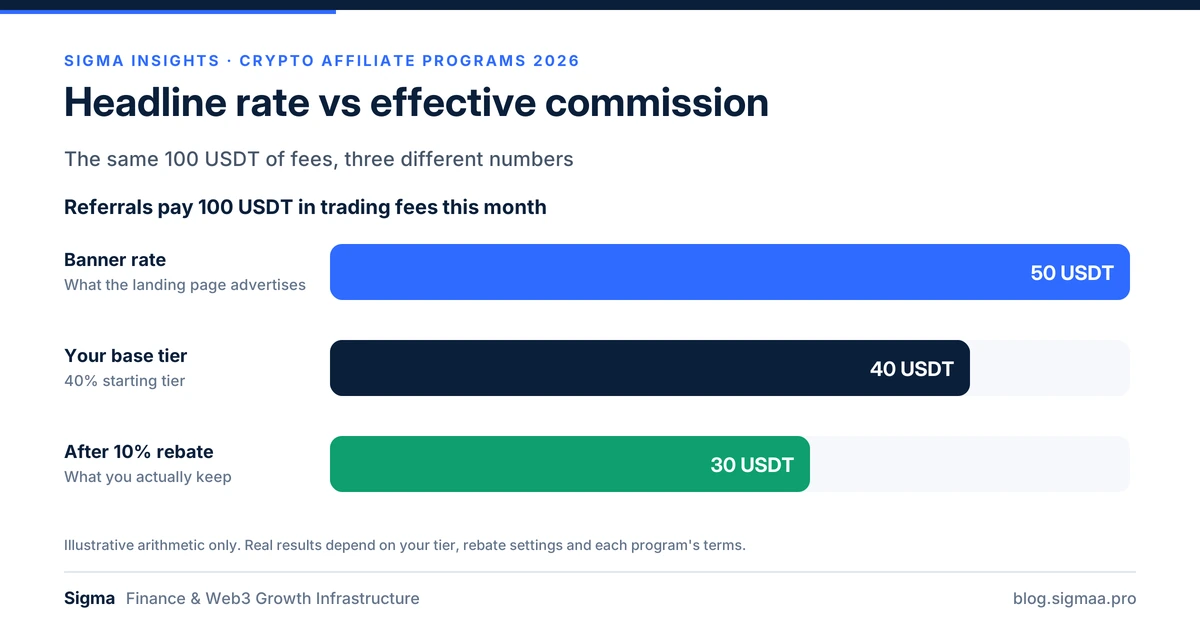
A simple example shows the gap. Say your referrals pay 100 USDT in trading fees this month. You are on a 40% base tier and you pass 10 percentage points back to them as a rebate. You keep 30 USDT, not the 50 USDT a “50% commission” banner suggests. The example is illustrative; plug in your own tier and rebate settings.
Crypto referral program vs affiliate program
Most exchanges run both, and they are easy to confuse. A crypto referral program is open to ordinary users. An affiliate program is for creators, communities and media with an audience, and it is usually by application.
| Referral program | Affiliate program | |
|---|---|---|
| Who can join | Any verified user | Approved creators, communities, media and partners |
| Typical reward | Sign-up bonuses for both sides plus a lower commission | Higher, tiered commission; sub-affiliate earnings |
| Example | Bybit’s referral program offers up to 30% commission on referees’ trades; MEXC pays regular users 40% | Bybit’s affiliate program caps total rebates at 50%; MEXC affiliates can reach 70% including sub-affiliates |
| Tools | A personal link or code | Dashboard, campaign links, creatives, account manager |
| Best for | Inviting friends and small circles | Running promotion as a business |
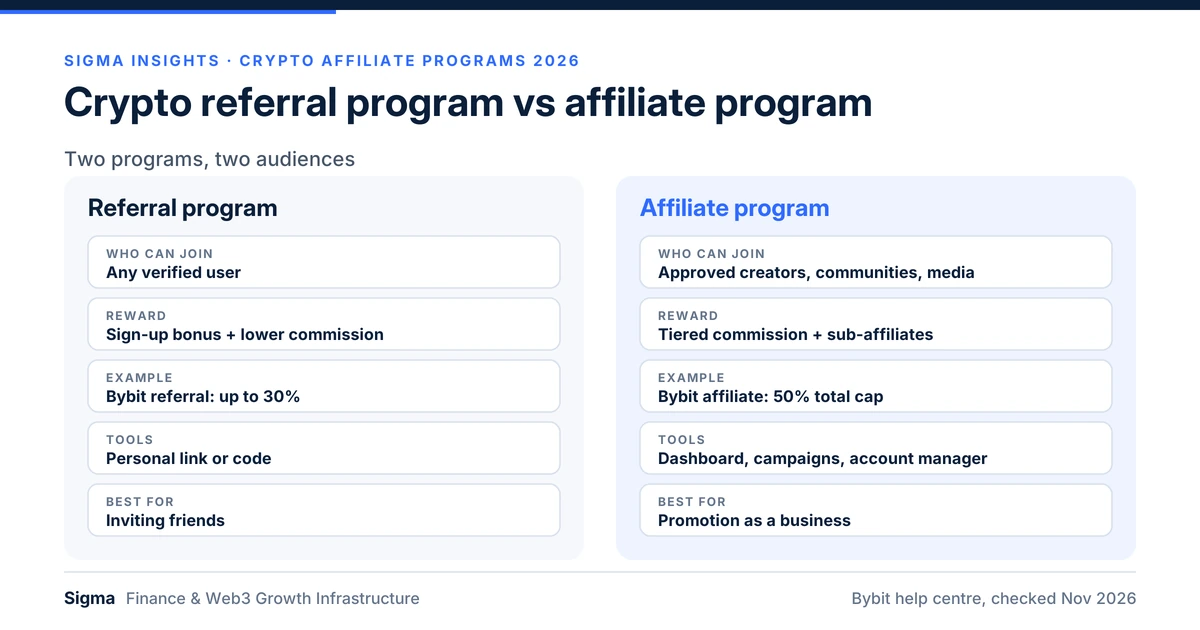
If you already refer people informally and they trade regularly, it is usually worth applying for the affiliate tier. The application asks for your channels and audience, and the approval decision is the exchange’s, not yours.
The best crypto affiliate programs, one by one
Each entry below summarises the official program page. We note what the page says, what it does not say, and what to confirm before you apply.
Binance Affiliate Program
Binance’s starter guide describes affiliates as users with a commission rate of 30% or above who can earn up to 50% referral commission across spot and futures, with an option to share up to 20% with referees as a rebate. Applications are assessed on social reach, community influence, audience quality and content relevance. Separate time-limited campaigns run on top of the base program.
- Confirm before you apply: the current spot and futures tier tables, and whether your audience’s countries are on Binance’s restricted list.
OKX Affiliate Program
OKX advertises up to 50% commission in USDT when users sign up through your link and trade, and it lets affiliates build sub-affiliate teams and earn from OKX Card spending. The page states that availability and terms may vary by country or region.
- Confirm before you apply: the tier table in OKX’s affiliate FAQ. The default rate is 30%; the top 50% tier requires, per month, 10 million USDT of spot volume (or 200 million USDT of futures volume) and 40 new and 200 total traders.
Bybit Affiliate Program
Bybit’s help centre says its affiliate program provides lifetime commissions based on the trading activity of referred users. Its FAQ illustrates a total rebate cap of 50% that is shared between master affiliates and sub-affiliates. Approved partners get a dedicated account manager.
- Confirm before you apply: the rate for your expected product mix, since derivatives and spot volumes can be treated differently.
Bitget Affiliate Program
Bitget’s page says affiliates start with a 40% rebate ratio and can earn up to 50%, with rates based on the average number of monthly trading users. Anyone with 100 or more followers on a social platform, or a community of more than 500 members, can apply, and applications are reviewed within 24 hours. Referrals must reach a required trading volume before commissions are earned.
- Confirm before you apply: the trading volume threshold, which the landing page does not state.
KuCoin Affiliate Program
KuCoin offers daily commissions of up to 60% of trading fees on spot and futures, describes affiliate relationships as permanent, and mentions second-tier commissions. Its eligibility list includes social accounts with more than 5,000 followers, communities with more than 500 members, and crypto media sites.
- Confirm before you apply: the second-tier rate, which the page mentions but does not quantify.
MEXC Affiliate Program
MEXC’s help centre advertises up to 70% in referral and sub-affiliate commissions combined, plus monthly bonus incentives for eligible affiliates. Its referral terms say regular users earn 40% on spot and futures, and MEXC’s own blog says commissions continue with no time limit.
- Confirm before you apply: how the 70% splits between your direct referrals and your sub-affiliates, and whether MEXC is permitted where your audience lives.
Gate Affiliate Program
Gate’s affiliate page does not publish rates. It refers to rebates across spot, futures, options and other products and to “permanent commission rebates”. Terms are set after you apply.
- Confirm before you apply: the full rate card in writing, since there is no public figure to compare against.
Coinbase Affiliate Program
Coinbase pays affiliates 50% of referred customers’ trading fees for the first three months. Approved affiliates get access to Impact tracking software and are paid in local currency via PayPal or bank account. Coinbase states that its UK affiliate program is closed until further notice.
- Confirm before you apply: whether a three-month window suits your audience. It favours people who trade heavily soon after signing up.
Kraken Affiliate Program
Kraken lists up to 50% for Kraken Consumer, Kraken Pro and Kraken DEX, and 25% for Kraken Prop. Its FAQ says rates and structures, both revenue share and CPA, are negotiated per partner during onboarding. Creator payouts are in USDC, monthly by default, while media networks and traditional affiliates apply through Impact for fiat payouts.
- Confirm before you apply: the affiliate agreement, which sets the final rate for your profile and region.
Ledger Affiliate Program
Ledger’s terms set a minimum 10% commission on the final sales price, after discounts and excluding VAT, GST and delivery costs. Affiliates on Ledger’s internal platform are paid in bitcoin, with a €50 minimum and at least two orders; affiliates on Impact have no minimum threshold. The terms page shows a last update of 1 August 2022.
- Confirm before you apply: the current cookie window, which sits in a separate policy.
How to choose a crypto affiliate program: a 7-point checklist
Use this checklist to compare any two programs on the same basis. It works for exchanges, wallets and other crypto products.
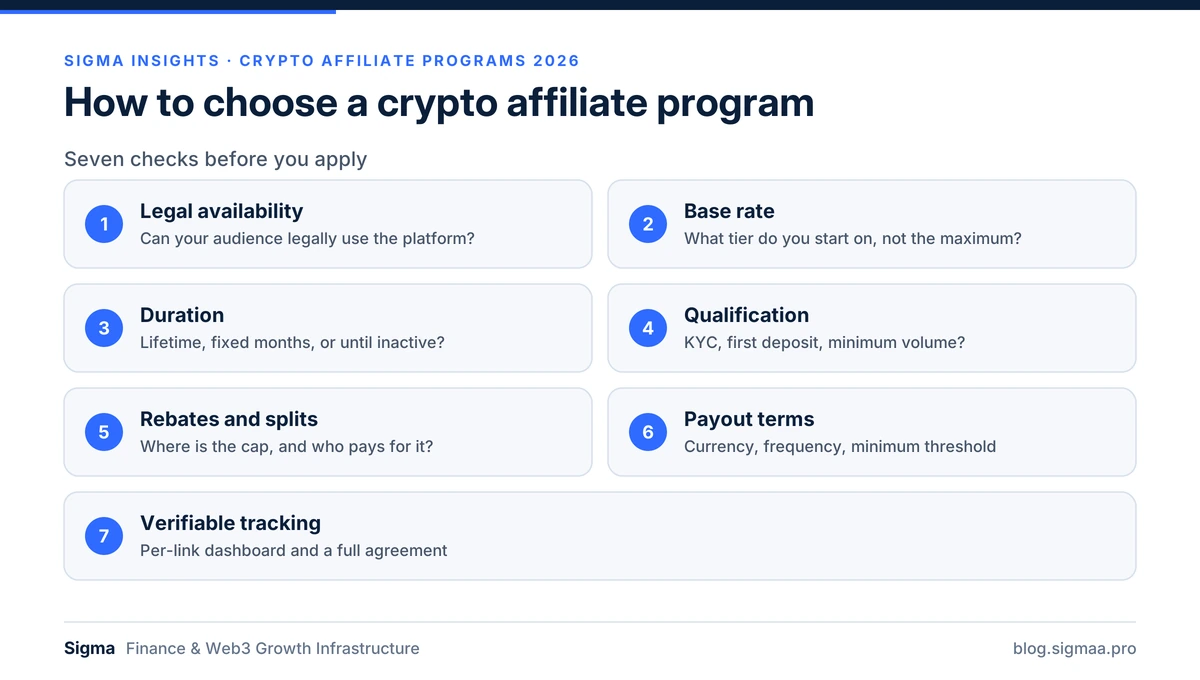
- Can your audience legally use the platform? Check the platform’s restricted-country list and whether it is licensed where your followers live. Our guide to what a cryptocurrency license covers explains what to look for, and EU readers can search ESMA’s data via our MiCA register guide.
- What is the base rate, not the maximum? Ask what tier you start on and what it takes to move up.
- How long do commissions last? Lifetime, a fixed number of months, or until the referral goes inactive.
- Who counts as a qualified referral? KYC, a first deposit, a minimum trading volume or a minimum number of active traders.
- How do rebates and sub-affiliate splits work? Find the cap and who it comes out of.
- How and when are you paid? Currency, frequency, minimum threshold and whether payouts need manual claiming.
- Can you verify the numbers? A dashboard with sign-ups, active traders and fee data per campaign link, plus an affiliate agreement you can read in full.
Exchanges reviewing affiliates run a similar check in reverse. They look at audience location, engagement and whether followers are real. The same signals brands use to vet influencers decide whether your application is approved and which tier you get.
Rules affiliates and creators must follow
In many countries, promoting a crypto platform is a regulated communication. The responsibility does not sit only with the exchange. Affiliates and creators can be liable too.
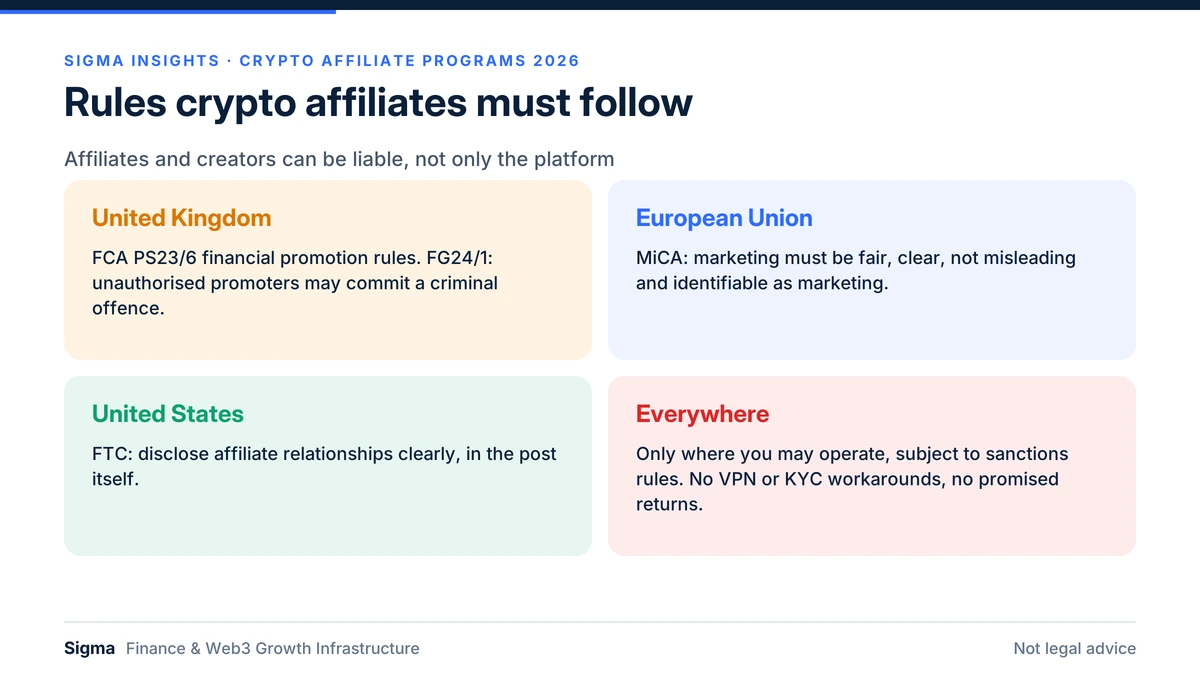
- United Kingdom. Cryptoasset promotions to UK consumers fall under the FCA’s financial promotion rules set out in PS23/6. The FCA’s social media guidance (FG24/1) warns that unauthorised influencers who promote a regulated product without approval from an appropriate authorised person may be committing a criminal offence. Coinbase, for example, states that its UK affiliate program is closed until further notice.
- European Union. Under MiCA, crypto-asset service providers must give clients information that is fair, clear and not misleading, including in marketing communications, which must be identifiable as such. Licensed exchanges pass these obligations on to their partners through affiliate agreements.
- United States. The FTC expects creators to disclose material connections, including affiliate commissions, clearly and in the post itself. See its Disclosures 101 for Social Media Influencers.
- Everywhere. Promote only in jurisdictions where you are permitted to operate and subject to applicable sanctions rules. Never target users in a platform’s restricted regions, never suggest ways around KYC or geo-restrictions, and never promise returns.
- Commission rates above 50% with no published terms or affiliate agreement.
- Encouragement to promote with VPNs, or to users in countries the platform does not serve.
- Payouts only in the platform’s own token, or withdrawal limits on earned commission.
- “Guaranteed income” or “passive income” claims in the program’s own marketing.
- No dashboard showing per-link sign-ups, active traders and fees.
Common mistakes affiliates make
- Choosing on the headline rate. A 70% ceiling you never reach pays less than a 40% base you start on.
- Ignoring duration. A three-month window and a lifetime commission are very different businesses.
- Promoting where the platform is unavailable. Referrals that cannot complete KYC never qualify, and the promotion itself may break local rules.
- Undisclosed links. Missing disclosure can breach FTC guidance and platform terms, and it costs audience trust.
- Running everything through one exchange. If that program changes its terms or your audience’s country is restricted, income stops overnight.
How Sigma helps creators and platforms with affiliate growth
Sigma is a Finance and Web3 growth infrastructure network, not an affiliate network or an exchange. We work on both sides of the affiliate relationship.
- For KOLs, creators and communities: partner introductions to exchanges and brokers, tracked links and Telegram bots, creator websites and SEO, and help negotiating terms you can verify. If you are new to the model, start with what is KOL marketing.
- For exchanges and brokers: program design, partner recruitment, fraud controls and regional partner networks across the GCC, MENA, Europe, LATAM and Southeast Asia. Our guide on how to build a crypto exchange affiliate program covers the operator side in detail.
Building an affiliate business or a partner program?
Tell us about your audience or platform and the markets you serve. We will show you how we would measure success before we discuss scope.
Frequently asked questions
What is the best crypto affiliate program?
There is no single best program for everyone. On official pages checked on 25 November 2026, MEXC advertises the highest ceiling at up to 70% (combining referral and sub-affiliate commission), KuCoin up to 60%, and Binance, OKX, Bybit, Bitget and Kraken up to 50%. The best choice is the program your audience can legally use, with the base rate, duration and payout terms that fit how they trade.
Which crypto affiliate program pays the highest commission?
MEXC advertises up to 70% in referral and sub-affiliate commissions combined, and KuCoin up to 60%. Headline rates are ceilings. Your effective rate depends on your tier, any rebate you share with referrals and sub-affiliate splits.
How do crypto affiliate programs pay?
Exchange programs usually pay a share of the trading fees your referrals generate, in USDT or USDC, daily, hourly or monthly depending on the program. Some pay for a fixed period, such as Coinbase’s 50% for the first three months. Kraken negotiates revenue share or CPA per partner. Wallet makers such as Ledger pay a percentage of each sale.
What is the difference between a crypto referral program and an affiliate program?
A referral program is open to any verified user and usually combines sign-up bonuses with a lower commission. An affiliate program is by application for creators, communities and media, and offers higher tiered commission, sub-affiliate earnings and better tracking tools.
Do I need followers to join a crypto affiliate program?
It depends on the program. Bitget accepts applicants with 100 or more followers or a community of more than 500 members. KuCoin lists social accounts with more than 5,000 followers or communities with more than 500 members. Binance assesses reach, influence, audience quality and content relevance.
Are crypto affiliate commissions paid for life?
Some are. Bybit describes lifetime commissions, KuCoin describes permanent affiliate relationships, and MEXC says commissions continue with no time limit. Coinbase pays for the first three months only. Always check the affiliate agreement, because terms can change.
Is crypto affiliate marketing legal?
It is legal in many countries, but it is regulated. In the UK, crypto promotions fall under FCA financial promotion rules, and unauthorised promoters may commit a criminal offence. In the EU, MiCA requires fair, clear and identifiable marketing. In the US, the FTC expects clear disclosure of affiliate relationships. Promote only where you are permitted to operate and subject to applicable sanctions rules.
How much can I earn from a crypto affiliate program?
Earnings depend on how much your referrals trade, your tier, the rebate you share and how long commissions last. Program landing pages show averages or examples, not guarantees. Track active traders and fee revenue per link to see what a program really pays you.
Sources
- Binance, Affiliate Program Starter Guide.
- OKX, Affiliate Program and Affiliate and Referral Program FAQ.
- Bybit, Affiliate Program FAQ (updated 23 February 2026) and Referral Program FAQ.
- Bitget, Affiliate Program.
- KuCoin, Affiliate Program.
- MEXC, Affiliate Program, referral commission terms and affiliate program overview.
- Gate, Affiliate Program.
- Coinbase, Affiliate Program.
- Kraken, Affiliate Program.
- Ledger, Affiliate Program Terms and Conditions (last updated 1 August 2022).
- UK Financial Conduct Authority, PS23/6 and FG24/1.
- Regulation (EU) 2023/1114 (MiCA), EUR-Lex.
- US Federal Trade Commission, Disclosures 101 for Social Media Influencers.