
Crypto Exchange Affiliate Program: How to Build One That Brings Funded Traders

Table Of Content
- What is a crypto exchange affiliate program?
- Why exchanges launch a crypto exchange affiliate program, and when they should not
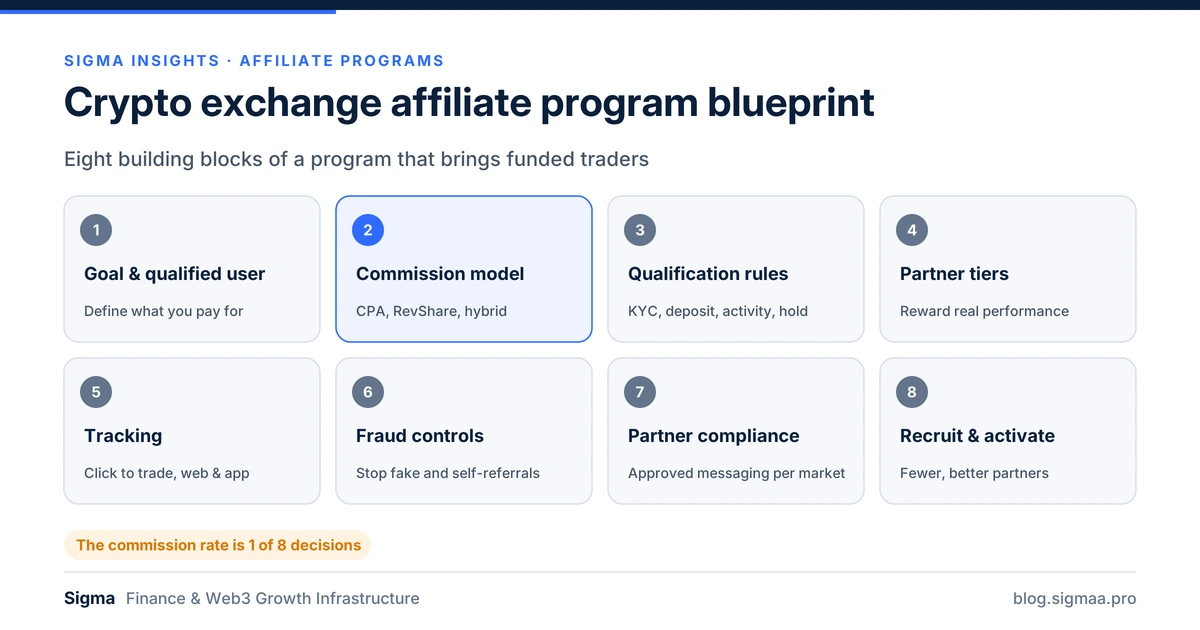
- How to build a crypto exchange affiliate program in 8 steps
- Step 1: Define the goal and your qualified user
- Step 2: Choose your crypto exchange affiliate program commission model
- Step 3: Set qualification rules and payout terms
- Step 4: Design partner tiers
- Step 5: Set up tracking and attribution
- Step 6: Build fraud controls into the program from day one
- Step 7: Make partner compliance part of the program
- Step 8: Recruit, onboard and activate partners
- Crypto broker affiliate programs: what changes
- How to measure a crypto exchange affiliate program
- Common mistakes in a crypto exchange affiliate program
- Crypto exchange affiliate program launch checklist
- How Sigma helps exchanges build affiliate and partner programs
- Build an affiliate program that brings funded traders
- Frequently asked questions
- Final summary
- Sources
- A crypto exchange affiliate program pays partners for bringing in users who meet clear conditions, usually verified, funded and actively trading accounts.
- The commission model is only one of eight decisions. Qualification rules, tracking, fraud controls and partner compliance decide whether the program brings real traders or expensive sign-ups.
- Pay for qualified users, not clicks or registrations. Define “qualified” before you set a single commission rate.
- Your partners’ promotions are your risk. In several markets, an exchange can be responsible for what affiliates publish on its behalf.
A crypto exchange affiliate program is a performance-based partnership in which an exchange pays creators, websites, communities and other partners a commission for referring users who meet agreed conditions, such as passing KYC, making a first deposit and trading. Commissions are usually a one-time payment per qualified user (CPA), a share of the trading fees those users generate (revenue share), or a mix of both.
Most articles about crypto affiliate programs are written for affiliates looking for a program to join (our comparison of the best crypto affiliate programs covers that side). This guide is for the other side: exchanges, brokers and trading platforms that want to build a crypto exchange affiliate program that brings funded traders, stays compliant and does not leak budget to fraud. It covers commission design, qualification rules, tracking, fraud prevention, partner compliance, recruitment and the metrics that show whether the program works.
Affiliate program: a structured program open to many external partners, paid per qualified user or as a revenue share. Referral program: rewards existing users for inviting friends, usually with smaller fixed rewards. Partner program: the wider umbrella, which can also include strategic partners, communities and business introducers on custom terms. A crypto exchange partner program often combines all three.
What is a crypto exchange affiliate program?
At its core, a crypto exchange affiliate program has three parts: partners who reach potential traders, a tracking system that records which partner referred which user, and a set of rules that decides when, how much and for how long the partner is paid.
| Program type | Who joins | Typical reward | Best for |
|---|---|---|---|
| Affiliate program | Content sites, creators, trading communities, educators | CPA, revenue share or hybrid | Scalable acquisition across markets |
| Referral program | Existing users | Small fixed reward or fee discount for both sides | Word of mouth and retention |
| Strategic partner program | Larger communities, fintech apps, regional business introducers | Custom terms, often revenue share | Market entry and high-value users |
Many exchanges run all three under one crypto exchange partner program. The crypto referral program rewards loyal users, the affiliate program scales reach, and a small number of strategic partners open new regions.
Why exchanges launch a crypto exchange affiliate program, and when they should not
For a new or growing exchange, an affiliate program has three clear advantages. You pay mostly for results rather than reach. Partners bring trust you cannot buy with ads, because their audiences already follow them. And partners can reach regions and languages your own team does not cover yet.
It is not the right first move in every case. Delay or narrow the program if:
- You do not hold a crypto license or registration in the markets partners would target.
- Your onboarding loses most users at KYC or first deposit. Partners will send traffic into a leaking funnel and leave.
- Liquidity on your main pairs is thin. Referred traders will try the platform once and not return.
- You cannot yet track users from first click to funded account.
Our guide on how to make a crypto exchange covers these foundations.
How to build a crypto exchange affiliate program in 8 steps
Step 1: Define the goal and your qualified user
Every crypto exchange affiliate program should start with what a good user is worth, not with what competitors pay. Decide which outcome you are buying: verified accounts, funded accounts, active traders, or traders who reach a trading-volume threshold. Then define a qualified user in writing, for example: passed KYC, deposited above an agreed minimum, and completed trades on at least a set number of days within 30 days.
This definition becomes the basis of every commission, report and fraud review. If it is vague, disputes with partners will follow.
Step 2: Choose your crypto exchange affiliate program commission model
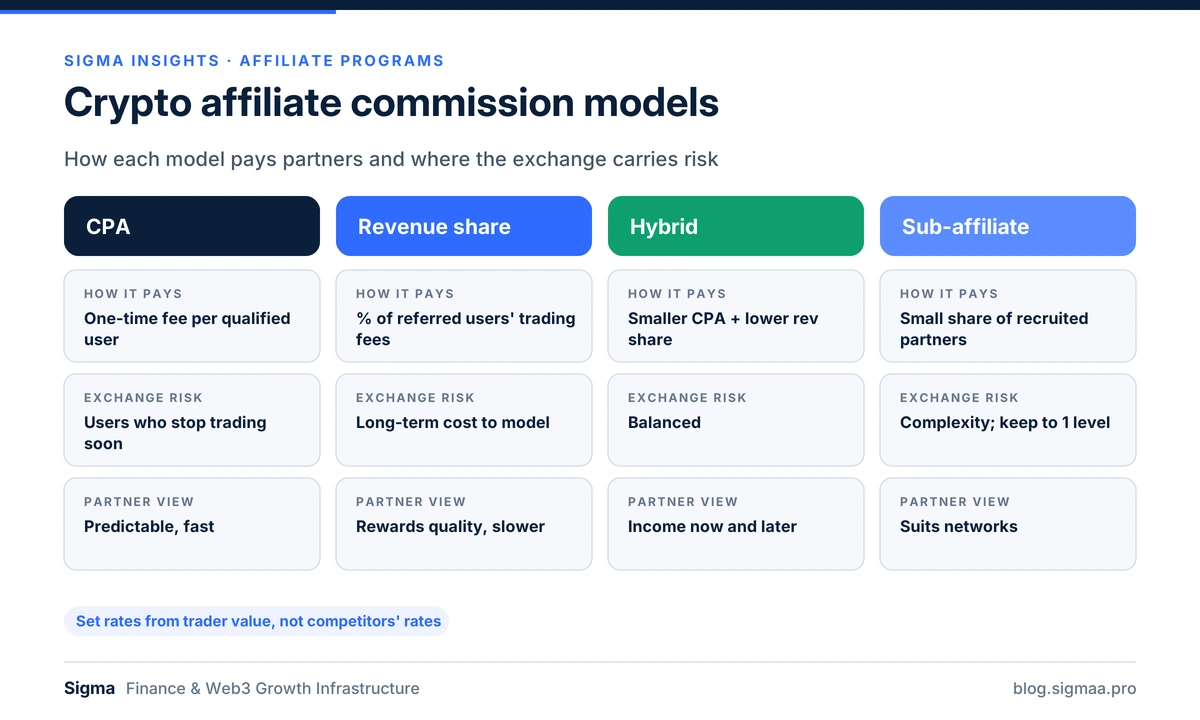
Crypto affiliate programs, from crypto CPA affiliate programs to revenue share programs, use four main models. Each one shifts risk differently between the exchange and the partner.
| Model | How it pays | Exchange’s risk | Partner’s view |
|---|---|---|---|
| CPA (cost per acquisition) | One-time fee per qualified user | Paying for users who stop trading soon after | Predictable, fast income |
| Revenue share | A percentage of the trading fees referred users generate, for an agreed period or for life | Long-term cost; must be modelled carefully | Rewards quality traffic; slower to earn |
| Hybrid | Smaller CPA plus a lower revenue share | Balanced | Some income now, some later |
| Sub-affiliate tier | A small share of what partners they recruit earn | Complexity; can look like multi-level marketing if overused | Attractive to networks and agencies |
A simple rule for setting rates: work backwards from value. Illustrative example only: if your finance team estimates that an average qualified trader generates a certain net fee income over 12 months, your total acquisition cost per trader, including the partner’s commission, has to sit comfortably below that figure after support, payment and compliance costs. Set the CPA or revenue share inside that margin, not at a number borrowed from another exchange.
Keep sub-affiliate structures shallow. One level of sub-affiliate commission is common; deep, multi-level payouts attract the wrong partners and can create regulatory and reputational problems. Our guide to how much crypto marketing costs shows how partner payouts fit into the wider budget.
Step 3: Set qualification rules and payout terms
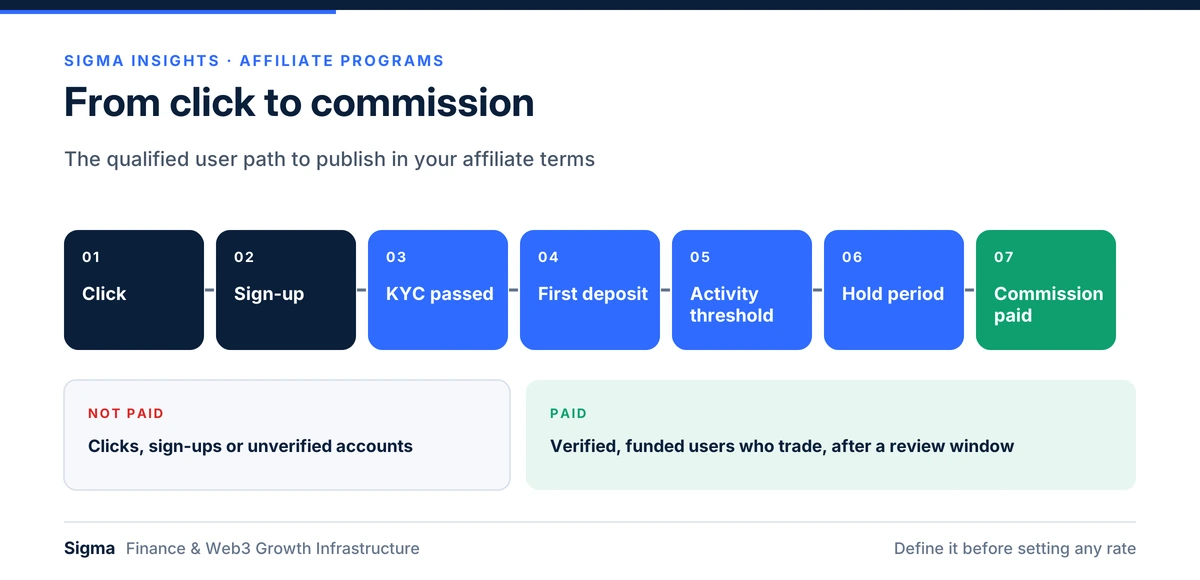
Qualification rules protect a crypto exchange affiliate program from paying for users who never trade. The most important ones are:
- Verification and funding: commissions start only after KYC and a qualifying first deposit.
- Activity threshold: a minimum number of trading days or trades, so one-off sign-ups do not qualify.
- Hold period: CPA is confirmed after a review window, which gives time to catch fraud and chargebacks.
- Revenue share basis: exactly which fees count (spot, futures where permitted, net of rebates and promotions).
- Attribution window: how long after the first click a sign-up still counts, and what happens when two partners claim the same user.
- Payment terms: payout schedule, minimum payout, currency, and the KYC or business checks partners must pass to get paid.
Step 4: Design partner tiers
In a crypto exchange affiliate program, tiers reward your best partners and give everyone else a reason to grow. Base tiers on qualified users or net revenue delivered, not on clicks or sign-ups. Higher tiers can earn better rates, a dedicated manager, early access to campaigns and co-branded landing pages. Review tiers monthly or quarterly so rewards follow current performance.
Step 5: Set up tracking and attribution
Tracking is where a crypto exchange affiliate program most often loses partners’ trust. You need:
- An affiliate platform or in-house system that issues links and codes and shows partners their results.
- Tracking from first click through sign-up, KYC, deposit and trading, using server-side events where possible, because many users switch devices or move from web to app.
- Support for promo codes and deep links into mobile apps, since much crypto traffic arrives on mobile.
- A clear rule for duplicate claims, and a partner dashboard that matches the numbers your finance team uses for payouts.
For journeys that move between wallets and exchanges, see our guide to crypto marketing attribution. The tracking and CRM layer is also where Sigma’s Web3 CRM and automation services connect partner data to onboarding and retention.
Step 6: Build fraud controls into the program from day one
Wherever there is a commission, and a crypto exchange affiliate program is no exception, someone will try to earn it without delivering real users. Common patterns in crypto affiliate programs include:
- Self-referral and multi-accounting: partners or users opening several accounts to collect CPA or bonuses.
- Incentivised low-quality traffic: users paid to sign up and deposit the minimum, then leave.
- Brand bidding: affiliates buying ads on your brand name and claiming users who were already looking for you.
- Cookie stuffing and click fraud: forcing tracking cookies onto users who never saw the partner’s content.
- Wash trading for revenue share: artificial volume generated to inflate fee-based commissions.
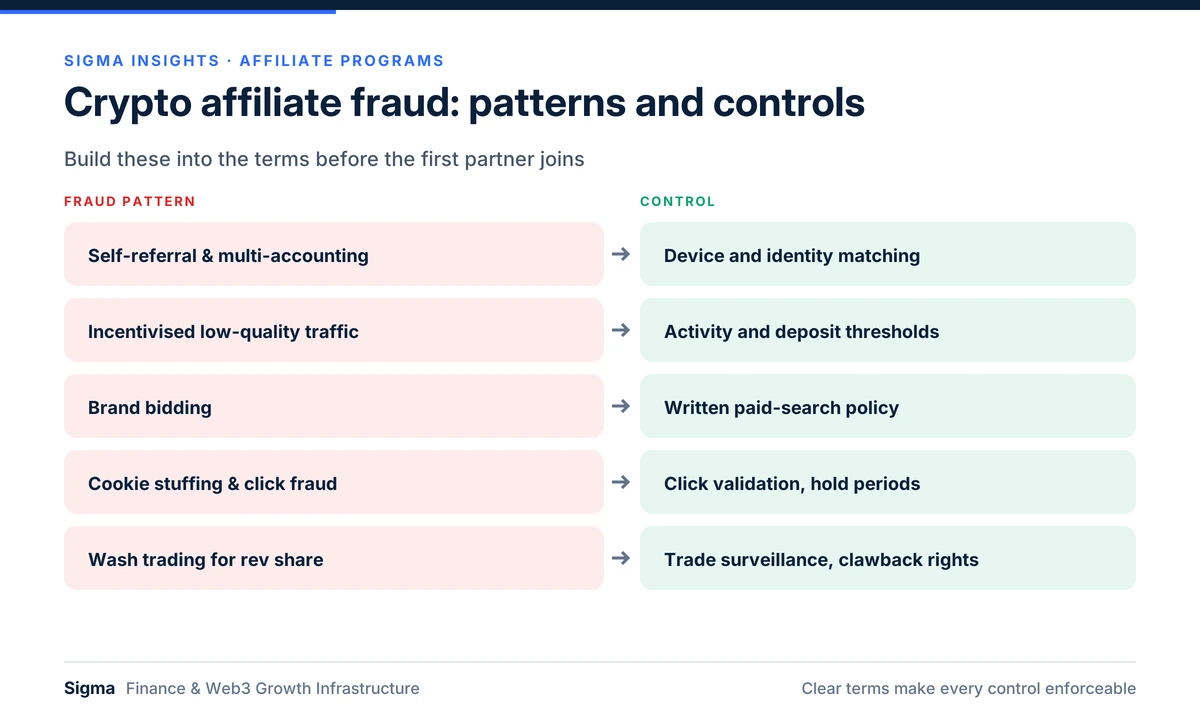
The controls are well known: device and identity matching, quality thresholds, a written paid-search policy, hold periods before payout, trade surveillance on referred accounts, and the contractual right to withhold or claw back commissions for breaches.
Step 7: Make partner compliance part of the program
This is the step most teams underestimate when they design a crypto exchange affiliate program. When an affiliate promotes your exchange, regulators and platforms often treat that content as your marketing. A few examples:
- United Kingdom: cryptoasset promotions to UK consumers must comply with the FCA’s financial promotion rules, and an unauthorised affiliate generally cannot communicate them unless an appropriately authorised firm has approved the promotion. The FCA’s guidance on financial promotions on social media also applies to creators and “finfluencers”.
- European Union: MiCA requires crypto-asset marketing communications to be fair, clear and not misleading, and identifiable as marketing. Before promoting an exchange to EU users, check that it appears among the MiCA compliant exchanges in ESMA’s register.
- Dubai: VARA’s marketing regulations cover virtual asset promotions aimed at Dubai residents, including those made on a firm’s behalf.
- United States: the FTC expects affiliates and creators to disclose clearly when they are paid for a recommendation, close to the recommendation itself.
In practice, compliance means a partner code of conduct, approved messaging and risk warnings per market, a list of restricted countries, including sanctioned jurisdictions where neither the exchange nor its partners may onboard users, a ban on profit promises and “risk-free” language, regular content checks, and the right to suspend partners who break the rules. Sigma is not a law firm; take legal advice on the rules in each market you target.
Step 8: Recruit, onboard and activate partners
In crypto affiliate marketing, a program with no active partners is just a sign-up form. The partners that usually perform best for exchanges are:
- Trading educators and analysts whose audiences already trade.
- Creators and KOLs in each target language. Our explainer, What is a KOL in crypto?, explains how to evaluate them, and our guide to crypto influencer campaigns covers campaign design.
- Telegram and Discord trading communities with real engagement, not just member counts.
- Comparison and review sites that rank for exchange-related searches.
- Regional business introducers who bring larger traders and local networks.
Check every candidate before you sign them; our guide on how to find KOLs and vet them applies to affiliate partners too. Activation matters as much as recruitment. Give every new partner an onboarding call or pack, ready-made compliant creatives, tracking links that work on day one, and a named contact. Partners who make no qualified referrals in their first 30 days rarely start later without help.
Crypto broker affiliate programs: what changes
Forex and multi-asset brokers adding crypto face the same questions with a few differences. In crypto trading affiliate programs run by brokers, commission models often rebate a share of spread or commission per traded lot rather than exchange fees. Leveraged products face tighter promotion rules in many markets, and some regulators restrict or ban certain incentive payments. Whether you call it a cryptocurrency affiliate program or a partner program, if you run both an exchange and a brokerage, keep separate terms, tracking and compliance checks for each product line.
How to measure a crypto exchange affiliate program
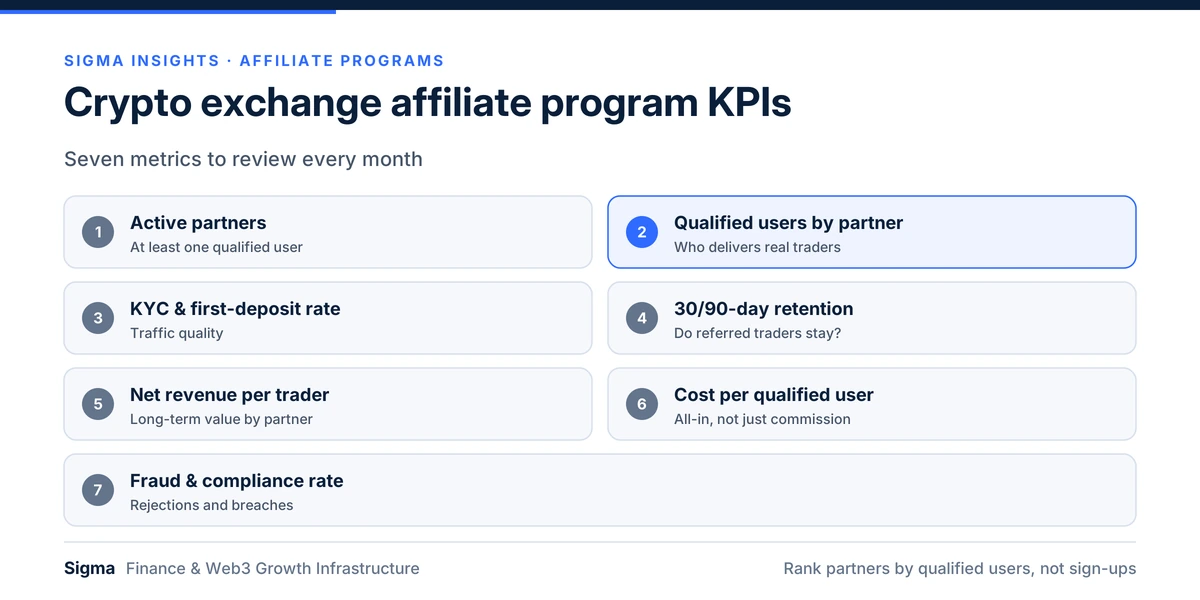
Judge the program on the quality and cost of the traders it delivers, and judge each partner the same way.
| Metric | What it shows | Watch for |
|---|---|---|
| Active partners | Partners with at least one qualified user this period | Programs where a few partners deliver almost everything |
| Qualified users by partner | Who delivers real traders | High sign-ups with few qualified users |
| KYC and first-deposit rate | Traffic quality and onboarding fit | Sharp differences between partners or regions |
| 30- and 90-day retention | Whether referred traders stay | Users who stop trading right after CPA qualification |
| Net revenue per referred trader | Long-term value by partner | Revenue share costs rising faster than revenue |
| Total cost per qualified user | Commission plus bonuses, tools and management | Cost creeping above the value of a trader |
| Fraud and compliance rate | Rejected users and partner breaches | Rising rejections from the same partners |
Retention also depends on what happens after the referral. Onboarding emails and in-app guidance lift first trades; see our guide to crypto email marketing.
Common mistakes in a crypto exchange affiliate program
- Paying per sign-up: the fastest way to buy fake and inactive accounts.
- Copying a competitor’s rates: their trader value and costs are not yours.
- Lifetime revenue share without modelling: commitments that grow faster than the business.
- Deep multi-level payouts: attracts the wrong partners and invites regulatory scrutiny.
- No partner compliance: profit promises and missing risk warnings published in your name.
- Tracking partners cannot trust: numbers that do not match payouts drive good partners away.
- Recruiting without activating: hundreds of sign-ups, a handful of active partners.
Crypto exchange affiliate program launch checklist
- Qualified user definition agreed by growth, finance and compliance
- Commission model and rates modelled against trader value
- Affiliate terms published: qualification, hold periods, attribution, payouts, termination
- Tracking tested from click to trade on web and mobile
- Partner dashboard matches finance payout reports
- Fraud rules live: device checks, paid-search policy, trade surveillance
- Partner code of conduct, approved messaging and risk warnings per market
- Restricted and sanctioned countries list, and geo-targeting rules for partners
- Onboarding pack and compliant creatives ready
- First 20 to 30 target partners identified, with a named owner for recruitment
- Monthly review of partner quality, cost and compliance scheduled
How Sigma helps exchanges build affiliate and partner programs
Sigma is a Finance and Web3 growth infrastructure network working with crypto exchanges, brokers and Web3 platforms. Through its affiliate program management service, Sigma helps teams design commission models and qualification rules, set up tracking and reporting, write partner terms and compliance guidelines with your legal advisers, and recruit and activate partners, including creators, trading communities and regional introducers across MENA and the GCC, Europe, LATAM, CIS and Southeast Asia, in jurisdictions where the client is permitted to operate and subject to applicable sanctions rules. For creator-led partners, this connects with Sigma’s work as a KOL management agency, and for exchange launches with crypto exchange growth services.
Sigma is not a broker, exchange or financial advisor, does not handle user funds or partner payouts, and does not guarantee partner numbers, users or trading volume. If you are comparing partners, see our guide to choosing a blockchain marketing consultant or agency, or learn more about Sigma’s crypto marketing services, built around exchange and broker growth.
Build an affiliate program that brings funded traders
Tell the Sigma team about your platform, markets and current partners. We’ll reply with a scoped program plan and quote.
Frequently asked questions
What is a crypto exchange affiliate program?
It is a performance-based program in which an exchange pays partners such as creators, websites and trading communities for referring users who meet agreed conditions, usually passing KYC, depositing and trading. Partners are paid per qualified user, as a share of trading fees, or both.
How do crypto exchange affiliate programs pay partners?
The main models are CPA, a one-time fee per qualified user; revenue share, a percentage of the trading fees referred users generate; hybrid, a smaller CPA plus a lower revenue share; and sub-affiliate commissions for partners who recruit other partners. Each model shifts risk differently between exchange and partner.
What is the difference between an affiliate program and a referral program?
An affiliate program is built for external partners who promote the exchange to their audiences, usually for larger, performance-based commissions. A crypto referral program rewards existing users for inviting friends, typically with smaller fixed rewards or fee discounts for both sides.
How do I set commission rates for my exchange’s affiliate program?
Work backwards from the value of a qualified trader. Estimate the net revenue a typical referred trader generates over a set period, subtract support, payment and compliance costs, and set commissions inside the remaining margin. Do not copy another exchange’s rates.
How do I prevent affiliate fraud?
Pay only for qualified users, use device and identity matching, publish a paid-search policy, hold CPA payments for a review period, monitor referred accounts for wash trading, and keep the contractual right to withhold or claw back commissions for breaches.
Is my exchange responsible for what affiliates publish?
Often, yes. In several markets, including the UK, EU and Dubai, regulators treat promotions made on a firm’s behalf as part of that firm’s marketing. Give partners approved messaging and risk warnings, restrict target countries, check their content and take legal advice for each market.
How long does it take to launch a crypto exchange affiliate program?
Designing terms, setting up tracking and preparing compliance materials usually takes several weeks. Recruiting and activating enough partners to see consistent qualified users usually takes several months. Plan both tracks in parallel.
Should a new exchange launch an affiliate program immediately?
Only once the basics are in place: licensing for target markets, an onboarding flow that converts, enough liquidity on main pairs and working tracking. Without these, partners send traffic that does not convert, and the best partners leave.
Can Sigma build and manage our affiliate program?
Sigma helps exchanges and brokers design commission models, qualification rules, tracking, partner terms and compliance guidelines, and recruits and activates partners. Sigma does not handle user funds or payouts. Message the Sigma team through the contact page for a scoped plan and quote.
Final summary
A crypto exchange affiliate program works when it pays for qualified traders, tracks them accurately, blocks fraud and keeps partners’ promotions compliant. Define your qualified user first, model commissions against real trader value, keep sub-affiliate tiers shallow, and treat partner compliance as part of the program, not an afterthought. Then recruit fewer, better partners and help them succeed in their first 30 days.
Sources
- UK Financial Conduct Authority, “PS23/6: Financial promotion rules for cryptoassets”.
- UK Financial Conduct Authority, “Marketing cryptoassets to UK consumers”.
- UK Financial Conduct Authority, “FG24/1: Finalised guidance on financial promotions on social media”.
- European Union, Regulation (EU) 2023/1114 on markets in crypto-assets (MiCA).
- Dubai Virtual Assets Regulatory Authority, “Marketing Regulations”.
- US Federal Trade Commission, “FTC’s Endorsement Guides: What People Are Asking”.
This guide is for informational and strategic purposes only and is not legal, regulatory or financial advice. Promotion and incentive rules differ by market and change over time; get qualified legal advice before launching or changing an affiliate program. Financial markets, including crypto, involve risk. Sigma is not a broker, exchange or financial advisor, does not manage user funds or partner payouts, and does not guarantee partners, users, trading volume or other outcomes.