MiCA License (CASP Authorisation): 2026 Guide and Register of Licensed Exchanges
Table Of Content
- What is a MiCA license?
- What a MiCA license is not
- Who needs a MiCA license? The 10 crypto-asset services
- What about non-EU exchanges serving EU users?
- MiCA license requirements
- 1. Substance in the EU
- 2. Capital: the higher of the class minimum or a quarter of fixed overheads
- 3. The Article 62 application file
- How to get a MiCA license: 8 steps and the statutory timeline
- How long does a MiCA license take in practice?
- How much does a MiCA license cost?
- Choosing a home Member State: where MiCA licenses have been granted
- The MiCA transitional period has ended
- Which crypto exchanges have a MiCA license?
- The detail most MiCA lists miss: scope
- How to verify any MiCA license yourself
- After the license: marketing a MiCA-licensed exchange
- What is changing next
- How Sigma helps exchanges enter the EU under MiCA
- MiCA license FAQ
- Sources
- A MiCA license is the CASP authorisation under Article 59 of the EU Markets in Crypto-Assets Regulation. You apply to one national regulator, the home Member State, and can then passport your services to all 30 EEA countries.
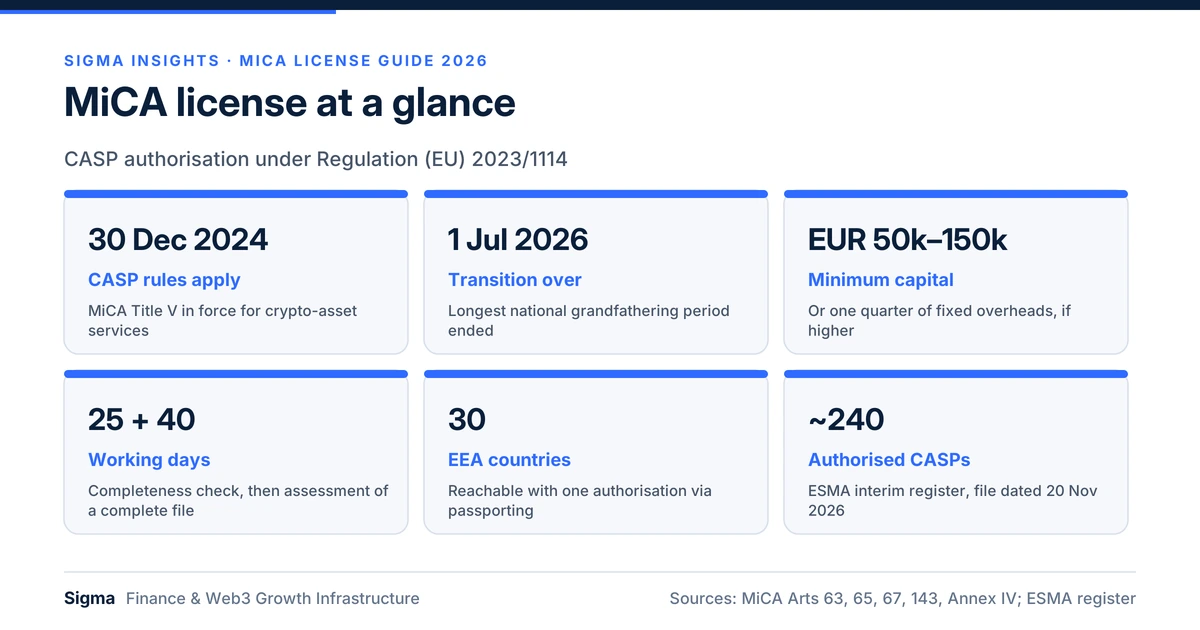
- The transition is over. MiCA’s CASP rules have applied since 30 December 2024, and the longest national grandfathering period ended on 1 July 2026. Without authorisation, a firm cannot serve EU clients.
- Minimum capital is EUR 50,000, 125,000 or 150,000, depending on your services. You must hold the higher of that amount or one quarter of last year’s fixed overheads.
- The legal clock is short, but it only starts once your file is complete: 25 working days for the completeness check, then 40 working days for the assessment.
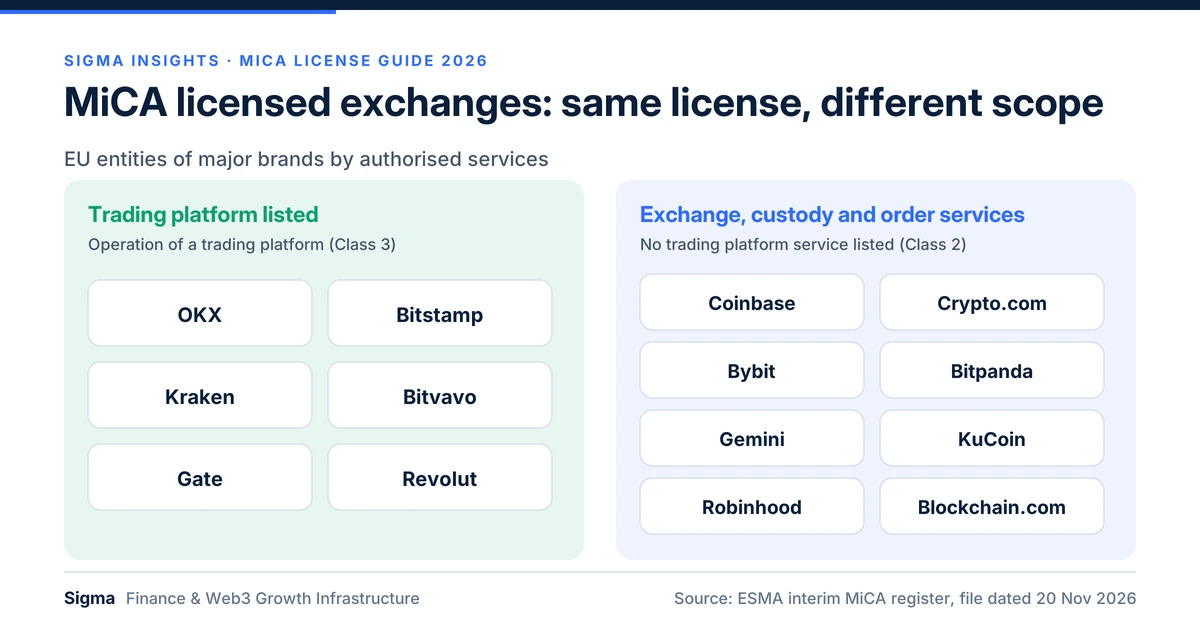
- Not every “MiCA-licensed exchange” runs a trading platform. In ESMA’s register (version dated 20 November 2026), only 19 entities list “operation of a trading platform”. Most big brands are authorised for exchange, custody and order services instead.
A MiCA license is the authorisation a company needs to provide crypto-asset services in the European Union under the Markets in Crypto-Assets Regulation (MiCA). The legal term is CASP authorisation: authorisation as a crypto-asset service provider. A national regulator grants it, ESMA records it in its register, and it can be passported across the European Economic Area.
This guide covers who needs a MiCA license, the requirements and capital rules, the statutory timeline, how to choose a home Member State, and which crypto exchanges hold one. The exchange data comes straight from ESMA’s interim MiCA register. We downloaded the file on 23 November 2026 and checked every entity by name. We also cover what most licensing guides skip: how MiCA changes the way a licensed exchange can market itself, use KOLs and work with partners.
What is a MiCA license?
Regulation (EU) 2023/1114, known as MiCA, created one rulebook for crypto-assets across the EU. Its Title V covers crypto-asset service providers. Article 59 of MiCA says that no one may provide crypto-asset services in the Union unless they are either:
- a legal person authorised as a crypto-asset service provider under Article 63, which is what people call a “MiCA license” or “CASP license”, or
- an already regulated financial firm, such as a bank, investment firm, e-money institution, market operator or fund manager, that notifies its regulator under Article 60 instead of applying for a new authorisation.
“MiCA license”, “MiCA licence”, “CASP license” and “MiCA CASP license” all mean the same thing. The regulation itself never uses the word “license”; it speaks of authorisation. The distinction matters in practice. A national registration you held before MiCA, such as a French PSAN or a VASP registration in another country, is not a MiCA authorisation. Only an entry in ESMA’s register based on Article 63, or a valid Article 60 notification, shows that a firm can serve EU clients today.
What a MiCA license is not
- It is not a licence for a token. Issuing or listing a token is covered by MiCA’s white paper rules (Titles II to IV), which are separate from CASP authorisation.
- It is not a global licence. It covers the EEA only. Other regions need local licences: see our guides to the crypto exchange license UAE routes (VARA, DIFC, ADGM) and the Labuan cryptocurrency license for Asia-focused structures.
- It is not needed by hardware or software wallet makers. Recital 83 of MiCA states that providers of hardware or software for non-custodial wallets fall outside the regulation. A wallet company needs authorisation only for any custodial, exchange or transfer service it provides.
Who needs a MiCA license? The 10 crypto-asset services
You need authorisation if you provide any of the ten crypto-asset services listed in MiCA to clients in the EU. The services you choose also decide your capital class.
| Crypto-asset service (MiCA Article 3) | Typical business | Capital class |
|---|---|---|
| Reception and transmission of orders | Apps that route client orders to another venue | Class 1 |
| Execution of orders on behalf of clients | Brokers, neo-banks, trading apps | Class 1 |
| Placing of crypto-assets | Launch and distribution partners | Class 1 |
| Transfer services on behalf of clients | Payment and remittance firms using crypto rails | Class 1 |
| Advice on crypto-assets | Advisory and research firms giving personal recommendations | Class 1 |
| Portfolio management on crypto-assets | Discretionary managers | Class 1 |
| Custody and administration on behalf of clients | Custodians, custodial wallets | Class 2 |
| Exchange of crypto-assets for funds | Brokerage-style “exchanges”, on-ramps | Class 2 |
| Exchange of crypto-assets for other crypto-assets | Swap services, brokerage-style exchanges | Class 2 |
| Operation of a trading platform for crypto-assets | Order-book exchanges matching third-party buyers and sellers | Class 3 |
This is where many founders misread their own business. If your platform takes the other side of client trades or quotes a price, you are exchanging crypto for funds or for other crypto (Class 2). If it runs an order book where third parties’ orders meet under non-discretionary rules, you are operating a trading platform (Class 3), with extra requirements on operating rules and market-abuse detection.
What about non-EU exchanges serving EU users?
Article 61 allows one narrow exemption, called reverse solicitation: a client in the EU who approaches a third-country firm entirely on their own initiative. The exemption ends the moment the firm, or anyone acting on its behalf, solicits EU clients through any channel. A disclaimer or a contract clause does not change that. ESMA’s guidelines on reverse solicitation treat it as an exception to read strictly. They name sponsorships, influencer posts and targeted advertising aimed at EU audiences as examples of solicitation. For a non-EU exchange that markets to Europeans, reverse solicitation is not a growth strategy.
MiCA license requirements
MiCA sets the same core requirements in every Member State. National regulators differ in how they review applications, not in the legal standard.
1. Substance in the EU
Under Article 59(2), an authorised CASP must have its registered office in a Member State where it carries out at least part of its services. It must also have its place of effective management in the EU and at least one director resident in the EU. A letterbox company with management offshore does not qualify.
2. Capital: the higher of the class minimum or a quarter of fixed overheads
Article 67 requires prudential safeguards at least equal to the higher of two amounts: the permanent minimum capital in Annex IV, or one quarter of the previous year’s fixed overheads, reviewed every year. The safeguards can be own funds (CET1 instruments), an insurance policy or comparable guarantee, or a combination.
| Class | Services covered (MiCA Annex IV) | Minimum capital |
|---|---|---|
| Class 1 | Order execution, placing, transfer services, reception and transmission of orders, advice, portfolio management | EUR 50,000 |
| Class 2 | Any Class 1 service plus custody, exchange for funds, or exchange for other crypto-assets | EUR 125,000 |
| Class 3 | Any Class 2 service plus operation of a trading platform | EUR 150,000 |

For any real exchange, the quarter-of-overheads test is usually the one that binds. A team with EUR 2 million in annual fixed costs needs at least EUR 500,000 in safeguards, whatever its class.
3. The Article 62 application file
Article 62(2) lists what the application must contain. The main items are:
- A programme of operations: which services you will provide, and where and how they will be marketed.
- Proof of the prudential safeguards under Article 67.
- Governance arrangements and internal controls, including AML/CFT risk management and a business continuity plan.
- Fit-and-proper evidence for the management body and for every shareholder with a qualifying holding.
- Technical documentation of ICT systems and security, plus a non-technical description.
- Procedures for segregating client crypto-assets and funds, and for handling complaints.
- Service-specific policies: a custody policy, trading platform operating rules and market-abuse detection, a commercial and pricing policy for exchange services, and an execution policy.
Two other EU laws apply alongside MiCA. The Transfer of Funds Regulation (the crypto “travel rule”) has applied since 30 December 2024. DORA, the Digital Operational Resilience Act, has applied to CASPs since 17 January 2025. Regulators expect both in the file, not as an afterthought.
How to get a MiCA license: 8 steps and the statutory timeline
MiCA’s deadlines are among the shortest in financial regulation. They run on working days, though, and the assessment clock only starts once the regulator considers your file complete. Most of the real time goes into getting the file to that point.
- Map your services and capital class. List every activity against the ten MiCA services. Choosing too few services means applying for an extension later. Choosing too many raises your capital and compliance burden.
- Choose your home Member State. Compare regulator experience, review practice, language, local hiring and where your clients are. The next section has the data.
- Build EU substance. Set up the legal entity and registered office. Appoint management based in the EU, including at least one EU-resident director, and hire or contract compliance, AML and ICT functions.
- Prepare the Article 62 file. Write the programme of operations, including your marketing plan, plus the policies, the ICT documentation and the fit-and-proper evidence. Many regulators offer pre-application meetings. Use them.
- Submit, then pass the completeness check. The regulator acknowledges receipt within 5 working days. It then has 25 working days to check that the file is complete, and can set you a deadline to supply missing items (Article 63(1)–(3)).
- Assessment. From receipt of a complete application, the regulator has 40 working days to decide. It may request further information up to the 20th working day of that period. Each request pauses the clock until you reply, for up to 20 working days (Article 63(9) and (12)).
- Decision and register entry. You are notified within 5 working days of the decision. The regulator sends your details to ESMA within 2 working days of granting authorisation, and ESMA publishes them in its register.
- Passport and launch. Notify your home regulator of the host countries, services and start date. It forwards the notification within 10 working days. You can start in those countries once you are told it has been forwarded, or at the latest from the 15th calendar day after you submitted it (Article 65).

How long does a MiCA license take in practice?
Count the legal maximums alone and you get roughly four to five months from filing to decision. Realistic plans add the time needed to build substance, hire key people and prepare a file the regulator accepts as complete. Expect several rounds of questions before the formal 40-day clock even starts. Regulators have also become stricter. In July 2025, ESMA published a fast-track peer review of a CASP authorisation in Malta. It found that some significant issues were still unresolved when the licence was granted. It asked all national regulators to scrutinise governance, intragroup arrangements, ICT and the promotion of unregulated services more closely. Applicants should treat this as the standard they will be held to everywhere.
How much does a MiCA license cost?
There is no single EU price. The fixed part is the capital in the table above. The rest depends on your home Member State and your business model:
- The national regulator’s application and annual supervision fees. Each Member State sets its own, so check the regulator’s current fee schedule.
- EU staff: management, compliance, AML and risk officers, often hired locally.
- Legal drafting of the file and policies, external audit, ICT and security work for DORA, and travel rule tooling.
- Ongoing costs: compliance monitoring, reporting, and updating your marketing materials and processes once you are live.
Be wary of anyone quoting a fixed “MiCA license price” without knowing your services, structure and target countries. That price usually leaves out capital, staff or the time it takes to get a file accepted as complete.
Choosing a home Member State: where MiCA licenses have been granted
Every authorisation carries the same passport, but regulators differ in experience, speed and focus. ESMA’s register shows where firms actually ended up. In the file dated 20 November 2026, ESMA lists about 240 authorised CASPs and about 170 Article 60 notifications from already regulated firms. Germany alone accounts for 123 of those notifications, mostly from banks.
| Home Member State | Regulator | CASP authorisations in ESMA register |
|---|---|---|
| France | AMF | 30 |
| Netherlands | AFM | 22 |
| Cyprus | CySEC | 20 |
| Malta | MFSA | 20 |
| Austria | FMA | 13 |
| Luxembourg | CSSF | 13 |
| Ireland | Central Bank of Ireland | 12 |
| Latvia | Latvijas Banka | 12 |
| Czech Republic | Czech National Bank | 11 |
| Spain | CNMV | 10 |
| Italy | CONSOB | 10 |
| Germany | BaFin | 8 (plus 123 notifications) |
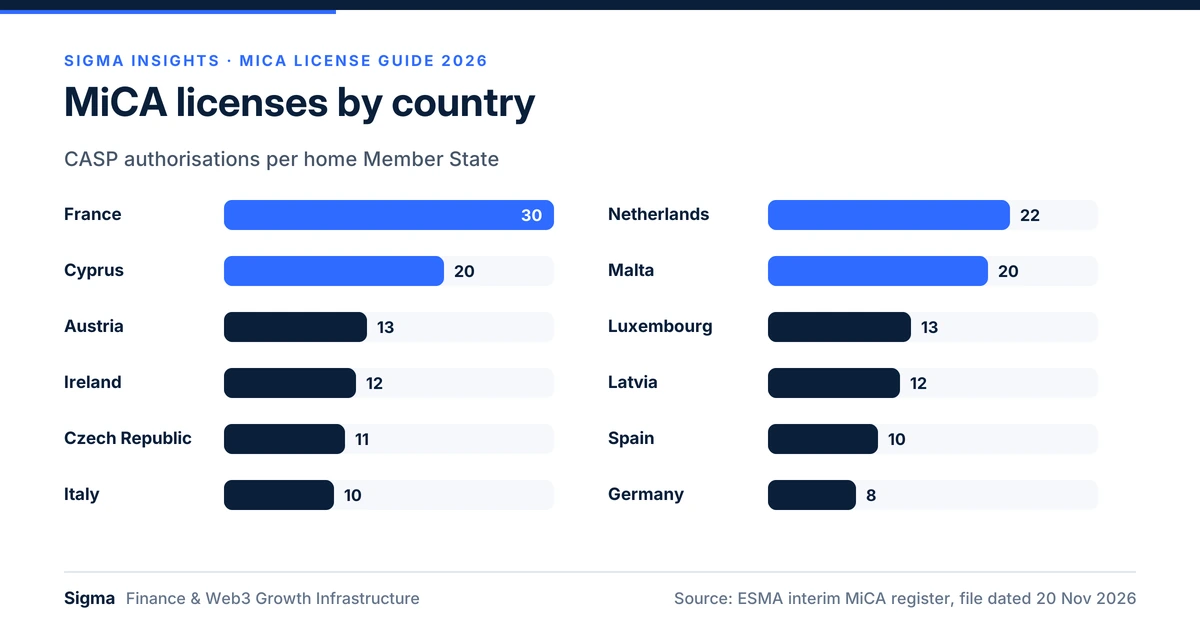
The pace is clear in the data. Of the roughly 240 authorisations, only about 90 were granted by the end of 2025. About 150 came in 2026, as national transition deadlines arrived. Some observations for anyone choosing where to apply:
- The Netherlands allowed only a six-month transition, so the AFM has been reviewing MiCA exchange applications since the start. Bitvavo, MoonPay and zerohash are authorised there.
- Malta and Cyprus host many large international brands. After the ESMA peer review, expect the closest scrutiny of group structures and intragroup outsourcing in these countries.
- Luxembourg, Ireland and Austria are the homes of several US and global names: Coinbase and Bitstamp in Luxembourg, Kraken in Ireland, and Bybit, KuCoin and Bitpanda in Austria.
- France has the largest number of authorisations of any Member State.
The right choice depends on your services, your management’s location and where your clients are, not on the length of the list. For a broader comparison of jurisdictions outside the EU, see our guide to crypto exchange licensing.
The MiCA transitional period has ended
Under Article 143(3), firms already providing services lawfully under national law before 30 December 2024 could continue until 1 July 2026, or until their application was granted or refused, whichever came first. Member States could shorten that period or not apply it at all. ESMA’s list of national choices shows:
| Transitional period | Countries |
|---|---|
| 6 months | Netherlands, Poland, Finland, Latvia, Hungary, Slovenia |
| 9 months | Sweden |
| 12 months | Germany, Ireland, Austria, Lithuania, Slovakia, Norway |
| 18 months (maximum) | France, Italy, Spain, Malta, Luxembourg, Cyprus, Belgium, Bulgaria, Czechia, Denmark, Estonia, Greece, Croatia, Portugal, Romania, Iceland, Liechtenstein |
Even the longest period is now over. A firm without MiCA authorisation or a valid notification can no longer serve EU clients, and a pending application does not extend that. ESMA expected firms that had not secured authorisation to have orderly wind-down plans in place. Some countries also set earlier filing deadlines within their periods, such as Czechia (31 July 2025) and Italy (30 December 2025).
Which crypto exchanges have a MiCA license?
The table below lists the EU entities of major exchange brands as they appear in ESMA’s interim register. The CASP file we used was last updated on 20 November 2026. “Trading platform” shows whether the entry lists the service “operation of a trading platform for crypto-assets”.
| Brand | Authorised EU entity | Home regulator | Authorisation date | Trading platform listed |
|---|---|---|---|---|
| OKX | OKX Europe Limited | MFSA, Malta | 27 Jan 2025 | Yes |
| Crypto.com | Foris DAX MT Limited | MFSA, Malta | 27 Jan 2025 | No |
| Bitpanda | Bitpanda GmbH | FMA, Austria | 9 Apr 2025 | No |
| Bitstamp | Bitstamp Europe S.A. | CSSF, Luxembourg | 15 May 2025 | Yes |
| Bybit | Bybit EU GmbH | FMA, Austria | 28 May 2025 | No |
| Robinhood | Robinhood Europe, UAB | Bank of Lithuania | 29 May 2025 | No |
| Coinbase | Coinbase Luxembourg S.A. | CSSF, Luxembourg | 20 Jun 2025 | No |
| Kraken | Payward Global Solutions Limited; Payward Europe Solutions Limited | Central Bank of Ireland | 25 Jun 2025 | Yes (Payward Global Solutions) |
| Bitvavo | Bitvavo B.V. | AFM, Netherlands | 26 Jun 2025 | Yes |
| Gemini | Gemini Intergalactic EU Ltd | MFSA, Malta | 21 Aug 2025 | No |
| Gate | Gate Technology Limited | MFSA, Malta | 29 Sep 2025 | Yes |
| Revolut | Revolut Digital Assets (Europe) Ltd | CySEC, Cyprus | 20 Oct 2025 | Yes |
| Blockchain.com | Blockchain.com Operations (Malta) Limited | MFSA, Malta | 22 Oct 2025 | No |
| KuCoin | KuCoin EU Exchange GmbH | FMA, Austria | 27 Nov 2025 | No |
| WhiteBIT | WB-Shields Innovations GmbH | FMA, Austria | 18 Jun 2026 | No |
When we searched the same file, we found no entry under the brand names Binance, Bitget, MEXC or HTX. A register search shows only what has been reported to ESMA. A brand may use a different legal name, and the register is updated weekly, so check it yourself before relying on any status.
The detail most MiCA lists miss: scope
Many “MiCA-licensed exchanges” lists treat every authorisation as the same. The register shows otherwise. Out of about 240 authorised CASPs, only 19 entities list operation of a trading platform. The EU entities of Coinbase, Crypto.com, Bybit and others are authorised for custody, for exchanging crypto for funds and for other crypto, and for related order, placing or transfer services. For a partner, a token project or a market maker, the authorised services tell you more than the word “licensed” does.
How to verify any MiCA license yourself
- Open ESMA’s MiCA page and download the crypto-asset service providers file.
- Search by legal entity name, not only by brand. Brands often run several EU entities.
- Check the legal basis (Article 63 authorisation or Article 60 notification), the authorisation date and any end date. Withdrawn authorisations stay in the file with their end date.
- Read the service list and the passporting countries. An entity may be authorised for custody but not for running a trading platform, or passported to only a few countries.
- Cross-check with the national regulator’s own register for the home Member State.
After the license: marketing a MiCA-licensed exchange
Most MiCA guides stop at authorisation. For growth teams, the harder rules start there. MiCA ties marketing directly to the licence: the Article 62 file must describe where and how services will be marketed, and the rules below apply from day one.
- Article 66(2): information to clients, including marketing communications, must be fair, clear and not misleading, and marketing must be identified as such. A CASP may not mislead clients, deliberately or negligently, about the real or perceived advantages of a crypto-asset.
- Article 66(3)–(4): clients must be warned about risks. Pricing, costs and fees must be published prominently on the website.
- Article 7: marketing for a token offer or listing must be consistent with the published white paper and carry the mandatory statement that no competent authority has reviewed it.
- Article 59(5): a firm that is not a CASP may not use names or marketing that suggest it is one.
- Article 61 and ESMA’s guidelines: a non-EU firm promoting to EU audiences through influencers, sponsorships or targeted ads is soliciting. That is exactly what the reverse solicitation exemption excludes.
Penalties are significant. Under Article 111, Member States must be able to fine legal persons at least EUR 5 million for breaches of the CASP rules, or a percentage of total annual turnover that rises to 12.5% for some provisions. Ad platforms add their own requirements. Google and Meta check regulatory status before approving crypto ads, so a crypto advertising platform plan has to match your authorised services and passport countries.
KOL and affiliate programmes need the most care. Their content is often treated as the CASP’s own marketing. Every post needs clear ad labelling, consistent risk wording and a claim set the compliance team has approved. Screening creators for crypto influencer red flags, such as profit promises or undisclosed paid posts, matters more under MiCA than ever.
What is changing next
- Possible EU-level supervision. On 4 December 2025, the European Commission proposed a market integration and supervision package that would move direct supervision of certain significant crypto-asset service providers to ESMA. As of November 2026 it is still a legislative proposal, not law.
- Tougher authorisation reviews. After the Malta peer review, applicants should expect deeper questions on group structures, outsourcing and Web3 products.
- A moving register. ESMA updates its interim register weekly. The numbers in this article reflect the file dated 20 November 2026. We will update this guide when there are material changes.
How Sigma helps exchanges enter the EU under MiCA
Sigma is a Finance and Web3 growth infrastructure network, not a law firm or a licensing agent. We do not file applications or guarantee approvals. What we offer is MiCA market-entry and licensing readiness advisory, the commercial side that sits next to your legal counsel:
- Licensing readiness review: mapping your product to MiCA services and capital class, and preparing the “where and how you will market” part of the programme of operations.
- Home Member State shortlisting: commercial factors such as target markets, talent, languages and existing partners, for discussion with your lawyers.
- Introductions to legal, compliance and technology providers in our network, in jurisdictions where you are permitted to operate and subject to applicable sanctions rules.
- Post-licence go-to-market: compliant KOL and partner programmes, localisation, SEO, PR and partnerships country by country, matched to your authorised services and passports.
If you are still deciding whether to build or launch, start with our guide on how to start a crypto exchange.
Planning to enter the EU with a MiCA license? Book a MiCA readiness and EU market-entry consultation with Sigma. Message the Sigma team for a quote.
MiCA license FAQ
What is a MiCA license?
A MiCA license is the authorisation a company needs to provide crypto-asset services in the EU under the Markets in Crypto-Assets Regulation (EU) 2023/1114. Its formal name is CASP authorisation under Article 63. One national regulator grants it, and it can be passported across the EEA.
Is a CASP license the same as a MiCA license?
Yes. “CASP license”, “MiCA license” and “MiCA CASP license” all describe authorisation as a crypto-asset service provider under MiCA. Banks, investment firms and other already regulated firms can instead notify their regulator under Article 60.
How much capital do you need for a MiCA license?
The higher of the Annex IV minimum or one quarter of last year’s fixed overheads. The minimum is EUR 50,000 for Class 1 services, EUR 125,000 for Class 2 (custody and exchange) and EUR 150,000 for Class 3 (operating a trading platform).
How long does it take to get a MiCA license?
By law, the regulator checks completeness within 25 working days and decides within 40 working days of a complete file. Information requests can pause the clock for up to 20 working days. In practice, building EU substance and preparing a complete file takes most of the time.
How much does a MiCA license cost?
There is no fixed EU price. Costs include the capital requirement, national regulator fees (set by each Member State), EU-based management and compliance staff, legal and audit work, and DORA and travel rule tooling. Check the fee schedule of your chosen regulator.
Which crypto exchanges have a MiCA license?
ESMA’s register (file dated 20 November 2026) lists EU entities of OKX, Crypto.com, Coinbase, Kraken, Bybit, Bitstamp, Bitvavo, Bitpanda, Gemini, Gate, Revolut, Robinhood, KuCoin, Blockchain.com and WhiteBIT, among others. Only 19 entities list operation of a trading platform.
Does Binance have a MiCA license?
In ESMA’s interim register file dated 20 November 2026, we found no entry under the Binance brand name. A brand may use a different legal entity name, and the register is updated weekly, so search ESMA’s file and the national registers for the current status.
Is the MiCA transitional period over?
Yes. The longest grandfathering period allowed by Article 143(3) ended on 1 July 2026, and many countries ended theirs earlier: the Netherlands on 30 June 2025 and Germany, Ireland and Austria after 12 months. Firms without authorisation can no longer serve EU clients.
Can a non-EU exchange serve EU clients without a MiCA license?
Only through reverse solicitation, when a client approaches the firm entirely on their own initiative. Any solicitation of EU clients, including through influencers, sponsorships or targeted ads, removes the exemption, and disclaimers do not change that.
Can you buy a company that already holds a MiCA license?
You can acquire a CASP, but under Article 83 anyone planning to reach or exceed 20%, 30% or 50% of its voting rights or capital must notify the regulator in advance and be assessed. A licence does not transfer freely with a share purchase.
This article is for informational and strategic purposes only. It is not legal, regulatory, tax or financial advice. Sigma is not a law firm, broker, exchange or licensed financial adviser, does not manage user funds and does not guarantee licensing outcomes. Financial markets, including crypto, involve risk. Always confirm current requirements with qualified counsel and the relevant national competent authority.
Sources
- EUR-Lex, Regulation (EU) 2023/1114 on markets in crypto-assets (MiCA): Articles 59–67, 83, 111, 143 and Annex IV.
- ESMA, Interim MiCA register, crypto-asset service providers file (version dated 20 November 2026, downloaded 23 November 2026).
- ESMA, List of grandfathering periods decided by Member States under Article 143(3).
- ESMA, Final report: Guidelines on reverse solicitation under MiCA (17 December 2024).
- ESMA, ESMA identifies opportunities to strengthen MiCA authorisations (10 July 2025).
- ESMA, ESMA welcomes the Commission’s proposal on market integration (4 December 2025).
- EUR-Lex, Regulation (EU) 2023/1113 (Transfer of Funds Regulation) and Regulation (EU) 2022/2554 (DORA).