
Table Of Content
- What is KOL marketing?
- KOL marketing vs influencer marketing
- Why KOL marketing works in crypto and finance, and where it fails
- KOL marketing strategy: a 7-step framework
- 1. Set one primary goal
- 2. Define your audience and markets
- 3. Choose your KOL mix
- 4. Write the brief and key messages
- 5. Agree the deal structure
- 6. Set up tracking before launch
- 7. Review for compliance
- KOL marketing campaign formats
- What is KOL management?
- KOL marketing budget and costs
- How to measure KOL marketing
- KOL marketing compliance by market
- Illustrative example: KOL marketing for an exchange entering a new region
- KOL marketing examples by product type
- Common KOL marketing mistakes
- Who should run your KOL marketing: in-house team, platform or agency?
- How Sigma approaches KOL marketing
- Plan a KOL marketing program that brings active users
- Frequently asked questions
- Final summary
- Sources
- KOL marketing is working with trusted experts and creators, known as Key Opinion Leaders, to reach and persuade a specific audience.
- In crypto and finance, KOL marketing works because trust is scarce. It fails when brands buy reach instead of fit, skip disclosure, or measure sign-ups instead of active users.
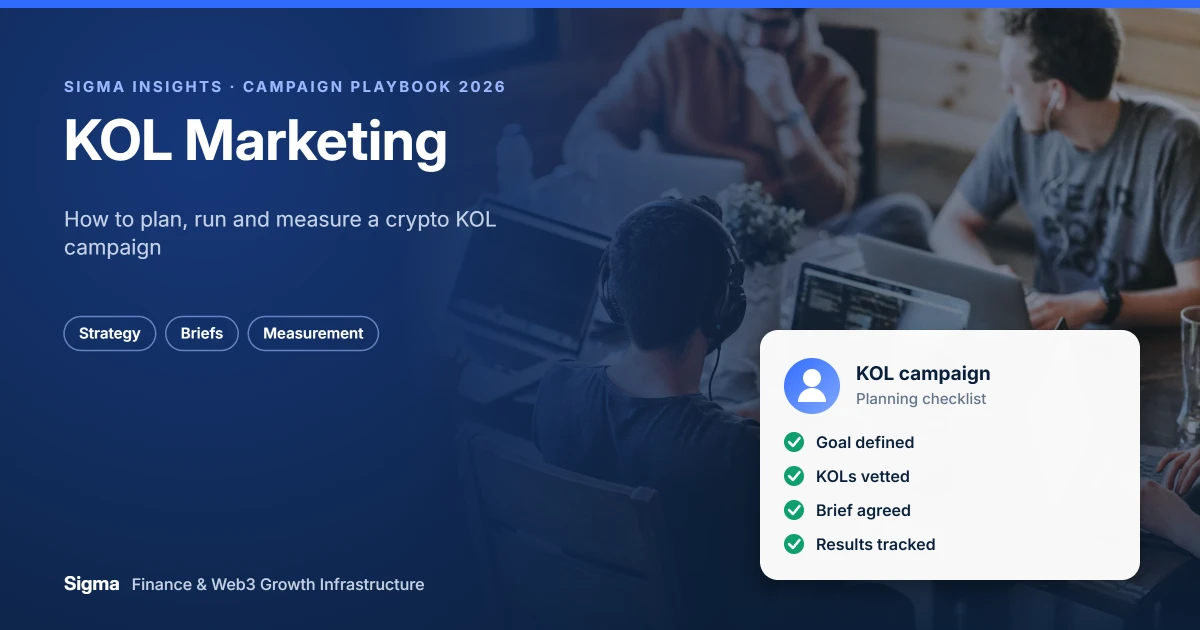
- A KOL marketing strategy has seven parts: goal, audience and markets, KOL mix, brief, deal structure, tracking and compliance review.
- Treat KOL marketing as a program, not a post. The best results come from long-term relationships connected to referral tracking and community.
KOL marketing is a form of marketing in which a brand partners with Key Opinion Leaders, people whose expertise a specific audience trusts, to reach that audience and influence how it thinks and acts. In crypto and finance, KOL marketing usually means working with analysts, educators, traders and community leaders on X, YouTube, Telegram and Discord to drive awareness, sign-ups and long-term product use.
This guide explains what KOL marketing is, how it differs from influencer marketing, and how to build a KOL marketing strategy that brings active users rather than one-day attention. It covers campaign formats, KOL management, budgets and deal structures, measurement, compliance by market, and when to use KOL marketing services from an agency. It is written for exchanges, brokers, Web3 platforms and the teams that run their growth.
KOL marketing is the planned use of Key Opinion Leaders to deliver a brand’s message to a defined audience through content the audience already trusts. It differs from broad influencer marketing in one way that matters: KOLs are chosen for expertise and audience fit in a niche, not for reach alone. For the full definition of a KOL, see our guide on what is a KOL.
What is KOL marketing?
At its simplest, KOL marketing borrows credibility. A brand cannot instantly earn the trust that an experienced analyst or educator has built with their audience over years. KOL marketing lets the brand reach that audience through that person, on the condition that the message is accurate, relevant and disclosed.
The term came into everyday marketing use in China and other Asian markets, where “KOL” is the standard word for a credible creator. Crypto, with its early Asian participation, adopted it, and KOL marketing is now one of the main growth channels for exchanges, token projects and Web3 apps worldwide.
KOL marketing vs influencer marketing
| KOL marketing | Influencer marketing | |
|---|---|---|
| Selection criterion | Expertise and audience fit in a niche | Reach and engagement |
| Typical audience | Smaller, more specialised, acts on advice | Larger, broader, more passive |
| Best for | Complex or high-trust products: trading, DeFi, security, B2B | Simple consumer products and broad awareness |
| Main risk | Over-reliance on a few voices; conflicts of interest | Paying for reach that never converts |
| Success measured by | Qualified users, activation, retention | Views, reach, engagement |
In practice the two overlap, and many crypto teams use the terms interchangeably. The distinction matters when you choose partners: for a trading platform or a DeFi protocol, KOL marketing built on expertise usually beats influencer marketing built on reach. Our guide to crypto influencer marketing strategy covers the broader creator landscape.
Why KOL marketing works in crypto and finance, and where it fails
KOL marketing works in crypto for a simple reason: users need someone to trust. Products are complex, transactions can’t be reversed, scams are common, and many teams are pseudonymous. A credible KOL shortens the research a new user would otherwise have to do alone.
The same dynamic explains why KOL marketing often fails:
- Buying reach instead of fit: a large audience in markets where the product is not available, or that does not trade.
- One-off posts: attention that fades within a day, with nothing to capture it.
- No tracking: no way to tell which KOL brought users who stayed.
- Hype and price language: content that damages trust and creates legal risk.
- Undisclosed deals: a fast route to losing the audience’s trust and breaking advertising rules.
KOL marketing strategy: a 7-step framework
A KOL marketing strategy should fit on a few pages and answer seven questions in order. Skip one, and the campaign usually fails at that step.

1. Set one primary goal
Awareness, sign-ups, first trades and 30-day active users are different goals that need different KOLs and different metrics. Choose one primary goal per campaign. A launch campaign might target awareness and waitlist sign-ups; a growth campaign for an exchange should target funded, active traders.
2. Define your audience and markets
Write down who you need to reach by experience level, language and country, and confirm that your product is legally available to them. KOL marketing aimed at a country where you are not licensed is wasted budget at best and a regulatory problem at worst.
3. Choose your KOL mix
Most effective campaigns combine several types rather than one big name:
- Analysts and researchers for credibility with experienced users.
- Educators to walk new users through sign-up, verification and first use.
- Community leaders on Telegram and Discord for activation and retention in a language or region.
- A few larger creators for reach at key moments, such as a launch.
In KOL marketing, smaller, specialised KOLs often deliver better results per dollar than the largest accounts, because their audiences are more engaged and more likely to act. Vet every KOL for audience location, real engagement and past disclosure practice before signing.
4. Write the brief and key messages
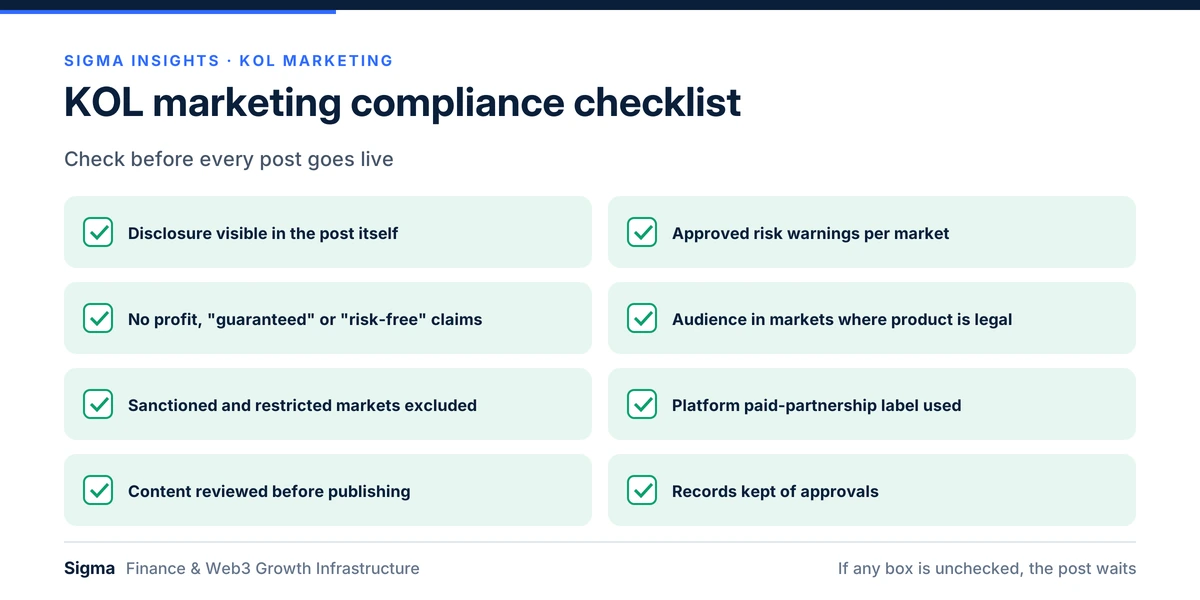
A good brief gives KOLs the facts and the limits, then lets them speak in their own voice. Include product facts, the one or two messages that matter, required risk warnings and disclosure format per market, what must never be said (profit promises, “guaranteed”, “risk-free”), and the review process before publishing.
5. Agree the deal structure
Common structures in KOL marketing are a flat fee per piece of content, a monthly retainer, a performance fee per qualified user, a revenue share, or a hybrid. Hybrid deals, a modest fixed fee plus a performance component, often align incentives best. Our guide to crypto exchange affiliate programs explains how performance terms work.
6. Set up tracking before launch
Give every KOL unique links and codes, track from first click to sign-up, verification, deposit and active use, and agree on how results will be reported. Where journeys cross wallets and apps, use on-chain attribution.
7. Review for compliance
Check every piece of content against the rules of the markets it will reach, confirm disclosure is visible in the post itself, and make sure the KOL’s audience excludes restricted and sanctioned jurisdictions. More on this below.
KOL marketing campaign formats
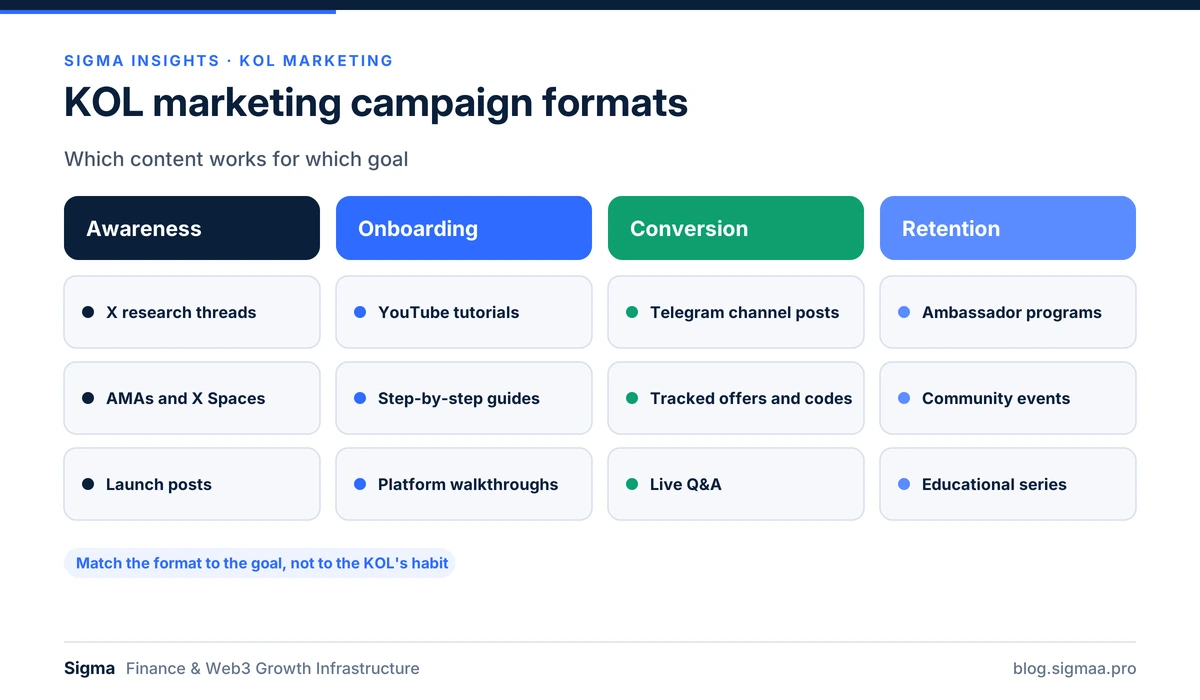
The format should match the goal. These are the formats most used in crypto KOL marketing:
| Format | Best for | Watch for |
|---|---|---|
| Research threads on X | Credibility, launch narratives | Drift into price predictions |
| YouTube reviews and tutorials | Onboarding and trust; long shelf life | Outdated walkthroughs after product changes |
| AMAs and X Spaces | Launches, answering community questions | Unprepared answers on regulated topics |
| Telegram channel posts | Direct reach and conversion in a language | Inflated member counts, impersonation scams |
| Step-by-step guides | Sign-up, verification and first deposit | Missing risk warnings |
| Ambassador programs | Long-term trust and retention | Exclusivity terms and conflicts |
| Trading competitions with KOLs | Activation of existing traders | Leverage and gambling-like framing; restricted in many markets |
For token launches, the sequence of formats matters as much as the formats themselves; see our guide to crypto token launch marketing. For exchanges, KOL marketing should be part of a wider launch plan, as covered in our guide on how to create a cryptocurrency exchange.
What is KOL management?
KOL management is the day-to-day work of running a KOL marketing program: finding and vetting KOLs, negotiating terms, briefing, approving content, tracking results, paying on time and keeping relationships healthy. It is where most of the effort in KOL marketing actually goes.
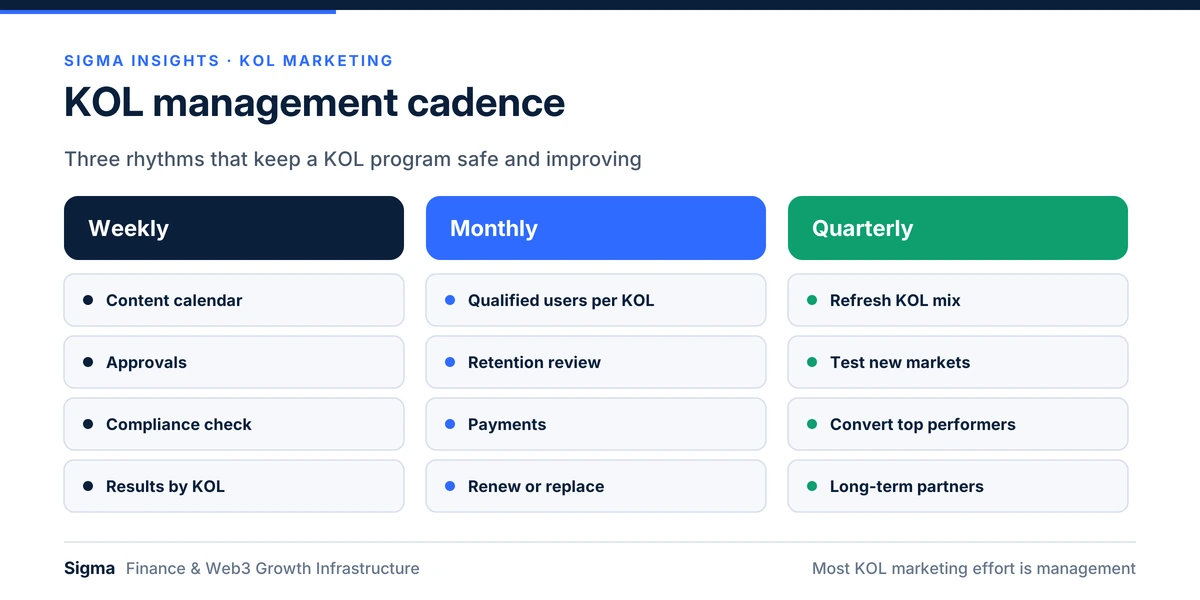
A practical weekly and monthly rhythm looks like this:
- Weekly: content calendar check, content approvals, compliance review, results by KOL, quick fixes to links or messaging.
- Monthly: performance review per KOL on qualified users and retention, payments, renewal or replacement decisions.
- Quarterly: refresh the KOL mix, test new markets or formats, and convert the best performers into ambassador or referral partner relationships. Over time, this turns a set of campaigns into a lasting KOL program.
KOL marketing budget and costs
KOL pricing varies widely with audience size, niche, market, format and deal structure, and published rate cards are rarely comparable. Instead of starting with a fee, start with value: estimate what a qualified, active user is worth to you, then set a total cost per qualified user that leaves a margin after support and compliance costs.
Budget for more than KOL fees. A realistic KOL marketing budget also covers content production and translation, tracking tools, management time, compliance review and, where relevant, incentives for users. Our guide to crypto marketing cost shows how KOL spend fits into the full plan.
How to measure KOL marketing
The most common mistake in crypto KOL marketing is reporting views and registrations as success. Both are easy to inflate. Measure the whole path instead:
| Stage | Metric | What it tells you |
|---|---|---|
| Reach | Views, impressions, attendees | Whether the content was seen; not whether it worked |
| Interest | Clicks, code uses, waitlist sign-ups | Whether the message landed |
| Conversion | Verified accounts, first deposits, first trades or first on-chain actions | Whether the audience fits the product |
| Retention | Users active after 30 and 90 days | Whether the KOL brought real users |
| Efficiency | Total cost per qualified, retained user by KOL | Where to put next month’s budget |
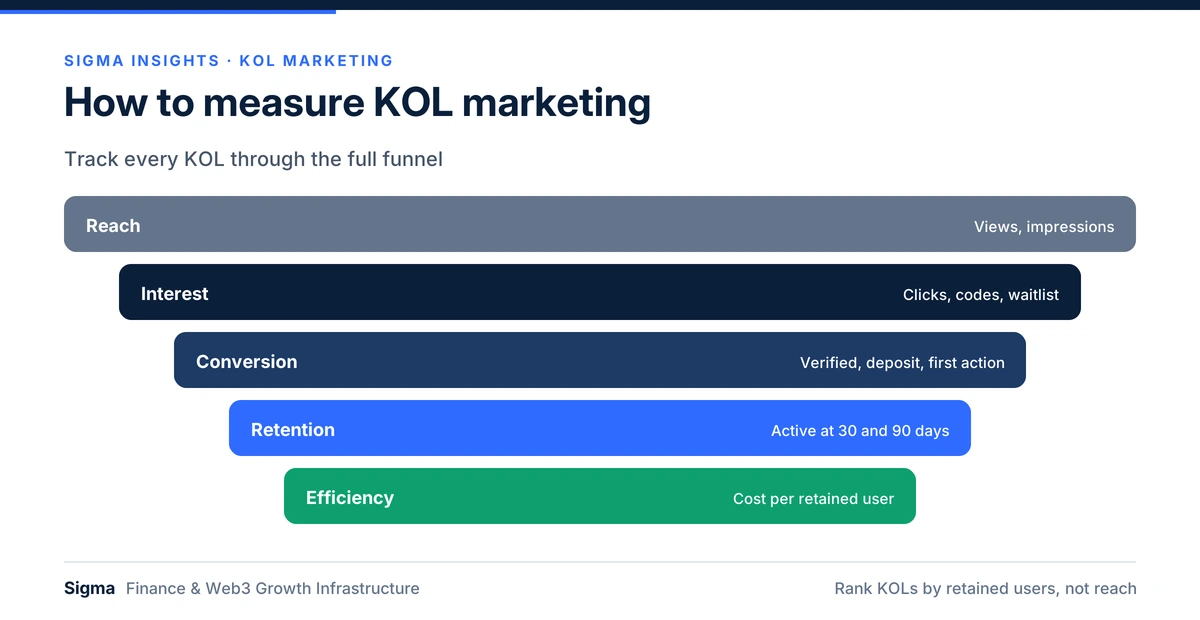
Rank KOLs by retained users and cost per retained user, not by reach. Over two or three campaigns, the KOLs whose audiences truly fit your product become obvious.
KOL marketing compliance by market
In crypto and finance, KOL marketing is regulated advertising in most major markets. Brands are often responsible for what paid KOLs publish on their behalf.
- United States: the FTC’s Endorsement Guides require clear, close-to-the-content disclosure of any material connection, including payment, free products and token allocations.
- United Kingdom: cryptoasset promotions must follow the FCA’s financial promotion rules. The FCA’s social media guidance (FG24/1) warns that creators who promote regulated products without approval from an authorised firm may be committing a criminal offence.
- European Union: MiCA requires crypto-asset marketing communications to be identifiable as marketing, fair, clear and not misleading. The exchange being promoted should also hold a valid CASP licence for EU clients.
- Dubai: VARA’s marketing regulations apply to virtual asset promotions aimed at Dubai residents, including those made on a firm’s behalf.
- Platforms: YouTube, Instagram and TikTok have paid-promotion or branded-content labels, and each platform sets its own crypto content rules. At the time of writing, X’s Paid Partnerships Policy lists crypto among prohibited industries for paid partnerships, so check the live policy before paying for posts there.
- Sanctions and restricted markets: campaigns must not target users in sanctioned or restricted jurisdictions, whatever the KOL’s own location.
This is general information, not legal advice. Take legal advice in each market you target.
Illustrative example: KOL marketing for an exchange entering a new region
This is a hypothetical scenario, not a client case. It shows how the framework fits together.
- Goal: funded, active traders in a newly licensed market, not sign-ups.
- KOL mix: two local-language educators for onboarding guides, one respected analyst for credibility, and three community leaders on Telegram for activation.
- Brief: local deposit methods, fee schedule, security features, required risk warning and disclosure wording in the local language.
- Deal: modest fixed fees for the guides, plus a performance component per qualified trader for community leaders.
- Measurement: weekly review of verified accounts, first deposits and 30-day active traders by KOL; budget moves to the KOLs whose referred traders stay.
KOL marketing examples by product type
The same principles apply across Web3, but the KOL mix, format and metric change with the product. These patterns are common:
| Product | Typical KOL mix | Formats that tend to work | Metric that matters |
|---|---|---|---|
| Crypto exchange | Local educators, trading analysts, Telegram community leaders | Sign-up and deposit guides, fee comparisons, AMAs | Funded, active traders |
| Forex or multi-asset broker | Market analysts, trading educators | Platform walkthroughs, market commentary with risk warnings | Verified, funded accounts |
| DeFi protocol | On-chain researchers, developers, DeFi educators | Research threads, tutorials, security explainers | Active wallets and retained usage |
| Token launch | Researchers, community leaders, a few larger voices | Narrative threads, Spaces, community AMAs | Engaged community and real product use |
| Web3 consumer app | Lifestyle creators with crypto credibility, KOCs | Short videos, first-use walkthroughs | Activated, returning users |
| B2B infrastructure | Builders, founders, technical analysts | LinkedIn posts, podcasts, technical deep dives | Qualified sales conversations |
Notice that reach is not the main metric for any of them. Even for a launch, a smaller group of credible voices usually does more than one large paid post. This is also why the line between KOL influencer marketing and broader digital campaigns matters: KOL digital marketing works best when creators, owned content, community and tracked offers are planned together rather than bought separately.
Common KOL marketing mistakes
- Choosing by follower count: big audiences in the wrong markets or with fake engagement.
- Scripts that sound like ads: audiences notice, and trust drops.
- No disclosure or hidden disclosure: breaks rules and damages credibility.
- Price and profit language: regulatory risk and the wrong kind of user.
- Paying everything upfront: no incentive to deliver or report.
- Measuring views and sign-ups only: scaling KOLs who never bring active users.
- One-off campaigns: losing the KOLs who perform instead of building long-term relationships.
Who should run your KOL marketing: in-house team, platform or agency?
There are three ways to run KOL marketing. An in-house team gives the most product knowledge but takes time to build relationships across markets. A KOL marketing platform helps with discovery and payments but rarely with strategy, briefs or compliance. A specialist agency brings existing relationships, vetting processes and campaign experience across regions, but should be judged on the same evidence as any partner: references, a named team, compliance awareness and reporting tied to real users. Our guide to choosing a blockchain marketing agency lists the questions to ask.
How Sigma approaches KOL marketing
Sigma is a Finance and Web3 growth infrastructure network. Through its work as a crypto influencer agency, Sigma helps crypto exchanges, brokers and Web3 platforms plan KOL marketing strategy, vet and brief KOLs, build disclosure and compliance into every campaign, and connect KOL activity to affiliate program management and crypto community management services, so the users KOLs bring in stay active. Sigma works across MENA and the GCC, Europe, LATAM, CIS and Southeast Asia, in jurisdictions where clients are permitted to operate and subject to applicable sanctions rules.
Sigma is not a broker, exchange or financial advisor and does not guarantee users, trading volume or token performance. Learn more about Sigma as a crypto marketing company for exchanges, brokers and Web3 platforms.
Plan a KOL marketing program that brings active users
Tell the Sigma team your product, target markets and goal. We’ll reply with a scoped KOL marketing plan and quote, including how we’d measure it.
Frequently asked questions
What is KOL marketing?
KOL marketing is a form of marketing in which a brand partners with Key Opinion Leaders, people whose expertise a specific audience trusts, to reach that audience and influence how it thinks and acts. It focuses on expertise and audience fit rather than reach alone.
What does KOL mean in marketing?
In marketing, KOL stands for Key Opinion Leader: a trusted expert or creator whose views a defined audience acts on. Brands work with KOLs to borrow that credibility for their message.
What is the difference between KOL marketing and influencer marketing?
KOL marketing selects partners for expertise and audience fit in a niche; influencer marketing usually selects for reach and engagement. KOL marketing suits complex, high-trust products such as trading platforms and DeFi; influencer marketing suits simpler consumer products and broad awareness.
How do you build a KOL marketing strategy?
Set one primary goal, define your audience and eligible markets, choose a mix of KOL types, write a clear brief with required disclosures, agree a deal structure, set up tracking before launch, and review every piece of content for compliance.
What is KOL management?
KOL management is the ongoing work of running a KOL marketing program: finding and vetting KOLs, negotiating terms, briefing, approving content, tracking results, paying on time and deciding whom to renew, replace or convert into long-term partners.
How much does KOL marketing cost?
Costs depend on audience size, niche, market, format and deal structure, so rate cards are rarely comparable. Start from the value of a qualified, active user and set a total cost per qualified user that leaves a margin. Budget also for content, translation, tracking, management and compliance review.
How do you measure KOL marketing ROI?
Track each KOL through reach, interest, conversion and retention, and compare total cost per qualified, retained user. Views and sign-ups alone are not reliable measures of success.
Is crypto KOL marketing legal?
Yes, when it follows the rules of each market. Most major markets require clear disclosure of paid relationships, fair and not misleading content, and in some cases approval by an authorised firm. Campaigns must also avoid restricted and sanctioned jurisdictions. Take legal advice for each market.
Can Sigma run our KOL marketing?
Sigma helps exchanges, brokers and Web3 platforms plan KOL marketing strategy, vet and brief KOLs, build compliance into campaigns and connect KOL activity to partner programs and community. Message the Sigma team through the contact page for a scoped plan and quote.
Final summary
KOL marketing works when it borrows real credibility for an accurate, disclosed message aimed at an audience that can actually use the product. Build your KOL marketing strategy around one clear goal, a mix of KOL types chosen for fit, a strong brief, tracked links and a compliance review, then manage the program weekly and measure retained users, not views. The KOLs who bring users that stay are the ones to build long-term relationships with.
Sources
- US Federal Trade Commission, “FTC’s Endorsement Guides: What People Are Asking”.
- UK Financial Conduct Authority, “FG24/1: Finalised guidance on financial promotions on social media”.
- UK Financial Conduct Authority, “Marketing cryptoassets to UK consumers”.
- European Union, Regulation (EU) 2023/1114 on markets in crypto-assets (MiCA).
- Dubai Virtual Assets Regulatory Authority, “Marketing Regulations”.
This guide is for informational and strategic purposes only and is not legal, regulatory or financial advice. Advertising and promotion rules differ by market and change over time; get qualified legal advice before running campaigns. Financial markets, including crypto, involve risk. Sigma is not a broker, exchange or financial advisor, does not manage user funds, and does not guarantee users, trading volume, token performance or other outcomes.