Crypto Market Makers (2026): How They Work, How to Choose One and Who’s Who

Table Of Content
- What crypto market makers actually do
- Market maker vs liquidity provider vs OTC desk
- Why exchange listings and market makers go together
- Market making models: retainer vs loan and call option
- Exchange market maker programs: the exchange side of market making
- Market making KPIs to put in the contract
- CEX vs DEX market making
- Onboarding security checklist
- How to choose a crypto market maker: 10 questions
- Contract red flags
- Where legitimate market making ends: wash trading and enforcement
- List of crypto market makers: main players at a glance
- Crypto market making firms: profiles
- Wintermute
- GSR
- Keyrock
- Flowdesk
- B2C2
- Cumberland DRW
- DWF Labs
- Kairon Labs
- How market makers fit into a token launch
- How Sigma helps with market maker introductions
- Frequently asked questions
- Sources
- A crypto market maker keeps buy and sell orders on an exchange’s order book, so a token can be traded with tighter spreads and more depth.
- Token projects usually hire one under a retainer or a loan and call option model. Each shifts cost, control and risk differently.
- Exchanges run their own market maker programs, trading maker fee rebates and faster access for measurable liquidity obligations.
- No legitimate market maker can guarantee a price or volume. Fake volume is market manipulation, and firms that sold it have been convicted in the US.
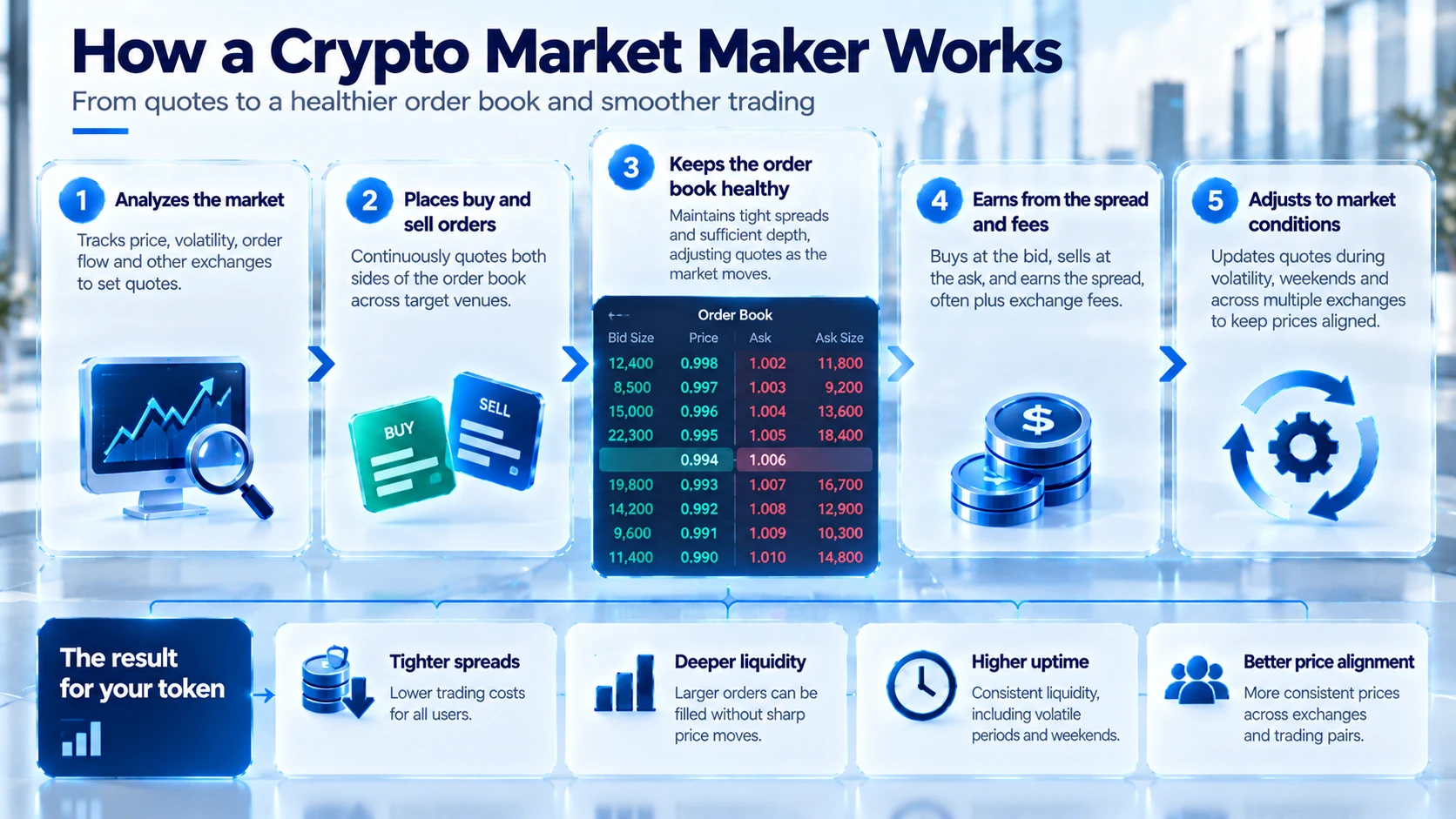
Crypto market makers are trading firms that continuously place buy and sell orders for a token on exchanges. They earn from the spread while keeping the market liquid. For a token project, they narrow spreads and reduce slippage. They also make the order book deep enough for real users and larger traders to trade without moving the price much.
This guide is written for token founders and exchange teams. It explains how crypto market making works, compares the two main contract models, and shows how exchanges structure their own market maker programs. It then covers how to evaluate a firm, which contract terms signal trouble, and who the main crypto market making companies are. Every firm profile is based on the company’s own public materials.
What crypto market makers actually do
An order book needs someone willing to buy and someone willing to sell at any moment. In a new or thinly traded token, those people are often missing. A market maker fills the gap by quoting both sides, all day, across the venues where the token trades.
In practice, that work covers four things:
- Spread: keeping the gap between the best bid and best ask narrow, so trading is cheaper.
- Depth: placing enough size close to the market price that a normal order doesn’t move it sharply.
- Uptime: staying active consistently, including during volatile periods and weekends.
- Coverage: quoting on every exchange and pair where the token is listed, and keeping prices aligned across them.
Market makers earn from the difference between buying and selling prices, from fee rebates, or from option structures in their contract. They are not supposed to push the price in a direction. Their job is to make trading possible, not to decide where the price goes.
Market maker vs liquidity provider vs OTC desk
These terms are often mixed up, and many firms offer all three. The difference matters, because each solves a different problem.
| Role | What it does | Where it works | Who usually needs it |
|---|---|---|---|
| Market maker | Quotes both sides of a specific token’s order book, continuously | Exchange order books, sometimes DEX pools | Token projects and exchanges listing new pairs |
| Liquidity provider | Supplies prices and capital to a platform, often across many assets | Brokers, exchanges, payment apps | Platforms that need pricing for users |
| OTC desk | Executes large trades privately, outside the order book | Direct bilateral deals | Funds, treasuries and large holders |
Why exchange listings and market makers go together
Liquidity is one of the first things an exchange looks at before listing a token, and one of the first things users notice after. A token with wide spreads and an empty order book is hard to trade and easy to manipulate.
For that reason, many exchanges ask projects to show a liquidity plan before listing, and some expect a named market maker. Market making also matters after launch. Retention, volume quality and the confidence of larger traders all depend on a functioning order book. Our crypto exchange marketing strategy explains how liquidity fits into the wider growth funnel.
Market making models: retainer vs loan and call option
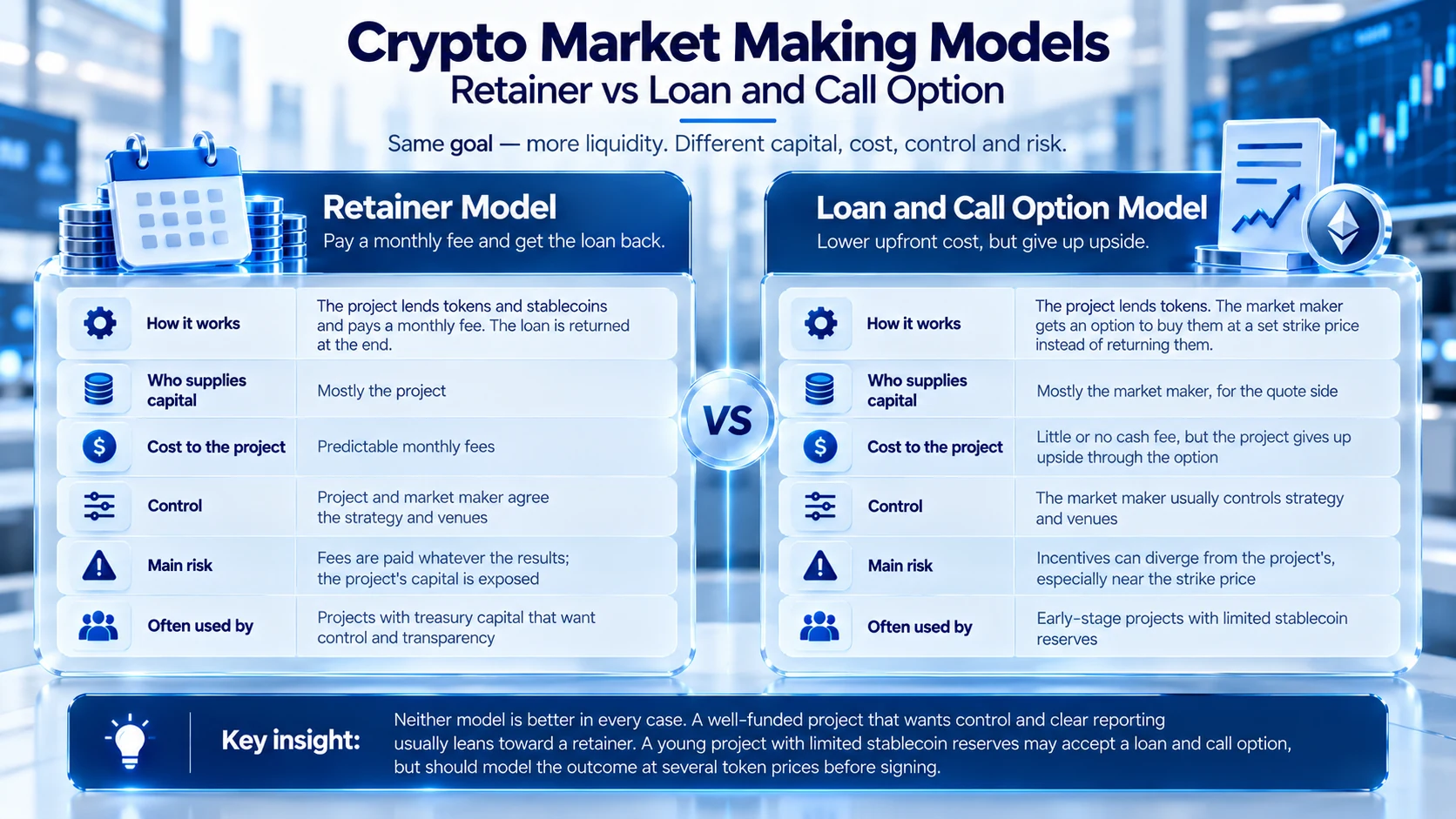
Token projects usually choose between two contract models. The choice decides who supplies the capital, who controls the strategy, and who carries the risk.
| Retainer model | Loan and call option model | |
|---|---|---|
| How it works | The project lends tokens and stablecoins and pays a monthly fee. The loan is returned at the end. | The project lends tokens. The market maker gets an option to buy them at a set strike price instead of returning them. |
| Who supplies capital | Mostly the project | Mostly the market maker, for the quote side |
| Cost to the project | Predictable monthly fees | Little or no cash fee, but the project gives up upside through the option |
| Control | Project and market maker agree the strategy and venues | The market maker usually controls strategy and venues |
| Main risk | Fees are paid whatever the results; the project’s capital is exposed | Incentives can diverge from the project’s, especially near the strike price |
| Often used by | Projects with treasury capital that want control and transparency | Early-stage projects with limited stablecoin reserves |
Neither model is better in every case. A well-funded project that wants control and clear reporting usually leans toward a retainer. A young project with little stablecoin treasury may accept a loan and call option, but should read the terms with great care.
Public pricing is rare. One published reference point comes from on-chain liquidity provider Arrakis, whose March 2026 guide describes retainers as typically $3,000 to $7,000 per month per exchange and loan deals as 1% to 5% of token supply for 12 to 24 months. These are one firm’s published reference points, not quotes, and actual terms vary widely.
One risk of the loan model is easy to miss. A market maker may sell some of the loaned tokens to fund the buy side of the book. In a thin market, that adds sell pressure, so ask how inventory will be managed.
From an operational perspective, the loan size, strike price and option expiry matter more than the headline fee. A small change in strike can move much of the economic value from the project to the market maker. Model the outcome at several token prices before signing.
Exchange market maker programs: the exchange side of market making
Market making is not only something token projects buy. Exchanges recruit market makers too, through formal market maker programs. A new exchange, or one adding pairs, needs firms that will quote consistently from day one, and these programs are how exchanges attract them.
The structure is similar across large exchanges. Binance’s Futures Market Maker Program invites firms with 30-day volume above 1,000 BTC on spot or 3,000 BTC on futures, plus quality market-making strategies. In return it offers higher maker fee rebates on selected pairs, higher API limits and low-latency connectivity. Bybit’s Market Maker Incentive Program assigns tiers based on maker volume share, reviews them regularly, sets minimum order sizes for derivatives quotes, and gives new joiners a trial period. Both programs change their thresholds over time, so always check the current page.
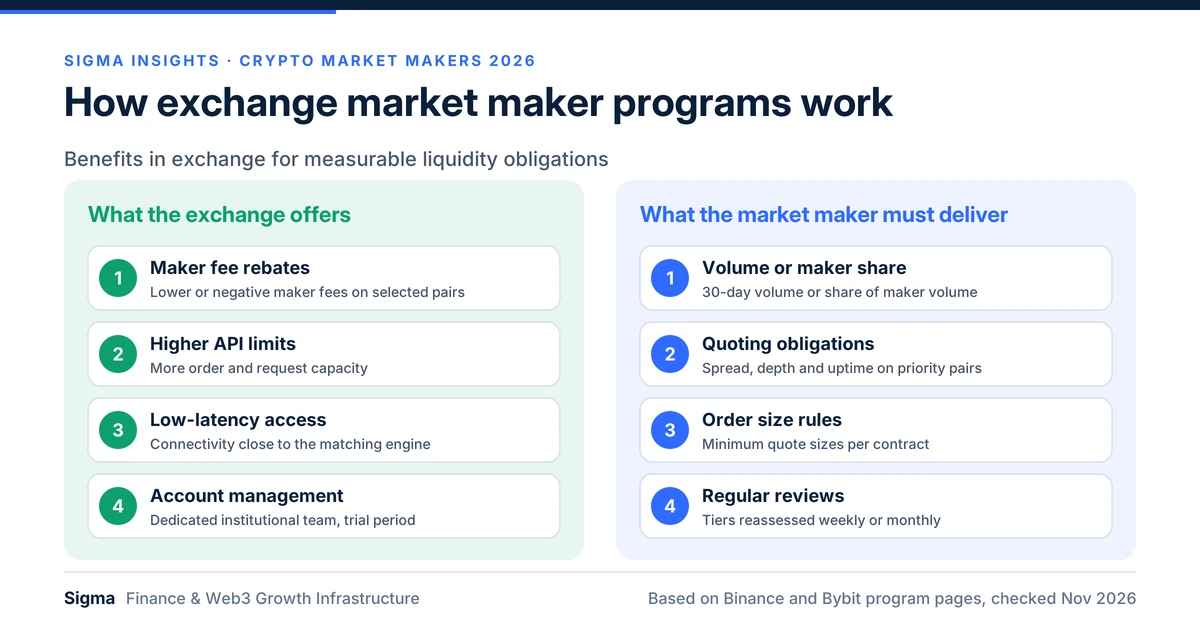
For an exchange designing its own program, the lessons are practical:
- Tie every benefit to an obligation: rebates only for firms that meet spread, depth and uptime targets on priority pairs.
- Measure maker share and quote quality, not raw volume. Volume alone rewards the wrong behaviour.
- Review tiers on a fixed schedule and publish the rules, so firms know how to move up or down.
- Offer a trial period for new firms, with clear exit criteria.
- Screen applicants for wash trading and self-trading controls before onboarding.
Market making KPIs to put in the contract
A market making agreement is only as good as its definitions. Write each KPI down, with how it is measured and on which venues.
| KPI | Definition | Why it matters |
|---|---|---|
| Spread | Gap between best bid and best ask, in basis points | The direct cost of trading for every user |
| Depth at ±2% | Value of orders within 2% above and below the mid price | How large an order the market can absorb without a sharp move |
| Uptime | Share of time the KPIs are met, including weekends | Liquidity that disappears in volatile periods is not liquidity |
| Slippage | Price impact of a standard order size you define | What a real buyer or seller actually experiences |
| Cross-venue deviation | Price difference for the token across your exchanges | Large gaps confuse users and invite arbitrage |
You can check much of this yourself. Exchange order books are public, and market data sites such as CoinGecko show ±2% depth for each trading pair. Compare those numbers with the market maker’s reports every week.
CEX vs DEX market making
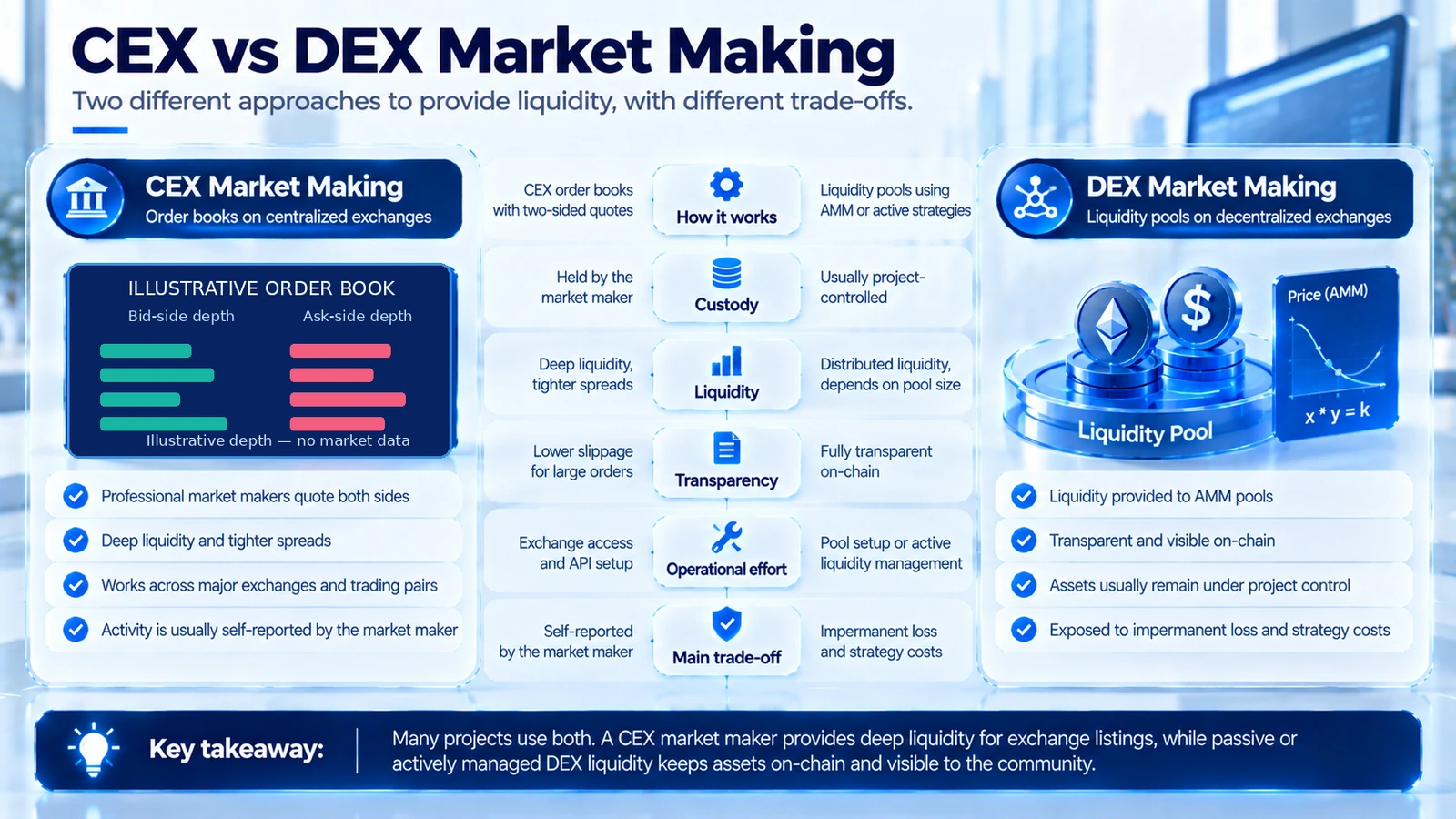
Market making no longer happens only on centralized exchanges. On decentralized exchanges, liquidity sits in pools, and projects have more options.
| Approach | How it works | Custody | Main trade-off |
|---|---|---|---|
| CEX market maker | A firm quotes on exchange order books under a contract | The market maker holds loaned assets | Deep liquidity, but activity is self-reported |
| Passive DEX liquidity | The project deposits tokens and a quote asset into a pool | Project-controlled | Simple, but liquidity is spread thin and exposed to impermanent loss |
| Active on-chain management | Automated strategies manage concentrated liquidity in DEX pools | Usually project-controlled | Transparent on-chain, but adds strategy costs and impermanent loss |
Many projects combine them: a CEX market maker for exchange listings, and managed on-chain liquidity for DEX trading. The right mix depends on where your users trade.
Onboarding security checklist
Handing tokens and exchange access to a third party creates operational risk. Set these controls before any assets move.
- Exchange API keys with trading permission only, never withdrawal rights.
- A dedicated sub-account for each market maker, separate from treasury accounts.
- Withdrawal address whitelisting on every exchange account.
- Multisig control over the treasury wallet that sends and receives loaned tokens.
- Written loan terms covering return dates, recall rights and what happens if the firm fails.
- Alerts for unusual order book activity or large transfers.
How to choose a crypto market maker: 10 questions
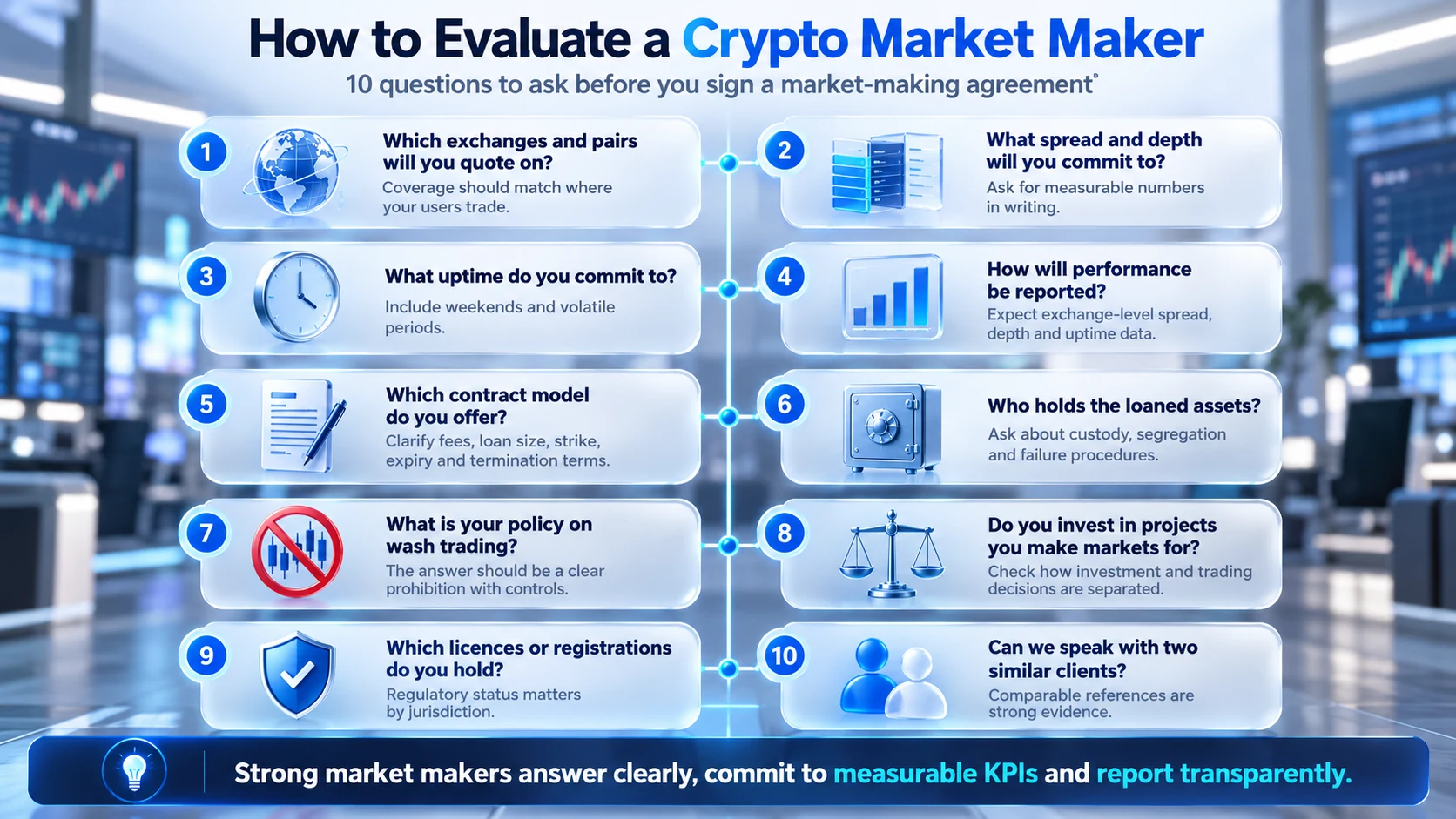
Ask every firm on your shortlist the same questions, in writing. The answers are easy to compare, and evasive answers are a signal in themselves.
- Which exchanges and pairs will you quote on? Coverage should match where your users actually trade.
- What spread and depth will you commit to? Ask for numbers, such as maximum spread and minimum depth within a set percentage of the mid price.
- What uptime do you commit to, and how is it measured? Include weekends and volatile periods.
- How will we see performance? Expect a dashboard or regular reports with spread, depth, uptime and volume by venue.
- Which contract model do you offer, and what are all the terms? Loan size, fees, strike, expiry, recall rights and termination.
- Who holds the loaned assets, and how are they protected? Ask about custody, segregation and what happens if the firm fails.
- What is your policy on wash trading and self-trading? The answer should be a clear prohibition, with controls to prove it.
- Do you invest in projects you make markets for? If yes, ask how trading and investment decisions are kept separate.
- Which licences or registrations do you hold? Rules differ by jurisdiction, and some regulators now supervise market makers directly.
- Can we speak with two current clients of a similar size? References from comparable projects are the best evidence you can get.
Contract red flags
- Any promise of a target price, a price floor or a guaranteed volume figure.
- Offers to “create volume” or “make the chart look active.”
- No written commitments on spread, depth or uptime.
- No regular reporting, or reports without exchange-level detail.
- Option strikes far below the current market price, with long expiries.
- No right for the project to recall the loan or terminate for poor performance.
- Requests to keep the arrangement secret from exchanges or the community.
Where legitimate market making ends: wash trading and enforcement
Wash trading means trading with yourself, or with a coordinated partner, to create a false impression of activity. It is market manipulation, not market making.
Enforcement is real. In October 2024, the US Attorney’s Office for the District of Massachusetts announced charges against eighteen individuals and entities in an investigation the FBI called Operation Token Mirrors. Among them were firms that presented themselves as market makers and allegedly sold wash trading to paying clients. The FBI even created its own token to identify firms offering these services.
Several of those cases have since ended in convictions. One firm that called itself a market maker pleaded guilty and was ordered to pay $428,059 and put on three years’ probation, during which it may not participate in US crypto markets. Another was sentenced to five years’ probation, during which it must cease to exist or operate.
In the EU, MiCA includes market abuse rules that prohibit market manipulation in crypto-assets. For a project, the lesson is simple. If a firm sells volume rather than liquidity, the project may share the legal and reputational risk.
List of crypto market makers: main players at a glance
The crypto market making companies below are among the best known in the industry. They are grouped by focus, not ranked. Each description comes from the company’s own website, checked in October 2026, and inclusion is not an endorsement.
| Firm | Main focus | Listed locations | Typical fit |
|---|---|---|---|
| Wintermute | Algorithmic trading, OTC, token liquidity | UK and Singapore entities | Established tokens on major venues |
| GSR | Market making, OTC, advisory, launch services | US, UK and Singapore entities | Token issuers wanting liquidity plus launch support |
| Keyrock | Market making on centralized and decentralized venues | Brussels, London, Zug, Paris | Projects wanting broad venue coverage |
| Flowdesk | Token, stablecoin and exchange liquidity | EU and Dubai entities | Projects that value regulatory status |
| B2C2 | Liquidity provision and OTC | London HQ, global offices | Exchanges, brokers and institutions |
| Cumberland DRW | Institutional OTC and derivatives liquidity | Not stated | Institutional traders and exchanges |
| DWF Labs | Market making and Web3 investment | Not stated | Earlier-stage tokens open to investor-market maker models |
| Kairon Labs | Algorithmic market making for token issuers | Not stated | Smaller and mid-size token projects |
Crypto market making firms: profiles
Wintermute
Wintermute offers algorithmic trading, OTC trading in spot and derivatives, API liquidity, token liquidity provision and DeFi partnerships, and invests in early-stage DeFi through Wintermute Ventures. Its site lists Wintermute Trading Ltd in England and Wales and Wintermute Asia in Singapore.
Worth asking: which of your target venues they actively quote on, and what minimum depth they commit to there.
GSR
GSR provides market making and OTC trading, risk management, venture investment, advisory and asset management. Through recent acquisitions it also offers launch operations for tokenized organizations.
Its site lists a US entity licensed as a money service business where required. It also lists a UK entity registered with the FCA for certain cryptoasset activities and a Singapore entity authorised by MAS.
Worth asking: how market making and advisory services are separated when both are provided to the same project.
Keyrock
Keyrock has provided liquidity since 2017. It offers market making, options, OTC and DEX liquidity, plus asset management and ecosystem development, and says it works across centralized and decentralized venues. It lists offices in Brussels, London, Zug and Paris and a team of more than 220 people.
Worth asking: what reporting the project receives, and how often.
Flowdesk
Flowdesk describes itself as a trading and technology firm providing liquidity for tokens, stablecoins, exchanges and DeFi, plus OTC trading and execution algorithms. It cites more than 150 exchange venues. Its site states it is regulated as a crypto-asset service provider under MiCA in Europe and as a virtual asset service provider under VARA in Dubai.
Worth asking: which of its regulated entities would contract with your project.
B2C2
B2C2 is a liquidity provider headquartered in London, with offices in the US, Japan, Luxembourg, Singapore, France and Poland. It serves asset managers, banks, brokers, exchanges, fintechs and crypto projects, and offers market making, OTC and stablecoin swaps.
Worth asking: whether it supports newly listed tokens, or mainly established assets.
Cumberland DRW
Cumberland, part of the DRW group, focuses on institutional liquidity: OTC spot trading in dozens of cryptocurrencies, listed options and futures, bilateral options and non-deliverable forwards. Its client base is mainly institutional.
Worth asking: whether its services fit a token project’s needs, or mainly institutional trading flows.
DWF Labs
DWF Labs describes itself as a Web3 investor and market maker that trades spot and derivatives on more than 60 exchanges. It reports a portfolio of more than 800 projects. Because it combines investment with market making, its model differs from firms that only provide liquidity.
Worth asking: how investment positions and market-making activity are separated, and what reporting the project receives.
Kairon Labs
Kairon Labs provides algorithmic market making and liquidity provision for digital asset issuers and tokens, using its own trading software.
Worth asking: which contract model it uses, and what spread and depth commitments it puts in writing.
How market makers fit into a token launch
A market maker is one part of a listing plan, not the whole of it. The seven steps below show where it belongs.
- Tokenomics and supply plan. Decide circulating supply, unlocks and how much of the treasury can support liquidity. See our guide to crypto tokenomics.
- Exchange selection. Choose venues that fit your users and regions.
- Market maker selection. Run the ten questions above with at least three firms.
- Contract and reporting setup. Agree written KPIs and a reporting format, and finish API and security setup before trading opens. Start these conversations several weeks before listing, not days.
- Community transparency. Many projects disclose market-making loans in their tokenomics or transparency reports. Doing so builds trust and avoids surprises when wallets move.
- Launch marketing. Coordinate community, KOLs and announcements. See crypto token launch marketing.
- Post-listing review. Check spread, depth and uptime every week for the first quarter.
If a launch has already struggled, our guide to token launch strategy covers recovery steps.
How Sigma helps with market maker introductions
Sigma is a Finance and Web3 growth infrastructure network, not a market maker. It does not trade, hold project assets or provide liquidity itself.
What Sigma does is help projects and exchanges prepare and connect. For token projects, that includes listing readiness reviews and introductions to market makers and liquidity providers. For exchanges, it includes help designing partner and market maker programs and recruiting liquidity partners, in jurisdictions where they are permitted to operate and subject to applicable sanctions rules.
It also includes the growth work that brings real users to the order book: community, KOL management, affiliate programs and regional market access across the GCC, MENA, Europe and LATAM. Market makers make a token tradable. Active users make it worth trading. Our Web3 go-to-market framework shows how the pieces connect.
Sigma does not guarantee listings, prices, liquidity or trading volume.
- Crypto market makers provide liquidity: tighter spreads, deeper order books and consistent uptime.
- Retainer models cost cash but keep control. Loan and call option models save cash but give up upside and control.
- Exchanges recruit market makers with rebates and access, in return for measurable obligations.
- Get spread, depth at ±2%, uptime and reporting commitments in writing, and verify them yourself.
- Lock down security before any tokens move: trade-only API keys, sub-accounts and whitelisting.
- Any offer of price targets or created volume is a red flag, and can be a crime.
Preparing a listing or building liquidity for an exchange? Tell us about your token or platform, target venues and timeline. Message the Sigma team for a quote.
Frequently asked questions
What is a crypto market maker?
A crypto market maker is a trading firm that continuously places buy and sell orders for a token on exchanges. It earns from the spread and keeps the market liquid, which lowers trading costs and slippage for users. It should not steer the price in any direction.
Who are the biggest crypto market makers?
Well-known crypto market makers include Wintermute, GSR, Keyrock, Flowdesk, B2C2, Cumberland DRW and DWF Labs. They differ in focus: some serve institutions and established tokens, others work with earlier-stage token projects. Compare them on coverage, contract model, reporting and regulatory status.
How much does a crypto market maker cost?
Costs depend on the model. Retainer deals involve a monthly fee plus a loan of tokens and stablecoins. Loan and call option deals often carry little cash fee, but the market maker receives an option on the loaned tokens. Compare total economic cost at several token prices, not only the fee.
What is a crypto exchange market maker program?
It is a program an exchange runs to recruit market makers. Exchanges such as Binance and Bybit offer maker fee rebates, higher API limits and faster connectivity to firms that meet volume or maker-share thresholds and quoting obligations. Tiers are reviewed regularly.
Do exchanges require a market maker for listing?
Many exchanges review liquidity before listing, and some expect a project to name a market maker or show a liquidity plan. Requirements vary by exchange, so confirm them directly with each venue during the listing process.
Is crypto market making legal?
Legitimate market making, which provides two-sided liquidity, is a normal market activity. Wash trading and other ways of creating fake volume are market manipulation. US prosecutors have convicted firms that sold these services, and the EU’s MiCA prohibits market manipulation in crypto-assets.
What is the difference between a retainer and a loan and call option model?
In a retainer model, the project lends tokens and stablecoins, pays a monthly fee, and gets the loan back. In a loan and call option model, the project lends tokens and the market maker can buy them at a set strike price. The first costs cash; the second gives up upside and control.
What is depth at 2% in crypto market making?
Depth at 2% is the total value of buy and sell orders within 2% of a token’s mid price. It shows how large an order the market can absorb before the price moves by 2%. It is one of the most common KPIs in market making contracts.
Can market making be done on a DEX?
Yes. On decentralized exchanges, projects can provide liquidity to pools directly or use automated strategies that manage concentrated liquidity. These approaches keep assets under project control and are visible on-chain, but they carry impermanent loss and strategy costs.
Sources
- US Attorney’s Office, District of Massachusetts, charges in Operation Token Mirrors (October 2024), sentencing of a market maker for wash trading (2025) and sentencing of a market maker and its founder (2025).
- European Union, Regulation (EU) 2023/1114 on markets in crypto-assets (MiCA).
- Binance, Futures Market Maker Program (updated January 2026), and Bybit, Market Maker Incentive Program, both checked November 2026.
- Arrakis, “Market Makers 101” (March 2026), for published pricing reference points.
- Firm descriptions come from each company’s own website, checked in October 2026: Wintermute, GSR, Keyrock, Flowdesk, B2C2, Cumberland DRW, DWF Labs and Kairon Labs.
This guide is for informational purposes only and is not financial, investment or legal advice. Inclusion is not an endorsement, and firm details are self-reported and may change. Financial markets, including crypto, involve risk. Sigma is not a market maker, broker, exchange or financial advisor, does not manage user funds, and does not guarantee listings, prices, liquidity or trading volume.